Motorcycle Insurance vs Car Insurance Requirements
Riding on two wheels often feels like a completely different world compared to driving a car, and when it comes to insurance, that feeling isn't far from the truth. Many riders get tangled up trying to understand if their motorcycle insurance needs to mirror their car insurance, or if there are entirely unique rules to follow. This guide will cut through the confusion, explaining the core distinctions and surprising overlaps between motorcycle and car insurance requirements so you can ride with peace of mind and proper coverage.
Fundamental Differences in Legal Requirements
It's easy to assume that if you have car insurance, you're all set for your motorcycle, but that's a dangerous assumption to make. While both require financial responsibility, the specifics often diverge quite a bit, primarily because motorcycles are viewed differently from a risk perspective.
Minimum Liability Coverage
The most significant difference usually starts with the minimum liability coverage. Every state that mandates insurance for vehicles on the road sets a minimum amount of coverage you must carry for bodily injury and property damage liability. These numbers are often expressed as a series of three figures, like 25/50/25, which translates to $25,000 for bodily injury per person, $50,000 for total bodily injury per accident, and $25,000 for property damage.
For cars, these minimums are a baseline, and many drivers opt for higher limits due to the potential for significant damages in a car accident. For motorcycles, however, while the structure of these minimums might look similar on paper in many states, some jurisdictions might have slightly different specific dollar amounts or even different rules around what qualifies as a "vehicle" for these minimums. For instance, in some states, the minimum required liability coverage for a motorcycle might be lower than for a car, reflecting different actuarial risk calculations. Conversely, some states, recognizing the higher injury potential in motorcycle accidents, might push for similar or slightly adjusted minimums to try and account for that. It’s crucial to remember that these are just the legal bare minimums, and relying solely on them can leave you woefully exposed if you're ever involved in a serious incident. Understanding the meaning of Motorcycle Insurance Minimums: 25/50/25 Meaning is vital for any rider.
Financial Responsibility Laws
Beyond just insurance policies, states enforce "financial responsibility laws." These laws ensure that anyone operating a vehicle can cover the costs if they cause an accident. For most drivers, this means carrying an insurance policy. However, some states offer alternative ways to prove financial responsibility, such as posting a bond, making a cash deposit with the state, or obtaining a self-insurance certificate for large fleets. These alternatives are far less common for individual riders or drivers.
The key distinction here is that while these options exist for both cars and motorcycles, insurance remains the most practical and widely used method for proving financial responsibility. The underlying principle is the same: you must be able to pay for damages you cause. However, the specific nuances of what constitutes "proof" or the acceptable limits can sometimes vary slightly between how they're applied to a car versus a motorcycle within the same state. For example, some states might have slightly different bond amounts required for a motorcycle compared to a car, although this is becoming less frequent as regulations converge. It’s important to research your state's specific Financial Responsibility Laws for Riders to ensure compliance.
No-Fault vs. At-Fault Systems
The difference between "no-fault" and "at-fault" insurance systems is a huge topic that profoundly impacts both car and motorcycle insurance, but especially motorcycles. In an at-fault state, the person who caused the accident is responsible for the damages and injuries, and their insurance pays out to the other parties. This is the traditional model, and it's generally straightforward when assigning blame.
No-fault states, on the other hand, require your own insurance company to pay for your medical expenses and sometimes lost wages, regardless of who caused the accident, up to a certain limit. This is often handled through Personal Injury Protection (PIP) coverage. The catch for motorcyclists in no-fault states is that many, if not most, states exempt motorcycles from the no-fault provisions. This means that even if you live in a no-fault state for cars, your motorcycle accident claim will often revert to an at-fault system. For example, in Michigan, a traditional no-fault state, motorcycle accidents are treated differently, often meaning motorcyclists have to pursue claims against the at-fault driver's bodily injury liability coverage. This can be a huge shock for riders who assume their PIP will kick in after a motorcycle crash. Understanding the specifics of Michigan Motorcycle Insurance (No-Fault) Explained is crucial if you ride there.
This exemption exists because motorcycles typically offer less bodily protection than cars, leading to higher injury severity and thus higher potential medical costs. Insurers argue that including motorcycles under general no-fault provisions would destabilize the system, leading to higher premiums for everyone. So, while your car might be covered under no-fault, your bike very likely isn't, placing a greater emphasis on bodily injury liability and comprehensive health insurance for riders.
Key Coverage Types: Similarities and Divergences
While the legal requirements might have some distinct twists for motorcycles, many of the actual types of coverage you'll encounter for a bike are quite similar to what's available for cars. However, their importance and how they function in a real-world scenario can feel very different.
Liability Coverage: Bodily Injury and Property Damage
Just like with cars, liability coverage for motorcycles is the absolute cornerstone of any policy. This coverage is designed to protect you financially if you cause an accident that results in injuries to other people (bodily injury liability) or damage to their property (property damage liability). The state minimums we discussed earlier primarily refer to these types of coverage.
For both cars and motorcycles, if you're found at fault in a collision, your liability coverage will step in to pay for the other party's medical bills, pain and suffering, and repairs to their vehicle or property, up to your policy limits. The major similarity is that this coverage doesn't pay for your own injuries or damage to your own bike or car. The key divergence, however, comes from the severity of potential outcomes. Motorcycle accidents often result in more severe injuries to the rider and passenger compared to car occupants, meaning higher medical costs for the at-fault motorcyclist to cover for the other party. This makes carrying adequate Liability Coverage for Motorcycles Explained incredibly important, often beyond state minimums. While the coverage type is the same, the stakes for inadequate limits can feel much higher on a bike.
Physical Damage Coverage: Collision and Comprehensive
When you want to protect your own vehicle, whether it's a car or a motorcycle, you look to physical damage coverages: collision and comprehensive. These are often grouped under what people commonly refer to as "full coverage," though that term itself can be a bit misleading.
- Collision Coverage: This pays for damages to your own vehicle resulting from a collision with another vehicle or object, regardless of who was at fault. If you accidentally hit a guardrail or another car, your collision coverage would pay for your repairs, minus your deductible. For motorcycles, collision coverage is particularly important because even a minor tip-over can cause significant damage to fairings, handlebars, and other expensive components. The vulnerability of a bike means that collision claims can be frequent and costly.
- Comprehensive Coverage: This protects your vehicle from non-collision-related incidents. Think theft, vandalism, fire, natural disasters (like hail or floods), or hitting an animal. For motorcycles, comprehensive coverage is invaluable, especially given the higher risk of Motorcycle Theft Claim: How It Works compared to many cars. Components are often easier to remove, and bikes themselves are easier to steal. So, while the coverage works identically for both vehicle types, its practical value for motorcycles can often feel more pronounced due to these elevated risks. It's a critical part of What Does Full Coverage Motorcycle Insurance Mean? for many riders.
Uninsured/Underinsured Motorist Coverage
This type of coverage is absolutely vital for both car drivers and motorcyclists, but perhaps even more so for those on two wheels. Uninsured Motorist (UM) and Underinsured Motorist (UIM) coverage protect you if you're involved in an accident with a driver who either doesn't have insurance or doesn't have enough insurance to cover your damages and injuries.
Considering the number of uninsured drivers on the road, and the potentially catastrophic injuries that can result from a motorcycle accident, having robust UM/UIM coverage is a non-negotiable for many riders. If you're hit by an uninsured driver, your UM bodily injury coverage can help pay for your medical bills, lost wages, and pain and suffering. UIM coverage kicks in if the at-fault driver has some insurance, but their policy limits aren't high enough to cover all your expenses. Given the severe nature of injuries often sustained by motorcyclists, this coverage frequently becomes the primary lifeline when dealing with a negligent, under-insured driver. For a deeper dive, check out Uninsured & Underinsured Motorist Coverage (UM/UIM).
Medical Payments and Personal Injury Protection (PIP)
Here's where we circle back to the no-fault discussion, and where a significant divergence can appear.
- Medical Payments (MedPay): Available in both at-fault and some no-fault states, MedPay provides coverage for your medical expenses (and sometimes those of your passengers) resulting from an accident, regardless of who was at fault. It's typically a lower limit coverage but can be a great supplement to your health insurance, often covering deductibles or co-pays. For motorcyclists, MedPay is incredibly valuable because, as mentioned, PIP often doesn't apply. This means MedPay might be your only immediate, no-fault source for medical expense reimbursement from your auto policy after a motorcycle crash.
- Personal Injury Protection (PIP): Primarily found in no-fault states, PIP is designed to cover medical expenses, lost wages, and sometimes even rehabilitation costs for you and your passengers, regardless of who caused the accident. As discussed, many no-fault states exclude motorcycles from PIP coverage. This means a car driver in a no-fault state would likely have their medical bills covered by their own PIP, but a motorcyclist in the same state would not. This stark difference underscores why riders in no-fault states must pay extra attention to MedPay, their health insurance, and adequate bodily injury liability on other drivers' policies.
It’s crucial to verify your state's specific rules regarding motorcycles and no-fault laws, as they can significantly impact your financial recovery after an accident.
State-Specific Variations and Exemptions
The beauty of riding across state lines means you get to experience diverse landscapes and different driving cultures. But it also means navigating a patchwork of laws, especially when it comes to insurance. What's required in one state might be optional or non-existent in another.
States with Unique Motorcycle Insurance Laws
While most states require some form of liability insurance for motorcycles, the specific minimums and additional requirements can be quite unique. For instance, some states might have specific requirements for uninsured motorist coverage, making it mandatory rather than optional. Others might have very specific stipulations about how financial responsibility is proven.
Consider states like Florida, for example. While they generally require motorcycle registration, Florida's vehicle insurance laws are complex, and many motorcyclists are often confused about whether they truly need an insurance policy. While it's certainly recommended, the nuances can be tricky. You might find yourself wondering, Do You Need Insurance for a Motorcycle in Florida?. Similarly, states like New York have specific rules for motorcycles that differ from their car insurance statutes, emphasizing the need for riders to research New York Motorcycle Insurance Requirements.
The general rule of thumb is this: never assume your home state's laws apply everywhere you ride. Before embarking on a long trip, especially one that crosses multiple state borders, it’s a smart move to quickly check the Riding Across State Lines: Insurance & Helmet Rules for your destination states.
States That Don't Require Motorcycle Insurance
Yes, you read that right. There are a handful of states where motorcycle insurance isn't legally mandated, at least not in the same way it is for cars. Florida, as mentioned, is one such state where the direct mandate for liability insurance for motorcycles isn't as straightforward as it is for cars. Instead, they operate under a financial responsibility law, meaning you must be able to prove you can cover damages if you're at fault in an accident. This could be through insurance, but also via a bond or cash deposit.
New Hampshire is another prime example. It's famously known for its "Live Free or Die" motto, and that extends to car and motorcycle insurance. They don't mandate insurance, but if you're involved in an at-fault accident, you're still financially responsible for any damages you cause. If you can't pay, you could face license and registration suspension. So, while not required, having insurance is still incredibly prudent. If you're curious about the exceptions, you can find more by searching for States That Don't Require Motorcycle Insurance.
However, even in states where insurance isn't strictly mandatory, if you finance your motorcycle, your lender will almost certainly require you to carry full coverage to protect their investment. So, for most riders, especially those with newer bikes, insurance is practically a necessity regardless of state law.
Special Rules for Mopeds, Scooters, and Dirt Bikes
This is another area where the lines blur and often confuse riders. The insurance requirements for smaller, less powerful two-wheelers like mopeds and scooters, or off-road vehicles like dirt bikes, can vary wildly compared to full-sized motorcycles.
- Mopeds and Scooters: Many states categorize mopeds and scooters differently than motorcycles based on engine size (e.g., under 50cc) or top speed. In some states, they might be treated more like bicycles and not require insurance or a special license. In others, they might need basic liability coverage, similar to a car, but often with lower minimums. For example, some jurisdictions might require insurance for a 50cc scooter while others won't. If you're riding one of these, it's essential to specifically check Moped & Scooter Insurance Requirements by State or even Do You Need Insurance for a 50cc Scooter?.
- Dirt Bikes and Off-Road Motorcycles: These vehicles are generally not intended for street use. As such, if they are only ridden on private property or designated off-road trails, they typically don't fall under the same state-mandated liability insurance requirements as street-legal motorcycles. However, if you transport them on public roads, or if you ever register them for street use, then traditional motorcycle insurance rules will apply. Many riders opt for specialized Off-Road & Dirt Bike Insurance Requirements to cover theft, damage, or liability if they accidentally injure someone while off-roading, even if it's not legally mandated for public roads.
It’s easy to get caught out by these subtle differences, so always confirm the specific regulations for your vehicle type and intended use.
Factors Influencing Premiums: Motorcycles vs. Cars
While the types of coverage are broadly similar, the factors that insurance companies use to calculate your premium can weigh differently for motorcycles compared to cars. This often leads to riders experiencing sticker shock or confusion when comparing their bike policy to their car policy.
Vehicle Type and Performance
This is perhaps the most significant differentiator. The type of vehicle you drive or ride heavily influences your insurance rates.
- Cars: A standard sedan will generally have lower insurance rates than a high-performance sports car or a luxury vehicle. Factors like safety ratings, repair costs, likelihood of theft, and cost of parts all play a role. A Honda Civic will almost always be cheaper to insure than a Porsche 911.
- Motorcycles: The variation is even more dramatic here.
- Sport Bikes: These are often the most expensive to insure. Their high performance, aggressive riding style association, and expensive plastic fairings (which are prone to damage in even minor incidents) lead to higher rates. Insurers see a greater risk of accidents and higher repair costs. Check out Sport Bike Insurance Cost (Why So High) for more details.
- Cruisers: Bikes like Harley-Davidsons or Indian Scouts typically have lower insurance costs. They are generally less powerful, ridden at slower speeds, and associated with a more relaxed riding style. Their sturdy construction often means less catastrophic damage in low-speed incidents, though custom chrome and parts can drive up repair costs. You can learn more about Harley-Davidson Insurance Cost.
- Touring Bikes: While expensive to purchase, large touring motorcycles (like a Honda Gold Wing) can have moderate insurance costs. They are often ridden by experienced, mature riders, which lowers the perceived risk of aggressive riding. However, their high value and complex electronics mean that damage can be very costly to repair. See Touring Motorcycle Insurance Cost (Gold Wing) for specific insights.
- Engine Size (CC): Generally, the larger the engine size (higher CCs), the higher the premium, as it correlates with higher performance and speed. However, this isn't always linear, as a very large cruiser might be cheaper than a smaller but more agile sport bike. Understanding Does Engine Size (CC) Affect Insurance Cost? is key.
The fundamental difference here is the inherent vulnerability of a motorcycle and the potential for greater injury to the rider, regardless of the bike's type. This contributes to a baseline cost that can sometimes feel disproportionately high compared to a car of similar value.
Rider/Driver Profile and Experience
Your personal profile is crucial for both car and motorcycle insurance, but certain aspects carry different weight.
- Age and Experience: For both cars and motorcycles, younger, less experienced operators typically pay higher premiums. However, this effect is often more pronounced for motorcyclists. A young rider (under 25) on a sport bike will face some of the highest premiums imaginable. Insurers statistically see young riders as higher risk due to a combination of inexperience and a tendency towards riskier behavior. For more on this, look into Motorcycle Insurance Cost for Young Riders Under 25 or How Much Is Motorcycle Insurance for a Beginner?.
- Driving Record: Accidents, speeding tickets, and DUIs will dramatically increase rates for both car and motorcycle policies. However, a single major violation might have a more severe impact on a motorcycle policy due to the perceived higher risk associated with riding. If you need an SR-22 for Motorcycles: When It's Required, expect your rates to jump significantly.
- Safety Courses: Taking a certified motorcycle safety course (like those offered by the Motorcycle Safety Foundation) can often lead to significant discounts on your motorcycle insurance. This is a testament to how highly insurers value formal rider training as a risk-reducing factor, often more so than defensive driving courses for cars. This is definitely a factor in How to Get Cheap Motorcycle Insurance.
Location and Usage
Where you live and how you use your vehicle also impact premiums, but with subtle differences between bikes and cars.
- Geography: Living in an urban area with high traffic density and higher theft rates will typically lead to higher insurance costs for both cars and motorcycles compared to a rural area. However, given the ease of motorcycle theft, specific metropolitan areas known for high vehicle theft can disproportionately impact bike insurance rates.
- Annual Mileage: For cars, high annual mileage can lead to higher premiums as it increases your exposure to potential accidents. For motorcycles, while annual mileage plays a role, seasonal riding patterns are often factored in. Many riders only use their bikes for a few months out of the year, and some insurers offer "lay-up" or Seasonal Lay-Up & Winter Storage Insurance coverage that reduces your premium during the off-season when the bike is stored. This kind of specialized seasonal adjustment is less common for cars.
- Storage: How and where you store your motorcycle can significantly affect comprehensive rates. Storing your bike in a locked garage is always better than on the street or in an open driveway, and insurers will often offer discounts for secure storage. This is particularly important given the theft risk.
Why You Might Need More Than the Minimum
It's tempting to opt for the cheapest, bare-minimum insurance required by your state, but for motorcycles, this can be a profoundly risky decision. The financial and personal consequences of being underinsured on a bike are often far more severe than in a car.
Protecting Your Investment
Your motorcycle isn't just a machine; for many, it's a significant investment and a source of passion. Minimum liability coverage does absolutely nothing to protect your own bike.
- Damage to Your Bike: If you're involved in an accident, even if it's your fault, or if you simply lay the bike down, liability insurance won't pay a dime for your repairs. Collision coverage is what you need for that. Without it, you're looking at potentially thousands of dollars out of your own pocket to fix a damaged fairing, bent forks, or a scratched tank. If your bike is financed, the lender will definitely insist on collision and comprehensive coverage to protect their asset. For insights, read about Motorcycle Insurance Requirements for Financed Bikes.
- Theft and Vandalism: Motorcycles are unfortunately prime targets for theft. Minimum liability won't cover you if your bike vanishes from your driveway or is vandalized in a parking lot. Comprehensive coverage is your shield against these non-collision damages. The cost of replacing a stolen motorcycle can be crippling, and without comprehensive, you'd be starting from scratch.
Personal Injury and Medical Costs
This is where the difference between car and motorcycle insurance truly hits home. The human body is incredibly vulnerable on a motorcycle.
- Your Injuries: Unlike a car, where the steel cage and airbags offer some protection, a motorcyclist is exposed. Even a low-speed accident can result in serious injuries, including broken bones, road rash, head trauma, and internal injuries. As we discussed, PIP often doesn't apply to motorcycles in no-fault states, leaving you potentially reliant on MedPay and your personal health insurance. If your health insurance has a high deductible or limited coverage for accident-related care, you could be facing immense out-of-pocket medical bills. Carrying higher limits of MedPay or ensuring robust health insurance is crucial.
- Uninsured/Underinsured Motorists: Despite your best efforts, you can be hit by someone who doesn't have insurance or has very low limits. In a car, your vehicle might crumple, but you might walk away with minor injuries. On a motorcycle, such an incident could leave you with life-altering injuries and massive medical debt. If the at-fault driver has no insurance, your own Uninsured & Underinsured Motorist Coverage (UM/UIM) becomes your primary recourse for medical bills, lost wages, and pain and suffering. Skimping on this coverage is an incredibly dangerous gamble for a motorcyclist.
The Reality of Riding Risks
Let's be realistic: motorcycling carries inherent risks. While training and defensive riding can mitigate many of them, you can't control every variable on the road.
- Severity of Accidents: Statistically, motorcycle accidents are far more likely to result in injury or fatality than car accidents. This isn't to scare you, but to impress upon you the importance of robust coverage. If you are involved in an accident, the costs (medical, repair, legal) are likely to be higher than for a similar car incident.
- Legal Fees: If you cause a serious accident and your liability limits aren't high enough, you could be personally sued for the difference. Legal defense costs alone can be staggering. Having higher liability limits provides a greater buffer against such financial ruin.
- The Unexpected: Life throws curveballs. A deer jumping out, a patch of gravel in a turn, or another driver simply not seeing you. These scenarios, unique to motorcycling, highlight why having comprehensive protection, including roadside assistance for breakdowns or towing after an accident, is incredibly valuable. Many riders choose to bundle Roadside Assistance & Towing for Motorcycles with their policies.
In essence, while the basic framework of motorcycle insurance and car insurance might appear similar, the increased exposure to personal injury, higher theft rates, and often more costly repairs for specific bike types mean that smart riders almost always opt for coverage well beyond the bare minimum.
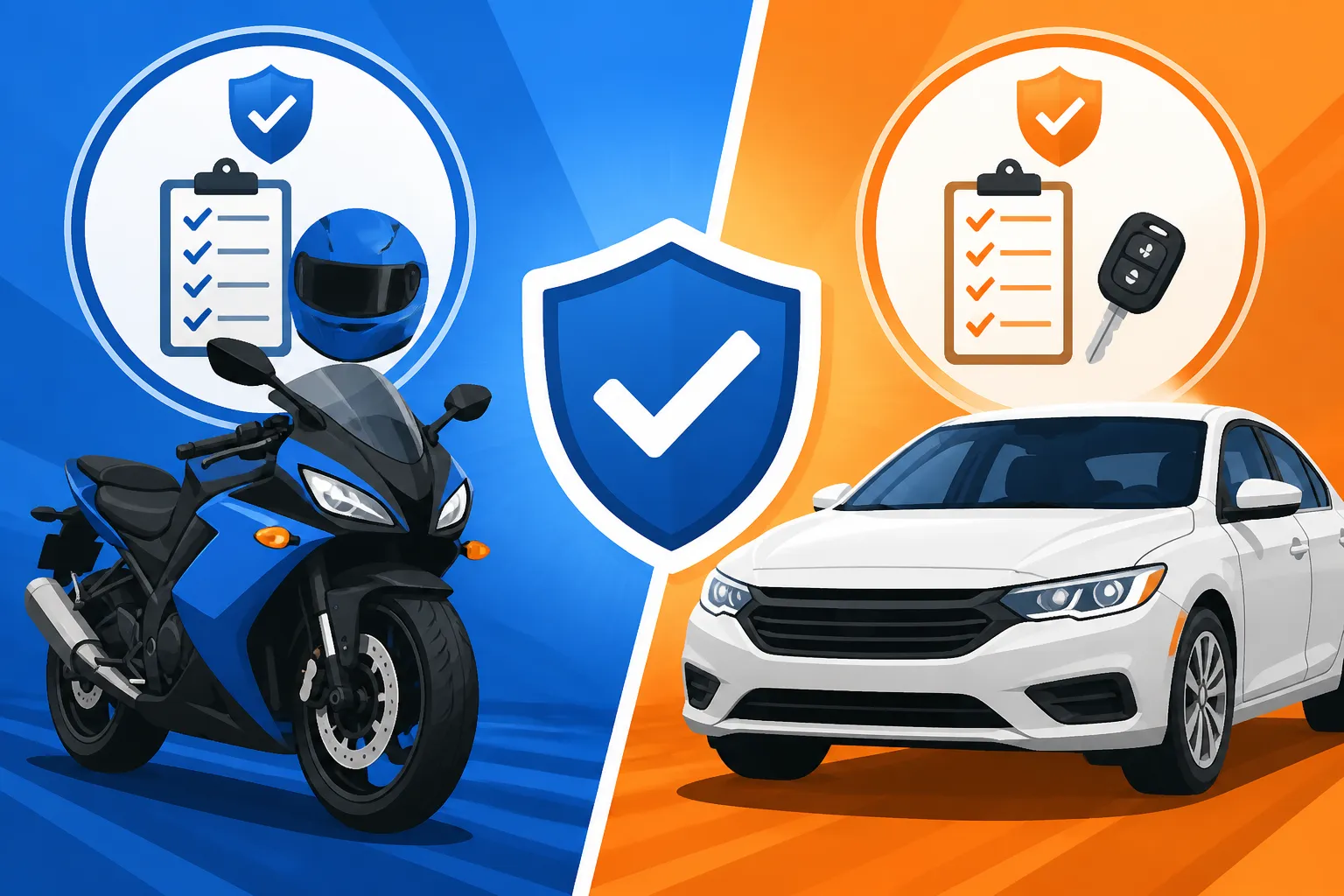
Motorcycle vs. Car Insurance Requirements Comparison
Let's break down some of the key differences and similarities in a concise table format to help you visualize them.
| Feature / Coverage Type | Car Insurance (General) | Motorcycle Insurance (General) | Key Differences / Considerations |
|---|---|---|---|
| Legal Mandate | Required in almost all states. | Required in most, but not all states; some have alternatives. | Some states don't legally mandate motorcycle insurance, but financial responsibility is always expected. |
| Minimum Liability | State-defined minimums for bodily injury and property damage. | State-defined minimums, sometimes different from cars. | Specific dollar amounts may vary; generally similar structure (e.g., 25/50/25). |
| No-Fault/PIP | Standard in no-fault states, covers own medical/lost wages. | Often exempted from no-fault laws in many states. | Huge difference: motorcyclists in no-fault states often cannot use PIP. Relies on MedPay or at-fault driver's liability. |
| Medical Payments | Optional in many states, covers own medical bills regardless of fault. | Highly recommended, often crucial if PIP is unavailable. | Critical for riders as a primary source of immediate medical coverage, especially in no-fault states. |
| Collision Coverage | Optional, covers damage to your car in an accident. | Optional, covers damage to your bike in an accident. | Essential for protecting your investment; bikes are vulnerable to damage even in minor incidents. |
| Comprehensive Coverage | Optional, covers non-collision damage (theft, vandalism, weather). | Optional, covers non-collision damage (theft, vandalism, weather). | Particularly vital for motorcycles due to higher theft rates and exposure to elements. |
| Uninsured/Underinsured Motorist | Optional or mandatory depending on state, covers you if hit by uninsured/underinsured driver. | Optional or mandatory depending on state. | Extremely important for riders due to high injury potential and prevalence of uninsured drivers. |
| Vehicle-Specific Add-ons | Roadside assistance, rental car reimbursement. | Roadside assistance, custom parts/accessories, trip interruption. | Motorcycle policies offer specialized coverages for custom parts, riding gear, and unique travel situations. |
| Rate Factors | Age, driving record, vehicle type, location, mileage. | Age, driving record, bike type, location, seasonal usage. | Bike type (sport vs. cruiser), rider experience, and seasonal use weigh heavily. |
| Required License | Standard driver's license. | Motorcycle endorsement or special license. | You'll need a specific Motorcycle License, Endorsement & Insurance to legally ride and often to get insurance. |
Disclaimer
Please remember that insurance laws and requirements are subject to change and can vary significantly by state and even by specific circumstances. This guide provides general information and should not be considered legal or financial advice. Always consult with a licensed insurance professional or your state's Department of Motor Vehicles or equivalent authority to confirm the exact requirements and recommended coverage for your specific situation.