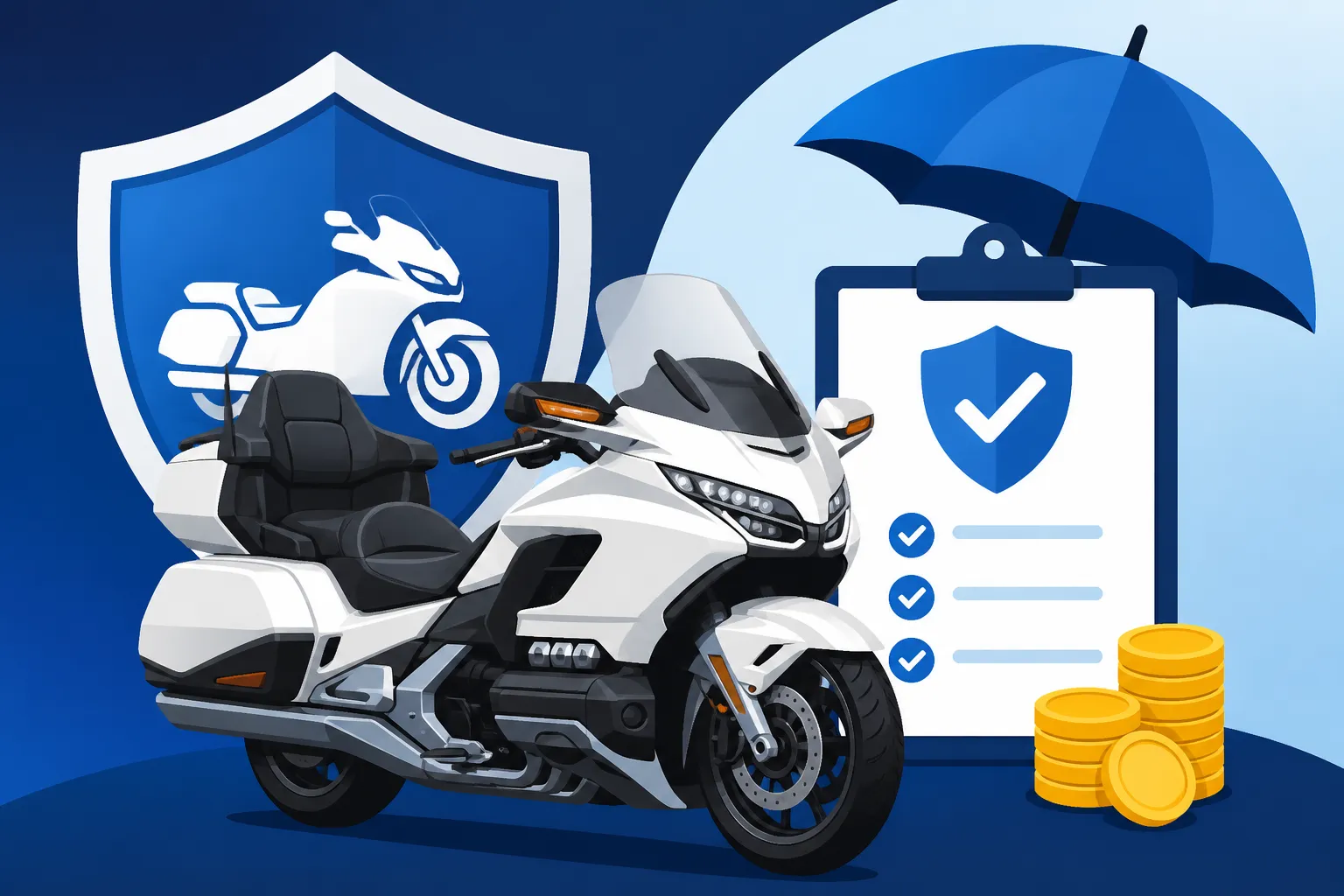
Touring Motorcycle Insurance Cost (Gold Wing)
Owning a touring icon like the Honda Gold Wing represents the pinnacle of long-distance freedom, but many riders find themselves staring at insurance quotes that look more like monthly car payments. Between the advanced navigation systems and the massive fairings, the cost to protect this luxury machine can be confusing and frustrating. This guide breaks down every factor influencing your touring motorcycle insurance cost.
Understanding the Baseline Cost for Touring Bikes
When you step into the world of heavyweight touring, you aren't just buying a motorcycle; you're buying a high-performance, two-wheeled luxury vehicle. The Honda Gold Wing, often referred to as the "Gold Standard" of touring, carries a price tag that reflects its engineering. Because the replacement value of a new GL1800 can exceed $25,000 to $30,000, insurance companies view it as a high-exposure asset. Unlike a small commuter bike, a Gold Wing represents a significant financial risk for the insurer if it is totaled or stolen.
The average cost for insuring a touring bike often sits between $800 and $1,500 per year, but this is a broad spectrum. Riders in lower-cost areas might see rates closer to $600, while those in major metropolitan hubs or states with high litigation rates could easily see premiums climb north of $2,000. It is vital to look at the Average Motorcycle Insurance Cost by State to see where your home base falls on the national spectrum. A rider in rural Iowa will inherently face different risk assessments than someone navigating the busy streets of Miami or Los Angeles.
Furthermore, the mechanical complexity of a touring bike adds to the premium. These machines are packed with airbags, electronic suspension, and integrated infotainment systems. If you experience a minor tip-over in a parking lot, the cost to replace the intricate plastic fairings and sensors can easily reach several thousand dollars. Insurance adjusters know these bikes are expensive to repair, and they price your policy accordingly to cover those potential labor and parts costs.
The Gold Wing Premium vs Other Models
The Honda Gold Wing is unique because of its flat-six engine and specialized parts. While you might expect the Cruiser Motorcycle Insurance Cost to be similar because of the weight, cruisers often lack the expensive fairing sets and electronics found on touring rigs. A Harley-Davidson Road Glide or a BMW K1600GT will have similar premiums to the Gold Wing, but the Honda often carries a slight edge in reliability ratings, which can sometimes work in the rider's favor.
When you are comparing these luxury models, it's helpful to use tools like The Zebra to see how different brands stack up against one another in real-time. Seeing the side-by-side comparison between a Gold Wing and a rival like the Indian Pursuit can reveal that even within the same weight class, specific brand "repairability" scores influence what you pay every month.
New vs Used Touring Bike Insurance
If you are looking at a 2026 Gold Wing, your collision and comprehensive coverage will be the most expensive part of your bill. However, for those riding a classic GL1500 or an early GL1800 from the early 2000s, the "actual cash value" of the bike is much lower. In these cases, riders often wonder if they should maintain full coverage or switch to a liability-only plan. While the bike might be older, the cost of medical bills or property damage remains the same, regardless of the bike's age.
For older touring bikes, you might consider if the premium for collision coverage exceeds the value of the bike over a three-year period. If you are paying $400 a year just for collision on a bike worth $4,000, you are essentially "buying" your bike back from the insurance company every decade. This is why understanding Why Is My Motorcycle Insurance So Expensive? is critical for owners of aging touring fleets.
National Averages and Regional Disparities
Geography is perhaps the largest "silent" factor in your touring bike insurance cost. If you live in a state with a short riding season, like Maine or Minnesota, you might expect lower annual rates, but many insurers spread the cost across the year. Conversely, in a state like Florida, where the riding season is year-round and the traffic density is high, the frequency of accidents leads to higher premiums across the board.
Checking the Florida Motorcycle Insurance Requirements can be eye-opening for riders moving from the Midwest. The lack of mandatory bodily injury liability in some scenarios creates a unique insurance landscape where your "Uninsured Motorist" coverage becomes the most important (and expensive) part of your policy. For touring riders who spend thousands of miles on the road, these regional differences aren't just trivia—they are the foundation of your financial protection.
Factors That Spike Your Touring Insurance Rates
It’s a common misconception that because touring riders are generally older and more experienced, their insurance should be dirt cheap. While the "rider profile" helps, the "machine profile" often pushes the price back up. The Gold Wing’s 1833cc engine is a powerhouse. While it’s tuned for smooth torque rather than raw racing speed, insurers still look at that displacement number. You can read more about how Does Engine Size (CC) Affect Insurance Cost? to see why an 1800cc touring bike might cost more to insure than a 1200cc adventure bike, even if the adventure bike is "faster."
Beyond the engine, the sheer weight of these bikes—often exceeding 800 pounds—means that if they are involved in an accident, they tend to cause more damage to other vehicles. Physics isn't on your side here. A heavy touring bike hitting a sedan at 35 mph carries significantly more kinetic energy than a 300cc sportbike. This increased "damage potential" is baked into your liability premium.
Safety Features and Theft Deterrents
One area where Gold Wing riders actually catch a break is in the safety department. Many modern touring bikes come standard with ABS, traction control, and even linked braking systems. Some newer models even feature adaptive cruise control and blind-spot monitoring. Insurance companies love these features because they statistically reduce the likelihood of a high-speed collision. When you're shopping on a platform like The Zebra, make sure you mention every safety bell and whistle your bike has, as these often trigger automatic discounts.
Theft is another major concern for insurers, though touring bikes are stolen less frequently than sportbikes. Why? They are hard to hide, difficult to move without a key, and generally owned by people who park them in locked garages. If you add an aftermarket GPS tracker or a high-quality alarm system, you can often shave a few percentage points off your comprehensive coverage.
Impact of Rider Age and Experience
There is a sweet spot for touring insurance, usually found among riders between the ages of 45 and 65. This demographic is statistically the safest on the road. They have decades of experience, usually have a clean driving record, and are less likely to engage in "hooning" or reckless behavior. If you are in this bracket, you are likely benefiting from the Motorcycle Insurance Cost for Riders Over 50 averages, which are among the lowest for any bike category.
However, if you are a younger rider who just happened to fall in love with the comfort of a Gold Wing, be prepared for a "youth surcharge." Even if you have a perfect record, an insurance company looks at a 22-year-old on an 800-pound, 1800cc machine as a high-risk scenario. Experience matters just as much as age; many insurers will ask how many years you have been licensed specifically for motorcycles, not just how long you've been driving a car.
Comparing Touring Costs by Category
| Feature | Honda Gold Wing | Harley-Davidson Ultra Limited | BMW K1600GTL |
|---|---|---|---|
| Engine Size | 1833cc | 1868cc | 1649cc |
| Average Annual Premium | $950 – $1,200 | $1,100 – $1,400 | $1,050 – $1,350 |
| Repair Cost Rating | High (Fairings/Electronics) | Moderate (Parts Availability) | Very High (Proprietary Tech) |
| Safety Features | Airbag, ABS, Traction | ABS, Reflex Linked Braking | Dynamic ESA, Cornering Lights |
| Theft Risk | Low | Moderate | Low |
Coverage Types Essential for Long-Distance Riders
When you are touring, your insurance needs are vastly different from the guy who just rides his bike to the local coffee shop. You are often hundreds, if not thousands, of miles away from home. This means a standard "minimum liability" policy is woefully inadequate. If your bike breaks down in the middle of the desert or you have a minor low-side in a different state, you need coverage that handles the logistics of being stranded.
Touring riders should prioritize "Total Loss" and "Accessories" coverage. Because of the high cost of touring gear—helmets, heated suits, GPS units, and custom saddles—your standard policy might not cover everything in your panniers. Many Gold Wing owners add $5,000 to $10,000 in custom chrome or comfort upgrades. Without specific Accessories & Custom Parts Coverage Explained, you might find that after a claim, the insurance company only pays for the stock components, leaving you out of pocket for your expensive upgrades.
Roadside Assistance and Trip Interruption
For a Gold Wing rider, roadside assistance isn't just a "nice to have"—it's a necessity. These bikes cannot be easily towed by a standard car tow truck; they require specialized trailers or "cradle" lifts to ensure the fairings aren't damaged and the bike doesn't tip. When you're choosing your policy, ensure the roadside assistance specifically covers "motorcycle specialized towing."
Even more important is Trip Interruption coverage. If you are 500 miles into a cross-country trip and your bike is sidelined by a covered loss (like an accident or a mechanical failure if you have a specific endorsement), trip interruption can pay for your hotel, meals, and even a rental car while your bike is being repaired. Understanding What Is Trip Interruption Coverage for Motorcycles? can be the difference between a ruined vacation and a minor inconvenience.
Comprehensive and Collision for Fairings
As mentioned earlier, the fairings on a touring bike are its Achilles' heel in an insurance claim. A simple tip-over in a parking lot can scratch the saddlebags, the engine guards, and the front fairing. In many cases, these parts cannot be "buffed out" because they are made of painted ABS plastic. They must be replaced.
Because the labor involved in stripping a Gold Wing down to replace fairing panels is extensive, these claims get expensive fast. Collision coverage will handle the damage if you hit an object or another vehicle, while comprehensive will cover you if a tree limb falls on the bike at a campsite or if it’s knocked over by a gust of wind. Given the high cost of these parts, skipping comprehensive or collision on a modern Gold Wing is a massive financial gamble.
Uninsured and Underinsured Motorist Protection
This is arguably the most critical coverage for any long-distance rider. Statistically, a large percentage of drivers on the road carry only the bare minimum insurance—or none at all. If a driver in a beat-up sedan merges into your lane and totals your $30,000 Gold Wing, their $10,000 property damage limit won't even cover half the cost.
Uninsured Motorist (UM) and Underinsured Motorist (UIM) coverage step in to pay the difference. It covers your medical bills and, in many states, your property damage when the at-fault party can't. When you use The Zebra to compare quotes, pay close attention to the UM/UIM limits. You want these limits to match your own liability limits to ensure you are fully protected from the negligence of others.
Regional Price Variations and Local Impact
Where you park your bike at night has a massive impact on your premium. Insurance companies use actuarial data to determine the "loss cost" of a specific zip code. If you live in a high-theft area or an area with a high frequency of deer-vehicle collisions, your rates will reflect that. For touring riders, who often live in suburban or rural areas where they have space to store such a large bike, this can work to their advantage.
However, don't forget that your "home" state laws dictate the framework of your policy. For example, if you are a Michigan rider, you are dealing with a unique "No-Fault" system that behaves very differently from the rest of the country. Reading about Michigan Motorcycle Insurance (No-Fault) Explained is essential if you plan to tour through or live in the Great Lakes State, as the medical coverage requirements there are some of the most robust (and expensive) in the nation.
Urban vs Rural Riding Environments
Riding a Gold Wing in New York City is a vastly different experience than riding one through the Black Hills of South Dakota. In urban environments, the "stop-and-go" nature of traffic increases the likelihood of rear-end collisions and low-speed drops. Furthermore, the risk of vandalism or theft is significantly higher. If you live in a major city, you might see a "city surcharge" that can add 20-30% to your premium.
Conversely, rural riders face the "animal strike" risk. For a heavyweight touring bike, hitting a deer at 55 mph is a common comprehensive claim. Insurers in states like Pennsylvania, Ohio, and Wisconsin price their comprehensive coverage with these strikes in mind. Always be honest about where the bike is "garaged," as misrepresenting your location to save money can lead to a denied claim later.
How State Laws Dictate Your Premium
Every state has a "minimum liability" requirement, often expressed as three numbers (e.g., 25/50/25). These numbers represent the maximum the insurer will pay for one person's injuries, total injuries per accident, and property damage. If you are riding a bike as valuable as a Gold Wing, these minimums are almost never enough.
If you are found at fault in an accident and you only have $25,000 in property damage coverage, but you totaled a modern SUV, you are personally liable for the remaining balance. This is why most touring riders opt for 100/300/100 limits. You can find more detail on this in the Minimum Liability Insurance Explained (The Three Numbers) guide. It might cost an extra $10 a month, but it protects your home, savings, and retirement accounts from a lawsuit.
Strategies to Lower Your Touring Bike Premium
Even though a Gold Wing is an expensive bike to insure, you don't have to just "take it" when the renewal bill arrives. There are several proactive steps you can take to bring that number down. The most effective method is bundling. If you already have your home and auto insurance with a major carrier, adding your motorcycle can often trigger a multi-policy discount of 10% to 15%.
Another often-overlooked strategy is the "Advanced Rider" discount. Most insurers will give you a discount if you have completed a Motorcycle Safety Foundation (MSF) course within the last three years. For touring riders, taking an "Experienced Rider" or "Advanced Rider" course not only makes you safer on those mountain switchbacks but also keeps more money in your pocket. Check out Does a Motorcycle Safety Course Lower Insurance? for a deeper look at how much you can save.
Leveraging Group and Safety Discounts
Are you a member of the Gold Wing Road Riders Association (GWRRA) or a similar touring club? Many insurance companies offer "affinity" discounts for members of recognized riding groups. Additionally, if you are a veteran or an active-duty military member, there are specific carriers that cater to you with lower rates.
Using a comparison engine like The Zebra is the best way to see which carriers are currently "hungry" for touring bike business. Insurance companies change their "appetite" for different types of risks every year. A company that was the cheapest for you in 2024 might be the most expensive in 2026 because they had a bad year of touring-related claims. Shopping around every two years is the only way to ensure you aren't overpaying.
Seasonal Lay-up and Storage Savings
If you live in a climate where the bike sits in the garage from November to March, you shouldn't be paying for "collision" coverage during those months. Many insurers offer a "Lay-up" policy or a "Winter Storage" credit. This maintains your comprehensive coverage (in case the garage burns down or the bike is stolen) but removes the expensive road-going coverages.
Before you just cancel your policy, though, be careful. A lapse in coverage can cause your rates to skyrocket when you try to restart in the spring. Instead, look into Seasonal Lay-Up & Winter Storage Insurance options that keep the policy active at a fraction of the cost. This keeps your "continuous coverage" history intact, which is a major factor in getting How to Get Cheap Motorcycle Insurance rates in the long run.
Shopping and Comparing Efficiently
When you sit down to compare quotes, have your VIN number, your driver's license number, and a list of all your safety gear and accessories ready. If you use a tool like The Zebra, you can input this information once and get multiple quotes back. This is far more efficient than calling five different agents and repeating your life story.
Be sure to ask about "disappearing deductibles." For touring riders who tend to go years without a claim, some companies will reduce your deductible by $100 for every year you ride safely. Eventually, your deductible could drop to $0. This is a fantastic benefit for the careful Gold Wing rider who wants to avoid out-of-pocket costs if they ever do have a mishap.
Motorcycle Insurance Disclaimer
This guide is intended for informational purposes only and does not constitute legal or financial advice. Insurance laws and regulations vary significantly by state and are subject to change. Always consult with a licensed insurance professional in your specific jurisdiction to ensure your policy meets all legal requirements and provides adequate protection for your unique situation. We do not guarantee the accuracy of rates or coverage details as they are dependent on individual rider profiles and carrier underwriting guidelines.