Does Engine Size (CC) Affect Insurance Cost?
Buying your first bike or upgrading to a more powerful machine is a rite of passage, but it often comes with a stinging reality check when the insurance quote arrives. Many riders assume that a higher engine displacement automatically translates to a massive premium increase, and while there is some truth to that, the relationship is far more complex than a simple one-to-one ratio. This guide dives deep into why engine size matters to underwriters, how different bike categories defy the "bigger is more expensive" rule, and what you can do to keep your costs down while still riding the machine of your dreams.
Understanding the Relationship Between CCs and Premiums
When we talk about CCs, we are referring to cubic centimeters, which is the measurement of the engine's displacement—the total volume of the cylinders where the fuel and air mixture burns. To an insurance company, this number is a primary indicator of power, but it is also a proxy for risk. The logic is relatively straightforward on the surface: a larger engine can move a bike faster, accelerate more aggressively, and potentially lead to more severe accidents.
However, the "CC tax" isn't just about raw speed. It is about the physics of the machine. A larger engine often means a heavier bike, which can be harder to maneuver for a novice. It also suggests a higher level of mechanical complexity. If you are comparing a 250cc entry-level bike to a 1000cc "liter" bike, the insurer sees two completely different worlds of liability. The smaller bike is seen as a manageable tool for learning, while the larger bike is viewed as a high-performance machine that requires significant skill to operate safely.
The Power-to-Weight Ratio and Insurance Risk
One of the nuances that veteran riders understand—but insurers analyze meticulously—is the power-to-weight ratio. A high-displacement engine in a lightweight frame is a recipe for high insurance rates. This is why a 600cc sport bike can sometimes be more expensive to insure than an 1100cc cruiser. The sport bike is designed for high-RPM performance and flickability, which historically correlates with higher claim frequencies and more expensive medical payouts.
Insurance companies look at the statistics of who buys which CC bracket. If data shows that riders on 600cc-750cc sport bikes are involved in more single-vehicle accidents than those on 1200cc touring bikes, the smaller engine will actually carry a higher premium. This is a common frustration for riders who think they are being "responsible" by not buying a 1000cc bike, only to find the 600cc class is the most heavily penalized by insurance math.
The Cost of Repair and Displacement
As engine size increases, the cost of the motorcycle generally increases as well. A 1600cc touring motorcycle isn't just expensive because of the engine; it's expensive because of the fairings, the advanced electronics, the luggage systems, and the high-end suspension required to handle that weight. When you ask for a quote on a high-CC bike, the insurer is calculating the potential cost of a "total loss" claim.
If you drop a 125cc scooter, the repair bill might be a few hundred dollars. If you lay down an 1800cc Gold Wing, you are looking at thousands of dollars in plastic and chrome repairs before you even touch the engine components. This is why What Affects Your Motorcycle Insurance Rate? is such a critical topic to understand; displacement is the starting point, but the "total value at risk" is what ultimately sets the ceiling for your premium.
Speed Capability and Actuarial Tables
Insurers use actuarial tables to predict the future based on the past. These tables clearly show that as engine displacement crosses certain thresholds—typically 600cc, 1000cc, and 1200cc—the severity of accidents tends to increase. High-CC bikes are capable of speeds that make even minor errors fatal or catastrophic for the machine.
Even if you are a safe rider, you are being grouped with everyone else who rides that specific displacement. If a particular 1000cc model is popular among riders who like to push limits on public roads, your premium will reflect that collective risk. Using a tool like The Zebra can help you see these patterns across different insurers, as some companies weigh displacement differently than others based on their own internal claims data.
The Thresholds: Where Insurance Costs Usually Spike
In the world of motorcycle insurance, not all CCs are created equal. There are specific "brackets" where you will notice significant jumps in your premium. Understanding these thresholds can help you make a strategic decision when shopping for your next bike, especially if you are on a budget.
Often, staying just under a certain displacement limit can save you hundreds of dollars a year. For example, a 599cc bike might sit in a different risk category than a 650cc bike, even if the real-world performance is nearly identical. These arbitrary lines in the sand are a quirk of the insurance industry that every rider should be aware of before they sign a bill of sale.
The Beginner Bracket: Under 250cc to 500cc
Bikes in the 125cc to 500cc range are generally the most affordable to insure. These are often categorized as "entry-level" or "commuter" bikes. Insurers love these bikes because they are typically easier to handle, have lower top speeds, and are often owned by riders who are focused on fuel economy or learning the ropes rather than high-speed thrills.
If you are a new rider, starting in this bracket is the best way to keep your initial costs low. You can find more detail on this in our guide on How Much Is Motorcycle Insurance for a Beginner? where we break down the specific savings for those starting small. Even within this bracket, there is a difference between a 250cc rebel and a 400cc Ninja, but generally, this is the "safe zone" for your wallet.
The Mid-Range Jump: 600cc to 900cc
This is where things get tricky. This bracket contains two very different types of riders: those on "middleweight" cruisers and those on "supersport" bikes. A 600cc supersport bike (like a Yamaha R6 or Kawasaki ZX-6R) is often one of the most expensive motorcycles to insure regardless of its CC count. This is because these engines are tuned for extreme power, and the bikes are lightweight and built for racing.
On the flip side, an 800cc cruiser is seen as a mild, stable machine. If you are looking at bikes in this range, the "CC" number matters less than the "type" of bike. You might find that Cruiser Motorcycle Insurance Cost is significantly lower than what you would pay for a sport bike with a smaller engine. This is a common realization for riders who use The Zebra to compare quotes; they find that displacement is only half the story.
The Liter Bike and Beyond: 1000cc Plus
Once you cross the 1000cc (or "liter") mark, you are entering the premium tier. For sport bikes, this is the "uninsurable" zone for many young or new riders, or at least the "painfully expensive" zone. For touring and large cruiser riders, this is the "standard" zone. A 1200cc BMW GS or a 1800cc Harley-Davidson will have high premiums due to their high MSRP, but they don't usually suffer from the "performance penalty" that a 1000cc sport bike does.
In this high-displacement tier, the insurer is looking closely at your experience. If you have been riding for ten years and move to a 1200cc bike, your rate might be very reasonable. If you are a new rider trying to insure a 1000cc bike, you may find that many companies will flat-out refuse to cover you, or they will provide a "go away" quote that is intentionally high.
Comparative Analysis: CC vs. Bike Type
To truly understand how engine size affects your wallet, you have to look at it through the lens of the motorcycle's classification. A common mistake is comparing a 1000cc bike of one style to a 1000cc bike of another. The insurance industry uses "ISO" codes or similar internal classification systems to group bikes by their purpose, not just their piston size.
This classification system is why two bikes with the exact same displacement can have insurance premiums that are thousands of dollars apart. When you are browsing listings, keep in mind that the engine is just a component of the bike's "personality" in the eyes of the underwriter.
The Cruiser vs. Sport Bike Paradox
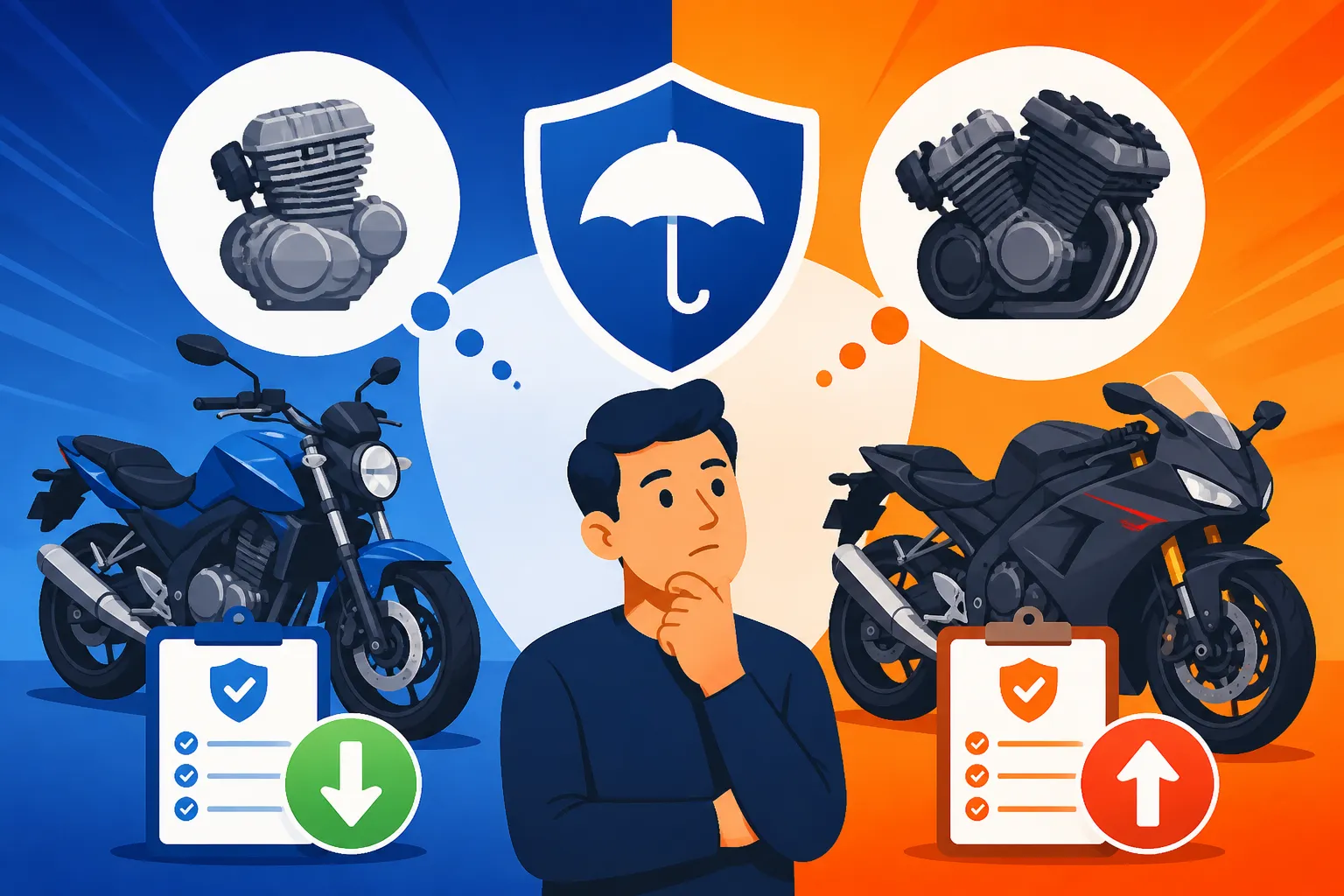
Let's look at a real-world scenario: a 1200cc Harley-Davidson Sportster versus a 600cc Suzuki GSX-R. By displacement alone, the Harley is twice the size of the Suzuki. However, in almost every insurance scenario, the 600cc Suzuki will be more expensive to insure. Why? Because the Suzuki is a high-performance sport bike with a high theft rate and a high accident-severity rating.
The Harley, despite its larger engine, is built for cruising. It has a lower center of gravity, a different target demographic (usually older, more experienced riders), and it isn't designed to be ridden at 160 mph. This is why Motorcycle Insurance Cost by Bike Type is often a more accurate predictor of your premium than engine size alone. Insurers know that CCs in a cruiser are used for "torque" and "comfort," while CCs in a sport bike are used for "velocity."
Touring Bikes: High CC, High Value, Lower Risk
Touring bikes often have the largest engines on the market, sometimes exceeding 2000cc in custom builds. These bikes are massive, heavy, and expensive. While the high CC count does increase the liability portion of the insurance, the primary driver of the cost here is the "Comprehensive" and "Collision" coverage. Because these bikes are so expensive to buy, they are expensive to replace.
Interestingly, touring riders are statistically some of the safest on the road. They tend to be older, carry more insurance (including life and umbrella policies), and ride more miles without incidents. Therefore, the "risk" associated with the high CC engine is offset by the "reliability" of the rider. If you're looking for a large-engine experience without the sport bike premium, the touring class is where you'll find the best balance.
Dual-Sport and Adventure Bikes
Adventure (ADV) bikes are a rapidly growing segment that often features engines in the 800cc to 1250cc range. These bikes occupy a middle ground. They are high-displacement, but they aren't "speed machines" in the way sport bikes are. They are designed for long-distance travel and off-road capability.
Insurers view ADV riders similarly to touring riders, but with a slight adjustment for the fact that these bikes are often ridden off-road, which increases the likelihood of "tips" and minor damage. If you're comparing a 1000cc ADV bike to a 1000cc sport-touring bike, the rates will be fairly similar, provided the MSRPs are in the same ballpark.
| Bike Category | Typical CC Range | Insurance Risk Level | Primary Cost Driver |
|---|---|---|---|
| Scooter/Moped | 50cc – 250cc | Very Low | Liability |
| Beginner Standard | 250cc – 500cc | Low | Value of Bike |
| Sport Bike | 600cc – 1000cc | Very High | Accident History / Speed |
| Cruiser | 750cc – 1800cc | Moderate | Chrome/Custom Parts |
| Touring | 1200cc – 2500cc | Moderate | Replacement Cost (MSRP) |
| Adventure (ADV) | 650cc – 1250cc | Moderate | Repair Costs / Off-road Risk |
Other Variables That Matter Just as Much as CC
While we've established that engine size is a major factor, it doesn't exist in a vacuum. Your insurance premium is a puzzle, and engine size is just one piece. If you change other variables, you can actually offset the cost of a larger engine. This is the "secret sauce" of veteran riders who manage to keep large-displacement bikes insured for reasonable rates.
If you are staring at a high quote for a high-CC bike, don't lose hope yet. You may be able to pull other levers to bring that number down. Underwriters are looking for a "whole picture" of risk, and you can provide data points that make you look like a much safer bet than the average rider of that machine.
The Rider's Age and Experience
A 21-year-old on a 1000cc bike is an actuarial nightmare. A 45-year-old on the same bike is a standard policy. Your age and the number of years you've held a motorcycle endorsement are massive factors. In many cases, experience can completely "neutralize" the penalty of a larger engine. If you've been riding for five years without an accident, an insurer is much more likely to give you a break on a 750cc bike than they would a brand-new rider on a 300cc bike.
This is why we often recommend looking into How Much Is Motorcycle Insurance for an 18 Year Old? to understand the baseline. If you are young, the engine size is a multiplier for your already high base rate. If you are older, that multiplier is applied to a much smaller base, making the increase feel more manageable.
Location, Storage, and Theft
Where you live can sometimes outweigh the CC of your engine in terms of cost. If you live in a high-theft urban area and you buy a 600cc sport bike (a top target for thieves), your premium will be astronomical. If you live in a rural area with a locked garage, that same bike might be surprisingly cheap to insure.
Insurers ask if the bike is garaged for a reason. High-displacement bikes are often more attractive to thieves because they can be parted out for more money. By proving you have a secure place to store the bike, you reduce the "Comprehensive" risk, which can help lower the total bill. Mentioning your security measures when using comparison sites like The Zebra can sometimes unlock specific discounts or better underwriting tiers.
Your Driving Record and Claims History
It should go without saying, but your history on four wheels affects your history on two. If you have a history of speeding tickets or at-fault accidents in your car, an insurer will assume you will bring those same habits to a high-CC motorcycle. Conversely, a clean driving record can help you secure "preferred" status, which opens up lower rates regardless of engine size.
If you do have a mark on your record, you might need to look into specialized filings. For instance, SR-22 for Motorcycles: When It's Required explains how certain violations can force you into a high-risk pool where engine size becomes an even more aggressive pricing factor. Keeping your record clean is the single most effective way to ensure that a "liter bike" stays affordable.
How to Save on High-CC Insurance
If you've already set your heart on a large-displacement motorcycle, there are practical steps you can take to mitigate the insurance hit. You don't necessarily have to settle for a smaller bike just to save money on premiums, but you do have to be smarter about how you shop and how you present yourself to the insurance company.
Insurance is a competitive market. Different companies have different "appetites" for risk. One company might hate 1000cc sport bikes but love 1800cc cruisers. Another might specialize in high-performance machines. Finding the right fit is key.
Shop Around Using Comparison Tools
The biggest mistake riders make is sticking with their auto insurance provider without checking other options. Motorcycle insurance is a niche product. A company like The Zebra allows you to plug in your bike's VIN and your personal details to see how ten different companies view that specific CC-to-risk ratio.
You might find that Company A charges $2,000 for a 1000cc bike while Company B charges $800. This happens because Company B might have a larger "pool" of that specific bike model and better data that shows it isn't as risky as Company A assumes. Never settle for the first quote, especially when displacement is high.
Take a Safety Course (MSF)
Most insurance companies offer a discount (usually 5% to 15%) if you complete a recognized Motorcycle Safety Foundation (MSF) course or an advanced rider course. For a high-CC bike, this 10% discount can represent a significant amount of money. Beyond the discount, it also shows the insurer that you are serious about your skills.
For riders moving from a small bike to a large one, taking an "Experienced Rider Course" is a great way to signal to your insurer that you are prepared for the extra power. You can learn more about how this works in our article on Does a Motorcycle Safety Course Lower Insurance? to see if the time investment is worth the savings for your specific situation.
Adjust Your Deductibles and Coverage Limits
If the "Comprehensive" and "Collision" portions of your quote are what's driving the price up on your high-CC bike, you can consider raising your deductible. By moving from a $250 deductible to a $1,000 deductible, you are telling the insurer that you are willing to shoulder more of the "small" risks. This can drastically lower your monthly or annual premium.
However, be careful with your liability limits. Many riders try to save money by opting for the Minimum Liability Insurance Explained (The Three Numbers) required by their state. While this saves money upfront, it can be a financial disaster if you cause an accident with a high-power bike. A larger engine means more potential for damage, so carrying higher liability limits is usually a wise move, even if it costs a bit more.
Final Thoughts on Engine Size and Insurance
At the end of the day, engine size is a significant factor in your insurance cost, but it's not the "doom and gloom" scenario many people make it out to be. If you choose a bike style that matches your riding habits—like a cruiser or a touring bike—you can enjoy a large engine without a large premium. The "CC penalty" is mostly felt in the high-performance sport bike category where speed and risk are at their peak.
Before you buy, run the numbers. Use a VIN from a similar bike on a comparison site like The Zebra to get a "ghost quote." This way, you know exactly what the "engine size tax" will look like for your specific profile before you're holding the keys. Knowledge is power, and in the world of motorcycles, it's also the best way to keep your wallet from being emptied by your insurance provider.
Disclaimer
This guide is for informational purposes only and does not constitute legal or financial advice. Insurance rates, regulations, and coverage requirements vary significantly by state, provider, and individual circumstances. Always consult with a licensed insurance professional or your state's Department of Insurance to verify specific laws and policy details applicable to your situation.