States That Don’t Require Motorcycle Insurance
Riders across the country frequently hear whispers at bike nights or online forums claiming that certain states allow you to ride completely free of insurance requirements. The reality, however, is far more complex and legally nuanced than simply kicking up your kickstand and riding off without a care in the world. This comprehensive guide breaks down the true legal framework behind states that do not strictly mandate traditional motorcycle insurance, how financial responsibility laws work, and the massive personal risks you take when hitting the highway unprotected.
The Legal Reality of States That Do Not Require Mandatory Motorcycle Insurance
Clarifying Mandatory Coverage vs Financial Responsibility
When you dive into state motor vehicle codes, you quickly realize that the phrase “insurance is not required” is one of the most misunderstood concepts in the riding community. Many riders assume this means they can buy a bike, tag it, and ride down the highway without a single penny set aside for potential accidents. In truth, state lawmakers rarely excuse anyone from liability; instead, they separate the mandatory purchase of an insurance policy from the legal obligation to pay for damages you cause.
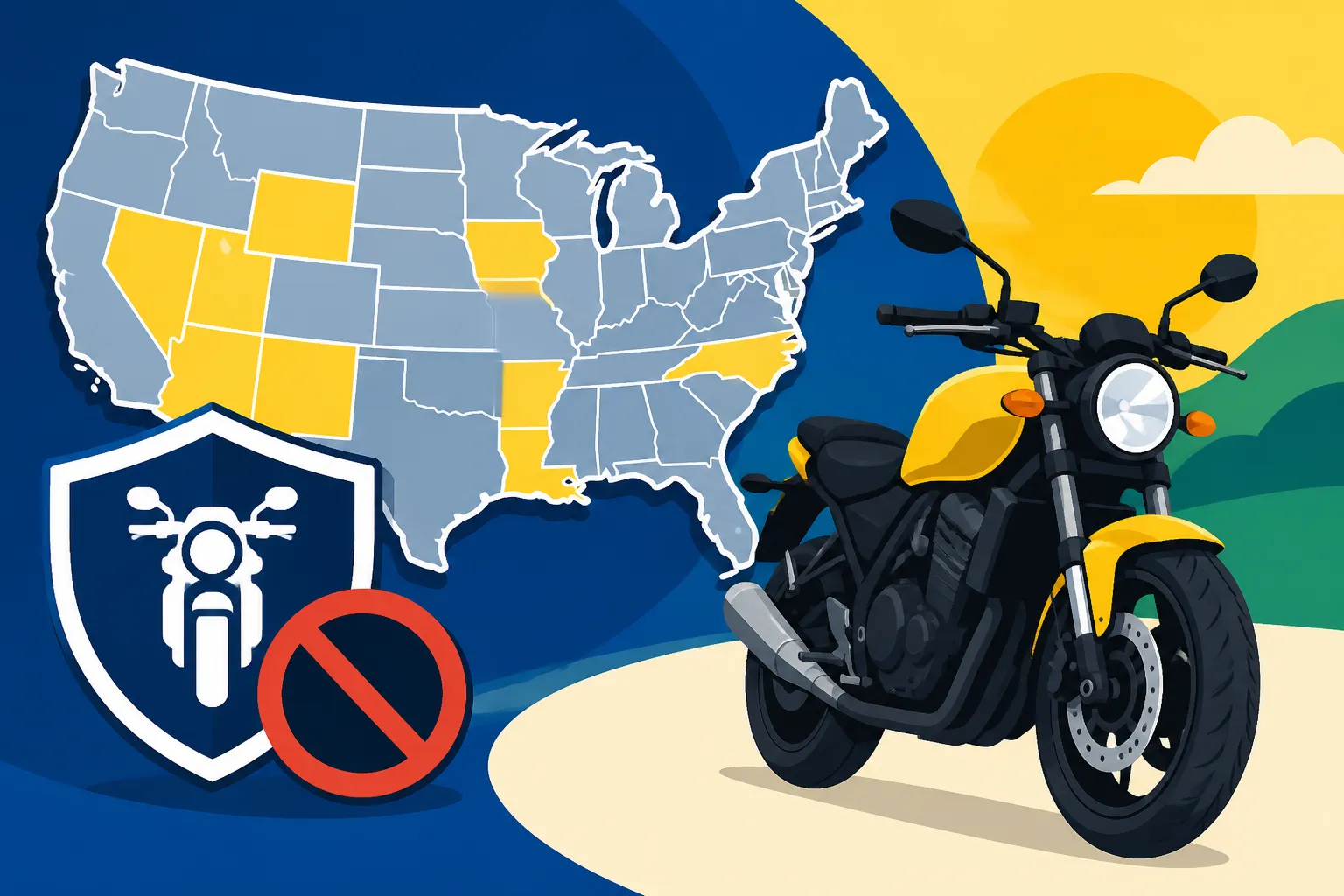
In most jurisdictions, compulsory motor vehicle liability laws require you to maintain an active insurance policy continuously as a condition of motorcycle registration and street operation. In states that diverge from this norm, the law simply offers alternative methods to prove you have the monetary means to cover damages if you cause a crash. To get a clear picture of how these statutes vary, checking States That Don’t Require Motorcycle Insurance can help clarify which jurisdictions stand apart from the national standard.
Understanding this distinction is vital because failing to prove financial ability after a collision carries severe legal repercussions. You might not get pulled over for lacking an insurance card during a routine traffic stop in a non-mandatory state, but the second an incident occurs, the full weight of the legal system demands proof that you can make the injured parties whole out of your own pocket.
The Uniqueness of Florida Motorcycle Insurance Laws
Florida stands as the most famous exception to standard motor vehicle insurance mandates for two-wheeled vehicles. Unlike four-wheeled passenger cars, which must comply with strict Personal Injury Protection rules, motorcycles are exempted from the state’s mandatory insurance registration laws. That means you can walk into a local tag office, register a cruiser or sport bike, and ride off without presenting proof of an active insurance card.
However, this exemption comes with a giant asterisk that catches thousands of Florida riders off guard every year. While you do not need insurance to register or ride the motorcycle initially, you remain 100 percent personally liable for any bodily injury or property damage you cause during an accident. If you cause a crash and cannot pay for the damages, the state will swiftly suspend your riding privileges, invalidate your vehicle registration, and mandate high-risk filing forms before you can legally ride again.
Furthermore, Florida ties its insurance statutes directly to its safety gear regulations. If you choose to ride without a helmet in Florida, the law explicitly requires you to carry a specific amount of medical payments coverage. To navigate these intricate rules, many riders turn to detailed breakdowns like Do You Need Insurance for a Motorcycle in Florida? and Florida Motorcycle Insurance Requirements to avoid costly legal traps.
New Hampshire and Its Alternative Compliance Models
New Hampshire holds a unique position in American traffic law under its famous “Live Free or Die” philosophy. It is the only state in the nation where motor vehicle insurance is not universally mandatory for all drivers and riders across the board. If you own your motorcycle outright and have a clean driving record, you can legally choose to ride on public roads without purchasing a traditional policy.
However, New Hampshire does not grant riders immunity from the financial fallout of a crash. The state operates under strict fault-based liability principles. If you are involved in an accident that results in injury or property damage, the state Department of Motor Vehicles will evaluate the incident. If you are deemed at fault, you must immediately demonstrate the financial capability to pay for all resulting damages out of pocket.
If you cannot provide immediate proof of funds or post a adequate cash bond, the state will revoke your driver’s license and motorcycle endorsement indefinitely. Moreover, if you have prior traffic violations, DUIs, or certain serious infractions, New Hampshire revokes your exemption and legally compels you to purchase high-risk insurance to maintain your license.
How Financial Responsibility Laws Work in Non-Mandatory States
Cash Deposits and Surety Bonds Explained
For riders who live in states offering alternatives to standard insurance policies, satisfying Financial Responsibility Laws for Riders often involves posting a cash deposit or purchasing a surety bond directly through the state’s department of transportation. This system is designed for high-net-worth individuals or businesses that prefer to self-insure rather than pay monthly premiums to an insurance provider.
To utilize a cash deposit option, a rider must deposit a designated, substantial sum of money—often tens of thousands of dollars—with the state treasurer or DMV. This capital sits in a state-managed account, completely tied up, acting as a collateral fund specifically allocated to pay out claims if you cause a collision. For the vast majority of average everyday riders, tying up tens of thousands of dollars in a liquid state account is completely impractical compared to standard policy premiums.
Surety bonds represent another alternative where a specialized surety company guarantees to the state that your legal liabilities will be paid up to a specified limit. However, a surety bond is not insurance. If the bond company pays out a claim to an injured party on your behalf after a crash, they will aggressively pursue you legally to recoup every single dollar spent, putting your personal savings, home equity, and paychecks on the line.
Self-Insurance Certification Requirements for Individual Riders
Some states permit individuals who own a fleet of vehicles or possess verified personal wealth to apply for an official Certificate of Self-Insurance. This process is far more rigorous than simply signing a waiver at the local motor vehicle branch. It requires submitting detailed audited financial statements, proof of unencumbered liquid assets, and undergoing a formal review by state financial regulators.
The threshold for self-insurance certification is deliberately set very high to protect the general public from uncompensated harm. State regulators want absolute guarantee that if you collide with a luxury sedan or cause severe bodily injury to another commuter, your bank account can absorb the losses instantly without bankrupting you or leaving the victim with unpaid medical bills.
For an individual motorcycling enthusiast with one or two bikes in the garage, qualifying for a self-insurance certificate is rarely attainable. The administrative paperwork, annual filing fees, and strict capital reserves required mean that self-insurance is functionally reserved for commercial operators, rental fleets, or exceptionally wealthy collectors rather than everyday commuters.
The Real Financial Consequences of Choosing Self-Insurance
Opting to forgo traditional insurance in favor of personal financial responsibility sounds empowering until an actual emergency unfolds on the pavement. The moment you pull out of your driveway, you assume total financial responsibility for every variable on the road, from unexpected oil slicks to unpredictable traffic patterns.
Consider a scenario where a rider accidentally rear-ends a late-model automobile at a traffic light. Even a low-speed impact can cause thousands of dollars in bumper, sensor, and paint damage to the vehicle. If the driver or passenger experiences soft-tissue neck injuries, medical evaluation bills, emergency room fees, and lost work wages can easily balloon into tens of thousands of dollars within days.
| Compliance Approach | Immediate Upfront Requirements | Post-Accident Financial Impact |
|---|---|---|
| Traditional Insurance | Monthly or annual premium payments | Deductible only (up to limits) |
| Cash Deposit / Surety | Massive tied-up capital or fees | Full repayment to bond company |
| Uninsured/Self-Reliant | Zero initial cost (if allowed) | 100% out-of-pocket, asset loss |
Without a insurance policy to step in and handle legal defense, negotiation, and settlement payouts, the uninsured rider must hire a personal attorney out of pocket or face direct civil litigation. Courts can issue garnishments against future wages, place liens on personal real estate, and order the seizure of personal assets to satisfy legal judgments arising from the crash.
Specific State Deep Dives: Florida, New Hampshire, and Beyond
Florida Motorcycle Insurance Requirements and Helmet Exceptions
Florida’s unique statutory framework creates endless confusion for local riders and touring tourists alike. Under Florida law, motorcycles are defined separately from traditional motor vehicles regarding compulsory no-fault insurance. As a result, you do not need to show proof of insurance to purchase a tag or maintain valid registration for a motorcycle.
However, the state ties financial capability directly to its helmet laws. Under Florida statute, if you choose to ride without an approved helmet, you must carry at least a specified amount in medical payments coverage specifically designed to pay for injuries you might sustain. Riding lidless without this required medical coverage exposes you to traffic citations and severe financial stress if you sustain head trauma or road rash.
Furthermore, if an uninsured Florida rider causes an accident that results in property damage or bodily injury, the state’s Financial Responsibility Law kicks in immediately after the fact. The state will issue an administrative order requiring the rider to pay for all damages, purchase a high-risk policy, and file proof of financial responsibility for a continuous three-year period. Failure to do so results in the immediate suspension of both the rider’s motorcycle endorsement and vehicle registration tags.
New Hampshire Motorcycle Laws and License Suspension Risks
New Hampshire stands alone as the only state that allows motor vehicle operators to completely bypass purchasing insurance without requiring special fleet status or upfront cash deposits prior to an incident. As long as you own your motorcycle free and clear, you can legally ride across the Granite State without carrying an insurance card in your wallet.
However, the legal leeway vanishes the moment an accident occurs. If you are involved in a collision in New Hampshire that causes property damage above a minor threshold or results in any personal injury, you are required to file an accident report with the DMV. If the state determines that you were at fault and you do not have insurance, you must immediately deposit sufficient cash or securities with the state to cover the total estimated cost of damages.
If you are unable to post this cash bond, the New Hampshire Division of Motor Vehicles will issue an order suspending your driver’s license and revoking all vehicle registrations in your name. This suspension remains in effect until you completely satisfy all financial claims with the injured party, obtain a formal legal release, or enter into an approved court-ordered payment plan that could span decades.
Historical Exceptions and Evolving State Regulations
It is important for long-time riders to recognize that motor vehicle legislation across the United States is constantly changing. Over the past few decades, several states that previously had loose or non-existent insurance laws for motorcycles have systematically tightened their codes to align with national standards.
In the past, states like Washington or Montana had distinct legal carve-outs that treated motorcycles differently from cars regarding mandatory coverage. Over time, state legislatures recognized the rising costs of uncompensated medical care delivered by emergency rooms to uninsured crash victims. Consequently, state after state closed these historical loopholes, making baseline liability insurance mandatory across nearly the entire national map.
Relying on outdated advice from veteran riders or decades-old forum threads can lead to massive legal headaches. Today, assuming you can ride uninsured anywhere without checking current statutes is a dangerous gamble. Reviewing broad guides such as Is Motorcycle Insurance Required? State-by-State is essential before taking to the highway, especially when planning multi-state road trips.
The Hidden Risks and Financial Pitfalls of Riding Uninsured
Personal Liability and Asset Exposure After a Crash
The most catastrophic risk of taking advantage of non-mandatory insurance statutes is the absolute exposure of your personal assets. When you carry an active insurance policy, your insurer assumes a legal duty to defend you against lawsuits and pay for covered losses up to your chosen policy boundaries. Without insurance, that entire legal buffer disappears entirely.
If you cause an accident while riding uninsured, the injured party’s insurance carrier will not simply write off the loss. Their legal recovery department will subrogate the claim, meaning they will aggressively pursue you personally to recover every dollar spent on their policyholder’s repairs, rental cars, and medical treatments.
Civil court judgments in personal injury lawsuits can follow you for decades. Judges can order the seizure of liquid funds in bank accounts, place legal judgment liens against non-exempt personal property, and enforce direct wage garnishments that automatically deduct a percentage of your monthly income before it ever hits your paycheck.
Medical Bills and Lack of Personal Injury Protection
Motorcycle crashes inherently carry a far higher risk of severe physical trauma compared to enclosed passenger car collisions. Without steel roll cages, airbags, and seatbelts, even a low-speed drop can result in fractured bones, severe road rash, soft-tissue damage, or traumatic brain injuries. Emergency transport, trauma room care, surgery, and physical rehabilitation costs rack up at an alarming pace.
When you ride without insurance in a state that does not require it, you also forfeit access to policy add-ons like Medical Payments coverage or Personal Injury Protection. If you suffer injuries in a crash that was your fault—or a single-vehicle incident like hitting a patch of loose gravel—you are personally responsible for every medical bill generated by hospitals and doctors.
Even if you have private health insurance, many health policies contain explicit exclusion clauses regarding injuries sustained while operating motor vehicles, or they require lengthy subrogation processes that leave you managing unpaid hospital collections in the interim. Without specialized motorcycle medical coverage, a single miscalculated turn can lead directly to medical bankruptcy.
What Happens When an Uninsured Rider Is at Fault
When an uninsured motorcycle operator is determined to be at fault in a multi-vehicle collision, a rapid cascade of legal and financial penalties begins. The responding law enforcement officer will document the lack of insurance coverage on the official police report, triggering administrative reviews by state licensing agencies.
Beyond civil lawsuits from the other driver, the state motor vehicle department will issue formal administrative sanctions. To understand the severe scope of these penalties, exploring What Happens If You Ride Without Insurance? reveals that penalties go far beyond simple traffic fines, often including mandatory license suspensions, vehicle impoundment fees, and mandatory SR-22 high-risk filings for three or more consecutive years.
| Penalty Category | Potential Real-World Impact on Uninsured Rider |
|---|---|
| Administrative Sanctions | License revocation, plate confiscation, impoundment fees |
| Civil Litigation Exposure | Bank account garnishment, real estate liens, personal debt |
| Reinstatement Requirements | Mandatory SR-22/FR-44 filings, heavily inflated future rates |
Once your license is suspended for failing to maintain financial responsibility after an accident, getting back on the road legally becomes an incredibly expensive endeavor. You must settle all outstanding financial damages, pay substantial state reinstatement fees, and maintain expensive high-risk insurance filings before any state agency will reinstate your driving credentials.
Insurance Requirements When Riding Across State Lines
Interstate Commerce and Out-of-State Traffic Laws
One of the most dangerous traps for riders living in or visiting states like Florida or New Hampshire is assuming that your home state’s insurance exemptions travel with you across state lines. The moment you cross a state boundary, you become subject to the traffic, safety, and financial responsibility laws of the jurisdiction in which you are physically operating your motorcycle.
If you live in Florida and decide to take a scenic ride up through Georgia or North Carolina, you are legally obligated to comply with those states’ mandatory insurance laws while riding on their highways. Law enforcement officers in mandatory states are not obligated to grant you an exemption simply because your motorcycle is registered in a state with looser rules.
If you are pulled over for a minor traffic violation or involved in an accident in a state that requires mandatory coverage, failing to produce a valid insurance card can result in immediate criminal or civil citations, heavy fines, and potential impoundment of your motorcycle right on the side of the highway.
Riding Across State Lines Insurance & Helmet Rules
Border towns present a daily trap for commuters and weekend cruisers who routinely cross state boundaries. A rider living near the state line in an insurance-optional area might comfortably ride locally without a policy, but taking a five-minute detour across a state line can instantaneously transform them into an illegal, uninsured driver in the eyes of neighboring authorities.
To protect yourself while touring, reviewing resources like Riding Across State Lines: Insurance & Helmet Rules is vital for staying fully compliant with regional mandates. States differ wildly not only in insurance minimums but also in universal versus partial helmet mandates, eye protection rules, and passenger equipment standards.
When touring interstate, carrying a valid, active insurance card that meets or exceeds the highest minimum liability requirements of any state along your planned route ensures that you can handle law enforcement interactions smoothly and avoid catastrophic legal consequences far away from home.
How State Reciprocity Impacts Uninsured Riders
State departments of motor vehicles do not operate in isolated bubbles. Under national legal agreements such as the Driver License Compact and the Non-Resident Violator Compact, states share driver records, conviction data, and administrative suspension notices seamlessly with one another.
If an uninsured rider from an optional-insurance state causes an accident or receives an uninsured driving citation in a neighboring mandatory state, that host state will report the violation directly back to the rider’s home state. The home state will then honor the administrative suspension, revoking the rider’s home-state driver’s license until all out-of-state fines and financial judgments are paid in full.
This legal reciprocity prevents riders from fleeing financial obligations incurred across state lines. A single uninsured incident abroad can freeze your driving privileges nationwide, making it impossible to legally register or operate any motor vehicle anywhere in the country.
Specialized Exceptions and Vehicle Classifications
Moped & Scooter Insurance Requirements by State
When exploring non-mandatory insurance rules, riders frequently confuse full-sized motorcycles with smaller two-wheeled vehicles like scooters, mopeds, and motorized bicycles. State legislatures treat these low-displacement vehicles under entirely separate statutory sections based on engine size, top speed, and transmission type.
In many jurisdictions, vehicles with engine displacements under 50cc or top speeds capped at 30 miles per hour are exempt from traditional motorcycle endorsement and insurance rules. However, the exact boundaries vary dramatically across state borders. Consulting resources like Moped & Scooter Insurance Requirements by State helps clarify whether your small-displacement runabout requires standard liability coverage or qualifies for moped exemptions.
If you modify a 50cc scooter with aftermarket big-bore kits or performance exhausts to exceed state speed limits, law enforcement agencies and insurance adjusters can reclassify the vehicle as a full motorcycle. Operating a modified scooter without a motorcycle endorsement or insurance exposes you to identical penalties as operating an uninsured full-sized motorcycle.
Off-Road & Dirt Bike Insurance Requirements
Another area that causes immense confusion is the legal distinction between off-road recreational vehicles and street-legal dual-sport motorcycles. Dual-sports, adventure bikes, and trail bikes modified for highway use fall under completely different legal expectations than pure off-road dirt bikes designed exclusively for closed-course tracks or private trails.
If you ride a dirt bike strictly on private land, OHV parks, or state-designated off-road trails, traditional street liability insurance is generally not legally mandated by state traffic codes. However, checking specific Off-Road & Dirt Bike Insurance Requirements is still essential, as state parks and federal lands frequently require proof of liability coverage or park permits before allowing access to public trail networks.
The moment you cross a paved public road, ride along a county road shoulder, or dual-register your dirt bike to obtain a license plate, it enters the domain of street vehicle statutes. At that point, you must comply with all standard state insurance or financial responsibility laws applicable to traditional highway motorcycles.
Custom, Vintage, and Stored Motorcycle Considerations
Riders who own rare vintage machines, highly modified custom choppers, or seasonal bikes that sit parked in a garage for long periods often wonder if insurance rules apply differently to non-standard or inactive bikes. The short answer depends entirely on whether the vehicle holds an active street registration tag with the DMV.
If a custom or vintage motorcycle is fully registered with a valid license plate, most mandatory states require continuous liability coverage regardless of whether the bike is currently running, undergoing a restoration, or parked on display. Allowing coverage to lapse on a registered motorcycle can trigger automatic electronic notifications from insurance databases directly to the DMV, resulting in administrative lapse fines and registration revocations.
For riders who store bikes during winter months or work on multi-year custom builds, utilizing specialized lay-up policies or officially placing the vehicle’s registration into an “inactive” or “planned non-operation” status with the state prevents legal penalties while eliminating the need for full continuous liability coverage during downtime.
Essential Coverage Recommendations for Every Motorcycle Rider
Minimum Liability Insurance Explained The Three Numbers
Even if you reside in a state where insurance is not legally mandatory, purchasing a baseline liability policy is the smartest financial decision any rider can make. When shopping for coverage, liability policies are outlined using three distinct numbers, such as 25/50/25 or 50/100/25, representing thousands of dollars in coverage limits.
Understanding these figures is straightforward once you know what each position represents:
– First Number (Bodily Injury Per Person): The maximum amount the policy will pay out for injuries sustained by a single individual in an accident you cause.
– Second Number (Bodily Injury Per Accident): The total cap the policy will pay out for all medical claims combined across everyone injured in a single collision you cause.
– Third Number (Property Damage Per Accident): The total maximum amount the policy will pay to repair or replace property damaged in the crash, including cars, guardrails, or structures.
To fully grasp how these numbers protect your personal bank account, reviewing Minimum Liability Insurance Explained (The Three Numbers) provides a foundational understanding of policy construction. Opting for state minimum limits often leaves significant financial gaps, making higher limits a wise investment for real-world protection.
Why Uninsured & Underinsured Motorist Coverage Is Crucial
While carrying liability protection guards your savings against claims from other people, it does nothing to protect you if another driver crashes into your motorcycle. On two wheels, you are exceptionally vulnerable to distracted drivers, illegal lane changes, and motorists who fail to yield the right-of-way at intersections.
Tragically, a massive percentage of drivers on American roads carry no insurance at all or carry only bare-minimum liability limits that are quickly wiped out by a single hospital stay. Adding Uninsured & Underinsured Motorist Coverage (UM/UIM) to your motorcycle policy ensures that your own insurance company steps in to pay for your medical treatment, lost income, and bike repairs if you are struck by an uninsured or hit-and-run driver.
UM/UIM coverage is arguably the most critical protection a motorcyclist can buy. It guarantees that regardless of how reckless, irresponsible, or uninsured the driver who hits you happens to be, you have direct financial resources available to pay for your recovery without ruining your personal finances.
Choosing Between Liability-Only and Full Protection
Deciding on the right level of coverage involves balancing the value of your motorcycle, your personal risk tolerance, and whether the bike is financed or owned outright. If you ride an inexpensive, older machine that you bought with cash, carrying a liability-only policy combined with robust UM/UIM coverage might satisfy both state laws and your financial strategy.
However, if you purchased your motorcycle through a bank loan or dealership financing, carrying full coverage is non-negotiable. Lenders require comprehensive and collision coverage to protect their financial investment in the machine until the loan balance hits zero. To learn more about lender mandates, checking Motorcycle Insurance Requirements for Financed Bikes will clarify what policy endorsements your finance company requires before you drive off the dealership lot.
Full coverage adds protection against non-collision events like vehicle theft, vandalism, garage fires, and storm damage. Considering how easy it is for thieves to hoist a motorcycle into the back of a pickup truck, carrying comprehensive coverage provides vital peace of mind whether you reside in a mandatory insurance state or an optional jurisdiction.
Disclaimer
This article is for general informational purposes only and does not constitute professional advice. Laws, prices and regulations vary by location and change over time. Consult a qualified professional for guidance on your specific situation.