What Happens if Someone Steals My Motorcycle Parts?
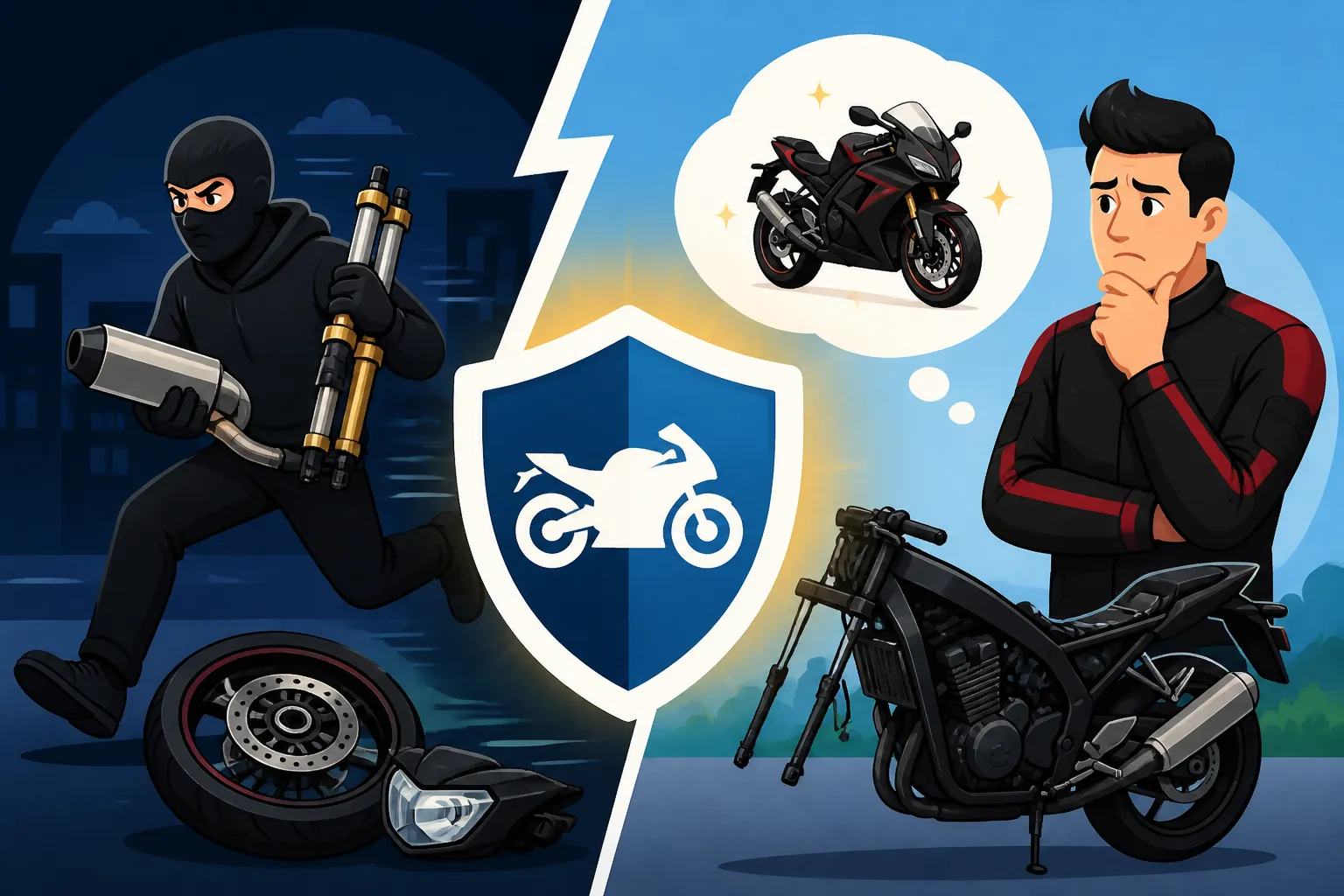
Few things sting quite like walking out to your motorcycle, ready for an exhilarating ride, only to find that some lowlife has stripped it of its valuable parts. That gut-wrenching feeling of violation and loss is all too real, knowing someone intruded on your property and damaged your prized possession just for a quick buck. This comprehensive guide is here to help you navigate that frustrating situation, outlining the crucial steps you need to take when motorcycle parts are stolen, how your insurance can help, and practical ways to prevent it from happening again.
Immediate Steps After Discovering Missing Motorcycle Parts
Discovering that parts have been stolen from your motorcycle is a shocking moment, often leaving you feeling helpless and angry. However, acting quickly and methodically can significantly improve your chances of recovery and a smooth insurance claim process. Don't panic; take a deep breath and follow these steps.
Prioritize Safety and Assess the Scene
Before you do anything else, take a moment to ensure your immediate surroundings are safe. If the theft just occurred, or if you suspect the thieves might still be nearby, avoid confronting anyone and prioritize your personal safety. Once you've established it's safe, carefully examine your motorcycle. What exactly is missing? Is it just the mirrors, the exhaust, the battery, or something more significant like the wheels or a custom fairing? Make mental notes (or better yet, physical notes) of every missing item and any damage caused during the theft. Did they cut wires? Break locks? Scratch the paint? This initial assessment is critical for the police report and your insurance claim.
Document Everything with Photos and Videos
In the age of smartphones, this step is non-negotiable. Pull out your phone and start taking pictures and videos from every conceivable angle. Get close-ups of the areas where parts were removed, showing cut wires, pry marks, or missing bolts. Take wider shots of the entire bike, showing its location relative to its surroundings. If there's any debris left behind by the thieves, photograph that too, but try not to touch or disturb it just yet. The more visual evidence you have, the stronger your case will be with both law enforcement and your insurance provider. Think of it as building your personal crime scene file. This documentation is vital to proving your claim, especially if you have valuable Accessories & Custom Parts Coverage Explained.
File a Police Report Immediately
Once you’ve documented the scene, the very next call should be to your local law enforcement agency. Explain clearly that parts have been stolen from your motorcycle. They will likely send an officer out to take a report or instruct you to come to the station to file one. Provide them with all the details you've gathered: a list of stolen parts, descriptions of any damage, photos, videos, and the exact location and estimated time of the theft. Get a copy of the police report or at least the report number. This official document is an absolute requirement for almost all insurance claims involving theft, even for just parts. Without it, your insurer will have a tough time processing your claim.
Understanding Your Motorcycle Insurance Coverage for Theft
It’s easy to assume that if something is stolen from your motorcycle, your insurance will automatically cover it. While this is often true, the specific type of coverage you have makes all the difference when it comes to stolen parts. It's not a one-size-fits-all situation, and understanding your policy is key to knowing what to expect.
Comprehensive Coverage: Your Best Friend Against Theft
When it comes to theft – whether it's the entire bike or just its components – comprehensive coverage is the policy feature you want in your corner. Unlike liability coverage, which only pays for damages you cause to others, comprehensive insurance protects your motorcycle from non-collision incidents. This typically includes theft, vandalism, fire, natural disasters, and even hitting an animal. If you have comprehensive coverage, your policy should cover the cost of replacing the stolen parts, minus your deductible, up to your policy's limits.
However, there's a crucial detail: standard comprehensive policies often have limits on coverage for custom parts and accessories. If you've invested heavily in aftermarket exhausts, upgraded wheels, custom paint, or a high-end GPS system, your basic comprehensive coverage might not cover their full replacement value. This is where specialized endorsements come into play. Many riders learn about this the hard way after a theft. Companies like Progressive, for example, offer robust comprehensive coverage and often have options for adding specific coverage for custom parts. If you're wondering, Does Motorcycle Insurance Cover Theft? then comprehensive coverage is your answer.
The Nuances of Accessories and Custom Parts Coverage
If you have a stock bike, standard comprehensive should do the trick for stolen OEM parts. But for those of us who customize our rides, regular comprehensive coverage often falls short. Imagine a scenario where a thief makes off with your high-dollar Vance & Hines exhaust system, or your custom-painted fairing. Without specific accessories and custom parts coverage, your insurer might only pay a small, pre-set amount for those items – often as low as $500 to $3,000, depending on the insurer and state.
This dedicated coverage is usually an add-on or endorsement to your comprehensive policy. It allows you to specify a higher coverage limit for your aftermarket parts, ensuring that your investment is protected. When you add new accessories, it’s a smart move to update your policy to reflect their value. You can check with agents or use comparison tools like The Zebra to see which insurers offer the best rates and coverage options for custom parts. This way, if someone steals your custom Does Motorcycle Insurance Cover Aftermarket Exhaust/Mods? or other valuable additions, you're not left footing the entire bill.
What Liability-Only Insurance Means for Stolen Parts
If you only carry liability insurance, I have to be blunt: you're likely out of luck. What Is Liability Coverage on a Motorcycle? is designed to protect other people and their property if you're at fault in an accident. It does not cover damage to your own motorcycle, nor does it cover theft of your bike or its parts. Many riders opt for liability-only coverage to keep their premiums low, especially on older or less valuable bikes. While it's a cost-saving measure, it leaves you financially vulnerable to incidents like theft, fire, or vandalism. In such cases, the full burden of replacing your stolen parts and repairing any damage will fall squarely on your shoulders. It’s a tough pill to swallow, but it’s a direct consequence of choosing minimum coverage.
Navigating the Motorcycle Parts Theft Claim Process
Once you've dealt with the immediate aftermath and understood your coverage, the next significant step is filing an insurance claim. This process can sometimes feel daunting, but knowing what to expect can ease the stress and ensure you get the compensation you deserve.
Contacting Your Insurance Provider
As soon as you have your police report number, it's time to call your insurance company. Don't delay; the sooner you report the theft, the better. You can usually start the process online, through a mobile app, or by calling their claims department directly. Be prepared to provide:
- Your policy number.
- The police report number and the contact information for the reporting officer/department.
- A detailed list of the stolen parts and any damage incurred.
- Your photographic and video evidence.
- An estimate of the value of the stolen items (if you have receipts, even better).
During this initial contact, your insurer will open a claim and assign a claims adjuster to your case. This individual will be your primary point of contact moving forward.
Working with the Claims Adjuster
The claims adjuster's job is to investigate your claim, determine coverage, and ultimately approve a settlement amount. They will review the police report, your submitted documentation, and may even want to inspect your motorcycle themselves. Be cooperative and provide all requested information promptly. If you have receipts for the stolen custom parts or accessories, definitely provide them. This helps establish the true value of your lost items. If you don't have receipts, provide as much detail as possible: brand names, model numbers, where you purchased them, and even screenshots of online listings if you can find them.
The adjuster will assess the Actual Cash Value (ACV) of the stolen parts, which means the replacement cost minus depreciation. For custom parts, if you have specific "stated value" or "agreed value" coverage, the payout will be based on those pre-determined amounts, which is usually better than ACV. Be prepared to negotiate if their initial offer seems too low, especially for unique or vintage parts. This is where your detailed documentation really pays off. For more details on the process, read our guide on How to File a Motorcycle Insurance Claim.
Receiving Your Settlement and Repairs
Once the adjuster has completed their investigation and you've agreed on a settlement amount, your insurance company will issue a payment. This payment will typically be for the agreed-upon value of the stolen parts, minus your deductible. For example, if $2,000 worth of parts were stolen and your comprehensive deductible is $500, you would receive $1,500.
You then use this money to purchase replacement parts and cover any necessary repair costs to get your bike back in riding condition. You might choose to buy new OEM parts, aftermarket replacements, or even use the opportunity to upgrade. Remember, the goal of insurance is to make you whole again, restoring your motorcycle to its pre-theft condition as much as possible.
| Coverage Type | What It Primarily Covers | Does It Cover Stolen Parts? | Key Limitation |
|---|---|---|---|
| Liability | Damages/injuries you cause to others | No | Does not protect your own motorcycle |
| Comprehensive | Damage from non-collision events (theft, fire, etc.) | Yes (for OEM parts) | Limited coverage for custom/aftermarket parts |
| Accessories/Custom Parts | Aftermarket additions, custom paint, upgrades | Yes (up to specified limits) | Usually an add-on, not standard |
Preventing Future Motorcycle Parts Theft
The best defense against parts theft is prevention. While you can't eliminate all risk, there are many proactive steps you can take to make your motorcycle a much less appealing target for thieves.
Enhance Your Motorcycle's Physical Security
Thieves are opportunistic and often go for the easiest targets. Making your bike harder to tamper with is the first line of defense. Start with robust physical deterrents. A heavy-duty disc lock on the front brake rotor, perhaps with an alarm, can prevent roll-away theft and deter casual thieves. A strong chain lock securing your bike to an immovable object, like a lamppost or ground anchor, is even better. Consider a handlebar lock or a grip lock to immobilize the throttle and brake. For quick-release parts like batteries or seats, you might explore tamper-proof screws or locks.
Even simple steps like removing your ignition key (it sounds obvious, but you'd be surprised!) and ensuring all compartments are locked can make a difference. Some riders go a step further with locking nuts on wheels and alarms with motion sensors. The more layers of security a thief has to bypass, the more likely they are to move on to an easier target.
Smart Parking and Storage Habits
Where you park your motorcycle can dramatically affect its vulnerability. Whenever possible, park in well-lit, high-traffic areas, or ideally, in a locked garage. If you live in an apartment complex, try to park near a security camera or in a spot visible from your window. Avoid secluded alleys or dark corners, which offer thieves privacy and time. When traveling, choose hotels with secure parking, or at least park in a well-trafficked, visible area.
For long-term storage, especially during off-season, an enclosed, locked garage is paramount. Consider disconnecting the battery and using a good quality cover. For those in shared garages, additional security measures like a ground anchor or even a storage unit might be worthwhile. Remember, a motorcycle in plain sight and difficult to move is less likely to be targeted. You might also want to read about Do You Need Insurance to Store a Motorcycle? for longer periods.
Utilize Tracking Devices and Marking Parts
Technology offers another layer of protection. GPS trackers can be discreetly installed on your motorcycle, allowing you to locate it if it's stolen. Many modern bikes come with some form of anti-theft system, but aftermarket trackers offer additional peace of mind. Some even notify you if your bike is moved or tampered with. Companies like LoJack (though less common for motorcycles than cars) and various app-based GPS trackers offer these services.
Beyond tracking, consider marking your valuable parts. Etching your VIN or a unique identifier onto parts like the exhaust, wheels, or custom components can make them less attractive to thieves who plan to resell them. It also makes it easier for law enforcement to identify your property if it's recovered. Some parts, particularly those that are easily removed and valuable, are highly sought after by thieves for resale on the black market. Making them identifiable creates a clear disincentive. You can also explore options like Motorcycle Insurance Requirements by State (2026 Guide) to see if anti-theft devices qualify you for discounts, which some insurers like Progressive or State Farm offer.
Insurance Discounts for Anti-Theft Measures
Don't forget to leverage your security efforts for potential savings on your motorcycle insurance. Many insurance providers, including large ones like Progressive and GEICO, offer discounts for approved anti-theft devices. This could include factory-installed alarms, aftermarket alarms, or GPS tracking systems. When you're comparing policies, perhaps through a platform like The Zebra, always ask about these discounts. Not only do these measures protect your bike, but they can also help lower your annual premium, making the investment in security pay off in more ways than one.
Dealing with stolen motorcycle parts is a real headache, but by taking immediate action, understanding your insurance, and proactively boosting your bike's security, you can minimize the damage and ride with greater peace of mind.
Disclaimer
Please remember that this information is intended for general guidance only and does not constitute professional insurance advice. Insurance policies vary widely by provider, state, and individual circumstances. Always consult with a qualified insurance agent or review your specific policy documents to understand your coverage, exclusions, and deductibles. Laws and regulations regarding motorcycle insurance can change, so staying informed with your provider is crucial.