Do I Need Gap Insurance if I Financed My Motorcycle?
It's a sinking feeling, isn't it? You've just ridden home on your dream machine, maybe a shiny new Harley-Davidson or a sleek Kawasaki, and the excitement is palpable. But then, a quiet dread starts to creep in: what if something happens? More specifically, what if your financed motorcycle is totaled or stolen, and your insurance payout doesn't even cover what you still owe? This guide is here to shed light on that exact worry and help you understand if gap insurance is the crucial safety net you need.
Understanding the Financial Gap in Motorcycle Ownership
When you finance a motorcycle, especially a brand-new one, you're essentially borrowing money to cover its purchase price. Traditional motorcycle insurance policies typically pay out based on the bike's "actual cash value" (ACV) at the time of a total loss. The problem is, motorcycles, much like cars, start losing value the moment they leave the dealership lot. This creates a potential financial chasm between what your bike is worth and what you still owe your lender, which is precisely what gap insurance is designed to cover.
Actual Cash Value ACV vs. Loan Balance
Let's break down the core of this problem. Actual Cash Value, or ACV, is what your motorcycle was worth just before it was damaged beyond repair or stolen. It’s not what you paid for it, and it’s certainly not what you think it’s worth. Insurance companies determine ACV by factoring in depreciation, mileage, wear and tear, and market conditions. They'll look at comparable bikes sold recently in your area, like on online marketplaces or at local dealerships, to arrive at a fair market value.
Now, contrast that with your loan balance. When you first buy a motorcycle, particularly with a small down payment or no down payment at all, your loan balance often starts out higher than the bike's ACV almost immediately. Think about it: a brand new Suzuki GSX-R1000 might cost you $16,000. You put down $1,000 and finance $15,000. If you get into an accident a month later and the bike is totaled, your insurance company might say its ACV is now $13,500 due to rapid initial depreciation. You still owe $14,800 on your loan (after some interest accrued). That's a $1,300 gap right there that you'd be personally responsible for, even though you no longer have a motorcycle to ride. This situation is exactly why many riders look into coverage options like Gap Insurance. You can learn more about this by checking out our guide on Agreed Value vs Stated Value vs Actual Cash Value.
The Depreciation Dilemma
Motorcycles, especially new models and certain types like sport bikes, can depreciate quite rapidly in their first few years. This quick drop in value exacerbates the gap problem. Imagine you financed a new Honda Rebel 500 with a small down payment and a five-year loan term. For the first year or two, the amount you owe on the loan might actually be more than what the bike is worth on the open market. This is a common scenario known as being "upside down" or "underwater" on your loan.
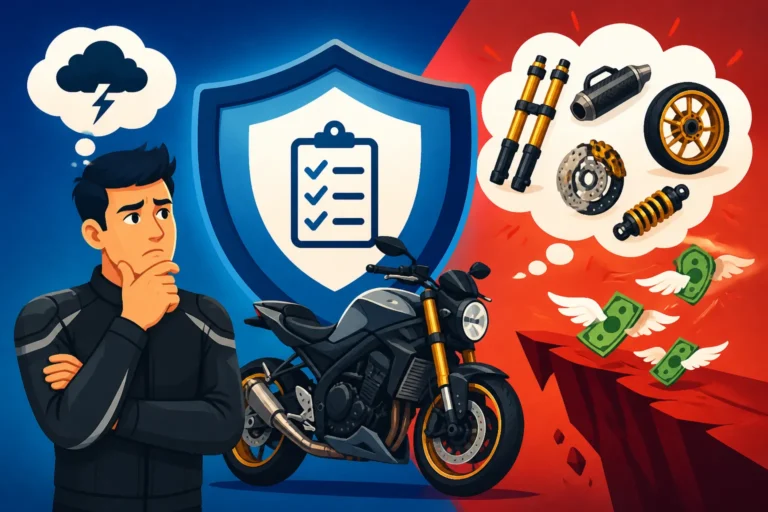
This depreciation isn't just an abstract concept; it has real financial consequences. If your fully financed bike is totaled early in your loan term, your standard comprehensive or collision coverage will only pay out its depreciated value. This could leave you owing thousands of dollars to the lender for a motorcycle you no longer possess. It’s a bitter pill to swallow to be making payments on something that no longer exists, and this is the fundamental frustration that gap insurance aims to resolve.
How Motorcycle Gap Insurance Works
Motorcycle gap insurance isn't a standalone policy you buy completely separate from your main coverage. Instead, it's typically an add-on or endorsement to your existing comprehensive and collision policy. It acts as a bridge, filling the monetary "gap" between your motorcycle's actual cash value (ACV) and the outstanding balance of your loan or lease in the event of a total loss.
When Gap Insurance Kicks In
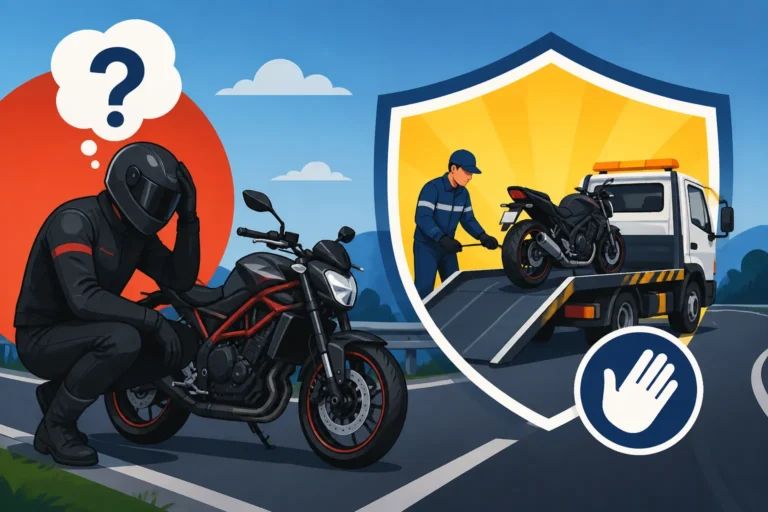
Gap insurance is specifically designed for scenarios where your motorcycle is deemed a "total loss." What exactly constitutes a total loss? Generally, it means your bike is either stolen and not recovered, or it's damaged so severely in an accident that the cost of repairs exceeds a certain percentage of its actual cash value – usually 70-80% depending on your state and insurer. If your motorcycle is involved in a serious collision, or if you return to find your garage empty, that's when gap insurance becomes incredibly relevant. Our article on What Happens When Your Motorcycle Is Totaled offers more detailed information on this topic.
For example, let's say your custom Harley-Davidson Road Glide, which you still owe $22,000 on, is stolen. Your insurance company investigates, confirms the theft, and determines the bike's ACV was $19,000. Without gap insurance, you'd get $19,000 from your insurer, but you'd still be on the hook for the remaining $3,000 to your lender. With gap insurance, it would cover that $3,000 difference, effectively wiping out your loan balance so you can move on without financial burden.
The Payout Process
When a total loss occurs and you have gap insurance, the process typically unfolds like this:
- File a Claim: First, you'll file a claim with your primary motorcycle insurance provider. You'll go through the standard procedure for comprehensive or collision claims, providing details about the incident. You can read more about how to do this in our guide on How to File a Motorcycle Insurance Claim.
- ACV Determination: Your insurer will assess the damage or loss and determine the actual cash value (ACV) of your motorcycle. This is the amount they will pay out under your standard policy.
- Lender Payout: The ACV payout is usually sent directly to your lender to pay down your loan.
- Gap Calculation: If the ACV payout is less than your outstanding loan balance, the "gap" is identified.
- Gap Insurance Kicks In: Your gap insurance policy then steps in to cover the remaining difference, also typically sending this payment directly to your lender.
The goal is that once both payments are made, your loan balance will be zeroed out. This means you won't be left making payments on a bike that's no longer yours. It's a huge relief for many riders, especially those who invested heavily in their motorcycles and don't want to carry a financial ghost long after their bike is gone.
Do YOU Need Gap Insurance for Your Financed Motorcycle?
The short answer is: it depends heavily on your personal financial situation and the specifics of your motorcycle loan. While it’s not always strictly required by law, many lenders will strongly recommend it, and some might even mandate it, especially if you have a low credit score or a high loan-to-value ratio. This coverage becomes more or less critical based on several factors unique to your purchase.
Situations Where Gap Insurance is a Smart Move
You might find gap insurance to be a truly invaluable asset if any of these situations describe your financed motorcycle purchase:
- You made a small down payment (or no down payment): The less money you put down upfront, the larger the initial gap between your loan balance and the bike's ACV. This is perhaps the biggest indicator that gap insurance could save you from significant out-of-pocket costs.
- You financed for a long term (e.g., 60 months or more): Longer loan terms mean you'll pay more interest over time, and your equity in the bike builds up slower. This prolongs the period where you're "underwater" on your loan, making gap coverage more relevant for a longer duration.
- You have a high loan-to-value (LTV) ratio: This happens when the amount you borrowed is very close to or exceeds the original price of the motorcycle, often due to rolling negative equity from a previous loan into the new one, or including additional costs like warranties and taxes in the financing.
- You purchased a brand-new motorcycle: New bikes experience the steepest depreciation in their first year or two. This rapid loss of value often outpaces the rate at which you pay down your loan, widening the potential gap.
- You bought a sport bike or high-performance motorcycle: These bikes often have higher initial price tags and can be more susceptible to rapid depreciation or total loss scenarios due to their performance characteristics, though this isn't a universal rule.
- You live in an area with high theft rates: If your bike is more likely to be stolen, and thus a total loss, gap insurance provides peace of mind that you won't be paying for a ghost.
Consider a rider in Phoenix, Arizona, who buys a new Kawasaki Ninja 650 with zero down and a 72-month loan. That bike will depreciate significantly in the first few years. If it's totaled after six months, the rider could easily owe several thousand dollars more than the insurance payout. For this rider, gap insurance would be a wise investment.
When You Might Be Able to Skip It
While gap insurance offers a fantastic safety net for many, it's not universally necessary for every financed motorcycle. Here are situations where you might find that you can comfortably pass on the extra coverage:
- You made a substantial down payment: If you put down a significant percentage of the bike's purchase price (say, 20% or more), you might start with little to no gap between the ACV and your loan balance. Your equity could keep pace with or even exceed depreciation.
- You have a short loan term: If you've financed your motorcycle over a short period (e.g., 24 or 36 months), you'll pay down the principal much faster, quickly closing any initial gap and potentially building equity sooner.
- You bought a used motorcycle at a good price: Used bikes have already experienced their steepest depreciation. If you bought a pre-owned bike for a fair market value, it's less likely to depreciate dramatically during your loan term, and you might start with less of a gap to begin with.
- Your loan balance is already less than the bike's ACV: If you're several years into your loan and have been making consistent payments, or if you initially financed a very small amount, the current market value of your bike might already be higher than your remaining loan balance. In this scenario, gap insurance wouldn't provide any benefit. You can always check your loan balance and compare it to current market values on sites like Kelley Blue Book or NADAguides.
For example, a rider in Portland, Oregon, who bought a three-year-old BMW R 1250 GS, put 30% down, and has a 36-month loan term, might find that their equity in the bike remains consistently higher than their loan balance. In this case, adding gap insurance might be an unnecessary expense, as the "gap" is unlikely to materialize. It's all about assessing your personal financial exposure.
Where to Get Gap Insurance and Important Considerations
Once you've determined that gap insurance is a smart choice for your financed motorcycle, the next step is figuring out where to get it and what details to pay attention to. It's not a one-size-fits-all product, and understanding your options can save you money and ensure you get the right protection.
Dealership vs. Insurance Provider Options
You generally have two main avenues for purchasing gap insurance, and each comes with its own set of pros and cons:
- Through the Dealership: When you're signing all the paperwork for your new or used motorcycle, the finance department will often offer gap insurance as an add-on. The convenience here is undeniable – it's a one-stop shop, and the cost can be rolled directly into your loan. However, this convenience often comes at a higher price. Dealer-offered gap insurance can sometimes be more expensive than what you'd find elsewhere, and because it's added to your loan, you'll also be paying interest on the gap insurance itself for the entire loan term. Plus, if you pay off your loan early or sell the bike, you might have to jump through hoops to get a pro-rated refund.
- Through Your Insurance Company: Most major motorcycle insurance carriers, like Progressive, Geico, or Dairyland, offer gap coverage as an endorsement to your existing comprehensive and collision policy. This is often the more cost-effective option. The premium for gap insurance is typically added to your regular monthly or annual insurance bill, so you're not paying interest on it. It also simplifies things if you ever need to make a claim, as everything is handled by one company. Shopping around is key here; using comparison sites like The Zebra can help you quickly compare quotes from multiple providers to see who offers the best rate for gap coverage in your area, alongside your other necessary coverages. You can also compare different Types of Motorcycle Insurance Coverage Explained to ensure you have a truly robust policy.
| Feature | Dealership-Offered Gap Insurance | Insurance Company-Offered Gap Insurance |
|---|---|---|
| Cost | Often higher; rolled into loan (pay interest on it) | Typically lower; added to insurance premium (no extra interest) |
| Convenience | One-stop shop at time of purchase | Requires separate contact with insurer |
| Term | Usually for the full loan term | Annual or policy term; can be removed when no longer needed |
| Refunds | Can be complicated if loan is paid early or bike is sold | Generally simpler to cancel and receive pro-rated refund |
| Provider | Third-party administrators, sometimes associated with lender | Your existing motorcycle insurance carrier |
| Transparency | May be less transparent on actual cost vs. loan interest | Clear premium visible on policy declaration page |
| Integration | Separate contract from insurance | Integrated as an endorsement on your primary policy |
Reading the Fine Print
No matter where you choose to get your gap insurance, it's absolutely crucial to read the policy's fine print. Not all gap insurance policies are created equal, and there can be important differences in what they cover, their limits, and any exclusions.
- Coverage Limits: Some policies have a cap on how much they will pay beyond your bike's ACV. For instance, a policy might state it will cover up to 125% of the ACV or a maximum of $10,000. Make sure this limit is sufficient to cover your potential gap.
- Deductibles: Your primary comprehensive or collision policy will have a deductible (e.g., $500 or $1,000) that you have to pay before your insurer pays out. Most gap policies will cover this deductible as part of the total gap, but some might not. Clarify this.
- Exclusions: Be aware of what your gap insurance won't cover. Common exclusions include: extended warranties, credit life insurance, past-due payments, penalties, or financial loss due to repossession. It only covers the actual depreciation gap on the vehicle itself.
- Loan Payoff vs. Total Loss: Ensure the policy explicitly states it covers the difference between ACV and loan balance in the event of a total loss.
- What it doesn't cover: Gap insurance is for a total loss scenario. It won't cover repairs if your bike isn't totaled, nor will it cover lost income if you can't ride, or medical bills. These are covered by other parts of your Motorcycle Insurance Requirements by State policy, like collision, comprehensive, or medical payments coverage.
Taking the time to understand these details will ensure that your gap insurance provides the peace of mind and financial protection you expect. It's a small investment that can prevent a huge financial headache down the road.
Disclaimer
This article is for general informational purposes only and does not constitute professional advice. Laws, prices and regulations vary by location and change over time. Consult a qualified professional for guidance on your specific situation.