What Happens if My Custom Parts Exceed Coverage Limits?
It's incredibly frustrating when you've poured countless hours, passion, and hard-earned cash into customizing your motorcycle, only to discover that your insurance might not actually cover the true value of those upgrades. Many riders assume their standard policy will protect their unique investments, but often, the reality hits hard after an incident. This comprehensive guide will walk you through what exactly happens when your custom parts exceed your motorcycle insurance coverage limits and, more importantly, how to ensure your pride and joy is fully protected.
Understanding Custom Parts Coverage on Your Motorcycle Policy
Let's be honest, for many of us, a motorcycle isn't just transportation; it's a canvas, a statement, an extension of our personality. From performance exhaust systems and custom paint jobs to upgraded suspension and bespoke seats, these modifications can significantly increase your bike's value. But while you see dollar signs and personal expression, your insurance company often starts with a baseline.
What Is "Custom Parts and Equipment" CPE Coverage?
Most standard motorcycle insurance policies include a small amount of coverage for Custom Parts and Equipment (CPE) or "Accessory Coverage" automatically. This is meant to cover minor additions like aftermarket grips, levers, or maybe some basic chrome. The initial amount is typically pretty low, often ranging from $1,000 to $3,000, and it's built right into your comprehensive and collision coverage. Think of it as a starter kit. If you have a brand-new Harley-Davidson Street Glide or a custom-built chopper, you can easily spend more than that on just one or two components, let alone the entire build.
This coverage is designed to protect items that weren't originally installed by the manufacturer but have become a permanent part of the bike. This can include everything from performance-enhancing upgrades like a new exhaust system or engine tuning, to aesthetic changes like custom paint, pinstriping, specialty wheels, or even comfort features like heated grips and upgraded navigation systems. The key here is to realize that this initial, often minimal, coverage is rarely enough for a truly customized machine. For a more detailed look, check out our guide on Accessories & Custom Parts Coverage Explained.
Common Misconceptions About Standard Policies
One of the biggest pitfalls riders face is assuming their standard policy covers everything they've added. It's easy to think, "I have full coverage, so I'm good." However, "full coverage" typically refers to the combination of liability, collision, and comprehensive coverage for the stock value of your motorcycle, not necessarily its custom modifications. The value of your stock bike is often determined by its Actual Cash Value (ACV), which means its replacement cost minus depreciation. Your custom parts, on the other hand, are often treated separately.
Many riders are shocked to find out after an accident that their policy only covered a fraction of their custom exhaust system, let alone their bespoke paint job or upgraded suspension. This misunderstanding often stems from a lack of clarity during the policy purchase or a failure to update the policy as customizations are added. Your insurer doesn't automatically know you just dropped $5,000 on a new fairing and performance tuner. It’s up to you, the rider, to declare these investments and ensure they are adequately covered. Without specific add-on coverage for your custom parts, you're essentially self-insuring those expensive modifications.
The Harsh Reality: When Your Custom Parts Exceed Limits
This is where the rubber meets the road, or more accurately, where your wallet meets a hard dose of reality after an accident or theft. The excitement of customization can quickly turn into regret if you haven't secured the right insurance.
The Out-of-Pocket Shock After a Claim
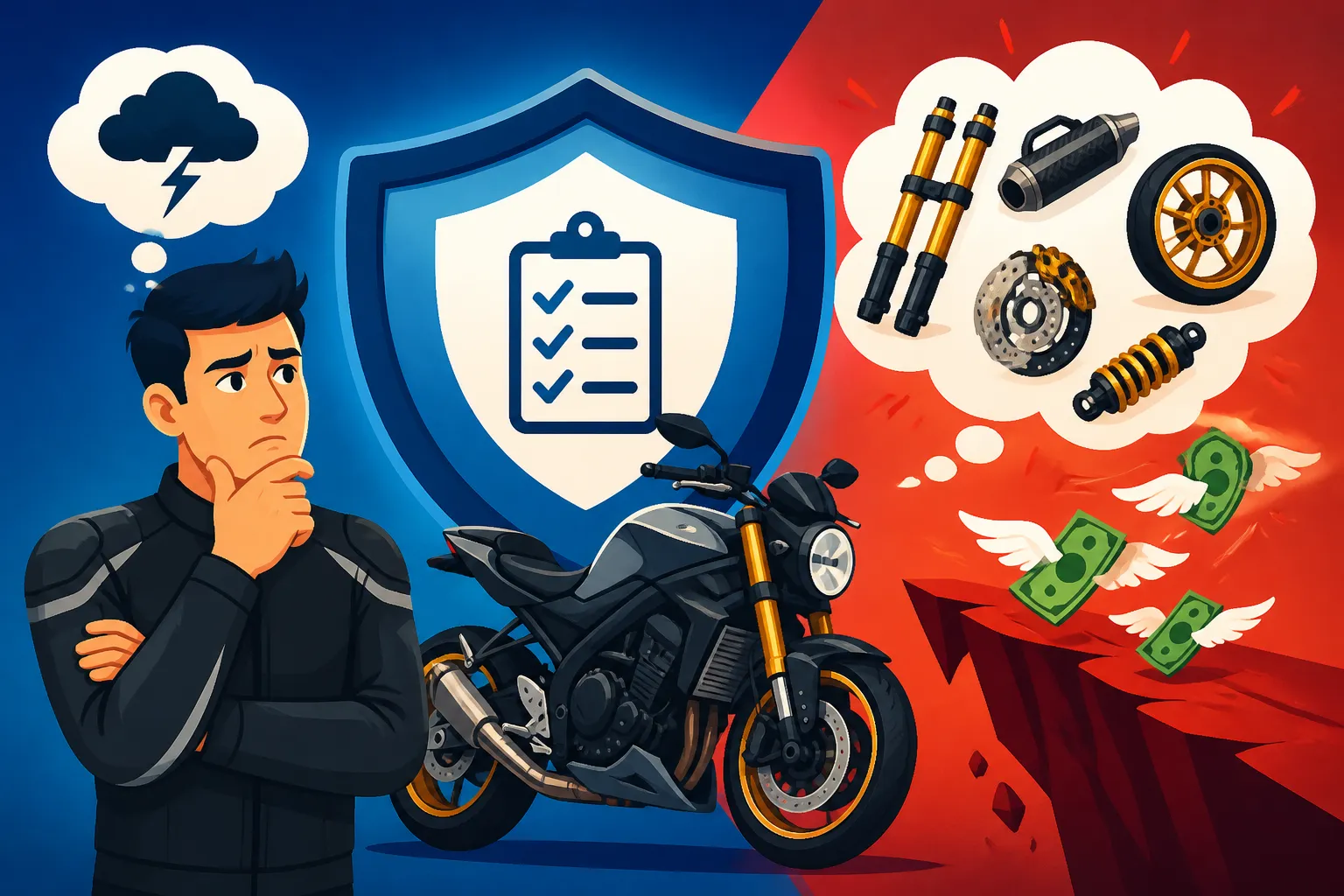
Imagine this: You've spent two years transforming your Kawasaki Ninja into a track-ready street machine. You've invested $15,000 in performance upgrades, carbon fiber fairings, and a fully adjustable suspension. You opted for "full coverage" on your policy, which included the standard $2,500 for custom parts. One unfortunate day, you hit some gravel, lay the bike down, and it's a total loss. When the insurance adjuster comes calling, they value your stock bike at $8,000 (after depreciation) and your custom parts at… $2,500.
You're left with a payout of $10,500, but your total investment was $8,000 (stock) + $15,000 (custom) = $23,000. That's a staggering $12,500 out of your pocket! This isn't just a hypothetical scenario; it's a common and devastating experience for many riders who didn't fully understand their custom parts coverage limits. The shock of realizing how much you've lost, simply because of an oversight in your insurance, is truly gut-wrenching. You poured your soul into that bike, and now a significant portion of that investment is gone. Understanding What Happens When Your Motorcycle Is Totaled? becomes critical in these situations.
Impact on Total Loss Settlements
When your motorcycle is declared a total loss, the insurance company typically determines its Actual Cash Value (ACV). This is the value of your bike just before the incident, taking into account depreciation. However, for custom parts, the situation is different. If your policy has a $5,000 limit for custom parts and you only declared $5,000, that's what you'll get, even if you spent $10,000. The total settlement will be the ACV of your base bike plus your declared custom parts coverage, up to its limit.
The issue isn't just the uncovered custom parts; it's how their underinsurance can depress the overall perception of your bike's value. An insurer might be less inclined to dispute a total loss if the declared value (including custom parts) is relatively low, even if the actual custom value pushed it far higher. You might feel like you're fighting an uphill battle to prove the true worth of your cherished ride, especially when facing an offer that feels insultingly low. For guidance on how to prove the true value of your motorcycle, consider reviewing our article on How to Prove Your Bike's Value in a Total Loss Claim.
Why Insurers Cap Custom Parts Coverage
Insurance companies are in the business of assessing and managing risk. When it comes to custom parts, they face several challenges:
- Valuation Difficulty: Unlike a stock motorcycle with a clear market value, custom parts are subjective. A hand-painted mural might be priceless to you but hard for an insurer to value objectively. They don't want to overpay for something with limited resale value on the open market.
- Depreciation: Custom parts, like any other part of a vehicle, can depreciate. However, some custom work might hold its value better or even increase it in certain niche markets. Insurers need a standardized way to account for this, which often means setting caps.
- Moral Hazard: Without limits, some individuals might be incentivized to overstate the value of custom work to receive a larger payout after a claim. Limits help mitigate this risk.
- Actuarial Data: Insurers base premiums on statistical data. Customizations are highly varied, making it harder to predict the likelihood and cost of claims involving them. Setting a cap simplifies their risk models.
This isn't to say insurers are trying to shortchange you intentionally, but they operate on a different set of financial principles. They need clear, definable limits to make their business viable, which means you need to be proactive in communicating your bike's true value.
How to Properly Insure Your Custom Motorcycle
Now that we've covered the potential pitfalls, let's talk about solutions. Properly insuring your custom motorcycle requires a proactive approach and a clear understanding of your options.
Increasing Your Custom Parts and Equipment Limits
The most straightforward way to protect your investment is to explicitly increase your CPE coverage. Most major insurers, like Progressive, Geico, Dairyland, and Markel, offer riders the option to purchase additional coverage for their custom parts and accessories. This is often an "add-on" or "endorsement" to your standard policy.
When you originally get a quote, whether online or through an agent, you'll be asked about any customizations. This is your opportunity to declare the approximate value of your upgrades. If you add more custom parts later, call your insurer immediately to update your policy. Don't wait until renewal, and certainly don't wait until after an incident. You can usually increase your limits in increments of $1,000, $5,000, or even more, depending on the insurer and the extent of your customizations. Be prepared to provide details and documentation, which brings us to our next point.
Agreed Value vs. Stated Value Policies
For significantly customized or vintage motorcycles, standard ACV policies might not cut it. This is where "Agreed Value" and "Stated Value" policies come into play. Understanding the difference is crucial:
- Agreed Value: This is often considered the gold standard for custom and classic bikes. With an agreed value policy, you and the insurance company agree on a specific value for your motorcycle before the policy is issued. If your bike is then declared a total loss, the insurer will pay you that agreed-upon amount (minus your deductible), regardless of its depreciated value. This is typically based on a professional appraisal of your bike and its custom work. It offers peace of mind, knowing exactly what you'll get.
- Stated Value: This one can be tricky and often misunderstood. While it sounds similar to agreed value, a stated value policy means you "state" the value of your bike, but the insurer reserves the right to pay out the stated value or the actual cash value (ACV) at the time of loss, whichever is less. This means if you stated your custom bike was worth $30,000, but the insurer assesses its ACV at $20,000 after an accident, you'll only receive $20,000. It's essentially a cap, not a guaranteed payout.
For serious custom builds, an agreed value policy is almost always the superior choice, as it eliminates the guesswork and protects your investment fully. You can delve deeper into this topic by reading Agreed Value vs Stated Value vs Actual Cash Value and also What Is Stated Value Motorcycle Insurance? (The Catch).
Here's a quick comparison:
| Feature | Agreed Value Policy | Stated Value Policy | Actual Cash Value (ACV) Policy |
|---|---|---|---|
| Value Determination | Insurer and owner agree on value upfront. | Owner states value, but insurer verifies at claim. | Market value minus depreciation at time of loss. |
| Payout Guarantee | Guaranteed payout of agreed amount (minus deductible). | Payout is up to stated value or ACV, whichever is less. | Payout is ACV at the time of loss. |
| Best For | Highly customized, classic, or collector bikes. | Bikes where ACV might be harder to determine, but still a risk. | Most standard, mass-produced motorcycles. |
| Premium | Generally higher, reflecting guaranteed payout. | Can be slightly lower than agreed value, but with payout risk. | Varies, often lower for older, depreciating bikes. |
| Documentation Needed | Often requires appraisal. | May require initial documentation, but appraisal less common. | Standard valuation methods. |
Documenting Your Customizations
This step cannot be stressed enough. Without proper documentation, proving the value of your custom parts to an insurance adjuster can be incredibly difficult, if not impossible. Think of it as building a portfolio for your motorcycle.
Here's what you should keep:
- Detailed Receipts: Save every single receipt for parts purchased and labor performed. This includes online orders, invoices from custom shops, and even personal records if you did the work yourself (though professional invoices carry more weight).
- High-Quality Photos: Take clear, comprehensive photos of your motorcycle before any customizations, then after each significant modification, and finally, of the completed build. Get close-ups of specific custom parts. These photos serve as undeniable proof of what was on the bike.
- Appraisals: For truly unique or high-value custom bikes, consider getting a professional appraisal from a reputable motorcycle appraiser. This expert valuation provides an impartial, documented assessment of your bike's worth, including all custom work.
- Build Sheets/Descriptions: Create a detailed list of all modifications, including brand names, model numbers, installation dates, and costs.
- Before-and-After Comparisons: A side-by-side comparison (even if just text descriptions) of the stock component vs. the custom upgrade can be very persuasive.
Store these documents digitally (cloud storage, external hard drive) and keep physical copies in a safe place. If your bike is stolen or totaled, having this evidence readily available will streamline your claim process and significantly increase your chances of a fair payout. For steps on how to file a claim, review How to File a Motorcycle Insurance Claim.
Practical Steps to Update and Maintain Your Coverage
Getting the right coverage initially is a great start, but maintaining it is an ongoing process, especially if you continue to customize your ride.
Regularly Reviewing and Updating Your Policy
Your motorcycle is a living, evolving machine, and your insurance policy should reflect that. Don't just set it and forget it. Make it a habit to review your policy at least once a year, or whenever you make significant changes to your bike.
- Annual Check-up: When your policy renewal comes around, don't just blindly pay the bill. Take 15-30 minutes to review your coverage limits, especially your custom parts and equipment coverage. Have you added anything new? Has the value of your existing customs gone up (e.g., if you've done more work on a specific part)?
- After Every Major Mod: As mentioned earlier, if you install a new exhaust, upgrade your engine, or get a custom paint job, contact your insurer right away. It's often easier to add coverage as you go rather than trying to retroactively account for years of modifications.
- Life Changes: Did you move to a new area? Did your riding habits change? These factors can also influence your policy, and while not directly related to custom parts, they're good opportunities to review everything.
Staying on top of your policy ensures that your coverage accurately reflects your investment, preventing any unpleasant surprises down the road.
Working with an Agent Who Understands Custom Bikes
While it's easy to get an online quote, for highly customized motorcycles, working with a knowledgeable insurance agent can be invaluable. A good agent specializing in motorcycle insurance will understand the nuances of custom bikes and can guide you through the process of obtaining adequate coverage. They can help you:
- Identify Appropriate Coverage: They'll know which companies offer the best custom parts coverage, whether an agreed value policy is right for you, and what specific endorsements you might need.
- Navigate Valuation: An experienced agent can advise you on whether an appraisal is necessary and help you understand how different insurers value custom work.
- Advocate on Your Behalf: Should you ever need to file a claim, a good agent can act as your advocate, helping you present your case effectively to the claims department.
Don't hesitate to ask prospective agents about their experience with custom motorcycles. A generic agent might not fully grasp the unique value of your customized machine, potentially leading to inadequate advice. When it comes to something as personal and valuable as a custom bike, a specialist's insight is truly worth its weight in gold.
Comparing Options and Quotes
Even with a great agent, it always pays to shop around. Different insurance companies have different appetites for risk and different ways of valuing custom parts. What one insurer caps at $5,000 for custom parts, another might allow you to increase to $20,000 or offer a robust agreed-value option.
Utilize online comparison tools like The Zebra to get multiple motorcycle insurance quotes quickly and efficiently. This can give you a broad overview of what various companies are offering for your specific needs, including custom parts coverage. When you use a platform like The Zebra, you can often input details about your customizations, and it will help you find insurers that are a good fit. Don't just look at the premium; scrutinize the details of the custom parts coverage offered by each company. What are their limits? Do they offer agreed value? How do they require custom parts to be documented? Our guide on How to Compare Motorcycle Insurance Quotes provides further details on navigating this process.
Look at reputable insurers known for their motorcycle offerings, such as Progressive, Dairyland, and Markel. These companies often have more flexible options for customized bikes than those that primarily focus on auto insurance. By comparing several options, you ensure you're getting the best possible protection for your unique investment at a competitive price.
Disclaimer
This article is for general informational purposes only and does not constitute professional advice. Laws, prices and regulations vary by location and change over time. Consult a qualified professional for guidance on your specific situation.