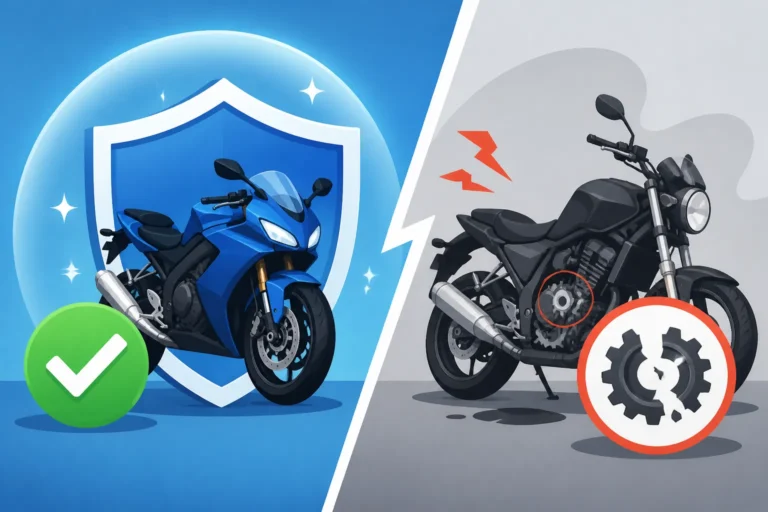
Agreed Value vs Stated Value vs Actual Cash Value
It's an unfortunate truth that many motorcycle riders only truly learn about the intricacies of their insurance policy after a total loss. Whether your cherished bike is stolen or totaled in an accident, the moment you get that settlement offer can be heartbreaking if it doesn't match what you believed your motorcycle was worth. This guide is here to cut through the jargon and explain three critical valuation methods – Actual Cash Value, Stated Value, and Agreed Value – so you can make informed decisions and protect your investment before disaster strikes.
Understanding Motorcycle Insurance Valuation Methods
When you hand over your hard-earned cash for an insurance policy, you’re essentially buying a promise: a promise that if something goes wrong, you’ll be made whole. But "made whole" can mean wildly different things depending on how your insurance company values your motorcycle. It's not just about getting "full coverage" – it's about how that full coverage calculates what your bike is truly worth when it's gone.
Why Your Bike's Value Matters to Your Policy
For most of us, a motorcycle isn't just a vehicle; it's a passion, a lifestyle, a mechanical extension of our very being. We pour time, money, and love into our rides, often customizing them to perfection. When you buy a car, it's generally a depreciating asset that serves a utilitarian purpose. With motorcycles, particularly custom builds, vintage beauties, or high-performance machines, the value isn't always so straightforward. This emotional attachment and the unique nature of many motorcycles are precisely why the valuation method in your policy is paramount. If your bike is stolen or deemed a total loss after an accident, the payout from your insurer is directly tied to this valuation method. Getting a settlement that's significantly less than what you believe your bike is worth can be a devastating financial blow, leaving you unable to replace your beloved machine or even pay off an outstanding loan.
The Core Challenge with Standard Valuation
The biggest frustration riders face is the disconnect between what their bike means to them and what an insurance company's algorithms say it's worth. Standard valuation methods, particularly the most common one, tend to treat motorcycles much like any other mass-produced vehicle, often overlooking the unique factors that contribute to a bike's true market value or sentimental worth. Imagine you've spent years meticulously restoring a classic Norton Commando, replacing parts, doing custom paint, and investing countless hours. A standard valuation method might only look at the base model's age and mileage, completely ignoring the craftsmanship and expense you've poured into it. This fundamental difference in perspective is what leads to so many difficult claim experiences and why understanding these terms upfront is absolutely vital.
Diving Deep into Actual Cash Value (ACV)
Actual Cash Value, or ACV, is the most common valuation method you'll encounter in motorcycle insurance. It's often the default unless you specifically opt for something different, and it's essential to understand exactly what it means for your wallet.
What is Actual Cash Value (ACV)?
In simple terms, Actual Cash Value is what your motorcycle was worth immediately before it was damaged or stolen, taking into account depreciation. The formula insurers use is generally "replacement cost minus depreciation." So, if you bought a brand new bike for $15,000, but it gets totaled three years later, the insurer won't pay you $15,000. Instead, they'll determine what it would cost to buy a similar make, model, and year motorcycle on the open market at the time of the loss, and then subtract value for factors like its age, mileage, and overall condition or wear and tear.
Depreciation isn't just about age; it factors in a lot of variables. A bike ridden hard for many miles will depreciate faster than one lovingly stored and only taken out on sunny weekends. The current market demand for your specific make and model also plays a huge role. If your bike model is suddenly less popular, its ACV might drop faster. For example, if you have a five-year-old Kawasaki Ninja 650 with 25,000 miles on it, an insurer will look at recent sales of similar bikes in your area, note the condition and mileage, and then apply a depreciation calculation to arrive at the ACV. This means the payout can be a moving target, constantly changing throughout your policy term, often downwards.
The Pros and Cons for Riders
One of the most appealing aspects of ACV for many riders is that it generally translates to lower insurance premiums. Since the insurer's potential payout is tied to a depreciating asset, their risk is lower, and those savings often get passed on to you. It's also widely available and straightforward for most standard, non-customized bikes. If you're riding an older, common model, or a bike that you don't have a lot of custom work invested in, ACV can be a perfectly adequate and cost-effective solution.
However, the downsides can be significant, especially if you have a newer, highly customized, or well-maintained older bike. The biggest con is that the payout can be significantly less than what you paid for the bike, what you owe on it (if financed), or what you feel it's truly worth. Imagine buying a brand-new bike, financing it, and then totaling it within the first year. The rapid depreciation means the ACV payout might not even cover the remaining balance on your loan, leaving you "upside down" and still owing money on a bike you no longer have. This often leads to deep frustration, as riders feel undervalued and undercompensated, discovering too late that their policy didn't truly protect their investment.
When ACV Makes Sense and When It Doesn't
ACV is often the most sensible choice for riders with older, lower-value motorcycles that are mostly stock. If your bike is ten years old, has significant mileage, and you haven't put much money into customizations, its market value is likely well-established, and ACV will probably give you a fair representation of that value. In these cases, paying for a more expensive valuation method might not provide enough additional benefit to justify the cost.
On the flip side, ACV is rarely the best option for brand-new motorcycles, especially if they are financed. The steep depreciation in the first few years can quickly leave you underwater. It's also a poor fit for highly customized bikes where the value of aftermarket parts and labor far exceeds the base bike's ACV. Similarly, if you own a classic or vintage motorcycle whose market value is determined more by rarity, condition, and restoration effort than simple age, ACV simply won't capture its true worth. For these types of bikes, where the value is either highly individual or less subject to standard depreciation models, you'll want to explore options like Agreed Value vs Stated Value vs Actual Cash Value to ensure you're adequately protected.
Exploring Stated Value Coverage
Stated value coverage often appears to be a middle ground, offering a hint of control over your motorcycle's insured value. However, it comes with a significant caveat that many riders overlook, leading to widespread disappointment.
What is Stated Value?
With stated value coverage, you, the rider, declare a specific value for your motorcycle when you purchase the policy. Sounds great, right? You tell them your custom Harley-Davidson Road Glide is worth $35,000, and they put it on the policy. The crucial, often misunderstood part, is that the insurer agrees to pay up to that stated value, but they reserve the right to pay the actual cash value (ACV) or the cost to repair, whichever is less, at the time of a total loss. In essence, it sets an upper limit on the payout, but doesn't guarantee you'll receive that amount.
This means that even if your policy shows a $35,000 stated value, if your motorcycle is stolen or totaled, the insurance company will still conduct its own appraisal, calculating the ACV at that moment. If their appraisal determines the ACV is $25,000, they will likely only pay you $25,000, even though you were paying premiums based on a $35,000 stated value. The stated value acts more like a cap than a guarantee, allowing the insurer to never pay more than that amount, but still giving them the flexibility to pay less.
The Illusion of Control: Rider Expectations vs. Reality
This "up to" clause in stated value policies is where the biggest disconnect happens for riders. Many assume that by declaring a value, they've locked in that payout. They've paid higher premiums, sometimes significantly higher than for an ACV policy, believing they've secured a guaranteed sum for their unique bike. When a loss occurs, and the insurer presents a settlement offer based on the market's ACV, which is often much lower than the stated value, the rider is left feeling betrayed and misled.
Consider this common scenario: a rider purchases a used, but beautifully customized, Suzuki GSX-R. They get quotes, and one insurer offers "stated value" where they can declare their bike is worth $12,000, reflecting the custom paint and aftermarket exhaust. The premium is higher than a standard ACV policy, but the rider thinks it's worth it for the peace of mind. A year later, the bike is stolen. The insurance company investigates and finds that while the stated value was $12,000, the ACV for a similar, stock GSX-R of that year and mileage, even with some consideration for custom parts, is only $8,500. The rider receives $8,500, not $12,000, despite having paid for the higher stated value. This experience is incredibly frustrating and highlights the critical difference between what you believe you're insuring and what the insurer is actually promising to pay.
Best Use Cases and Pitfalls of Stated Value
Given its inherent limitations, stated value coverage isn't often the ideal choice for most riders. In truth, it's a bit of a niche product that often gets confused with agreed value, to the detriment of the policyholder. Sometimes, it's offered for bikes that are difficult to precisely value but don't quite fit the strict criteria for agreed value policies. For example, some custom bikes might have components that, individually, are very expensive, but the overall market for the complete bike might not support an agreed value. In these cases, a stated value might be offered as a compromise.
The pitfalls are numerous and can be quite costly. First, you're paying higher premiums for a value that isn't guaranteed. This means you're absorbing more risk without the corresponding benefit of a fixed payout. Second, it can lead to a false sense of security, causing riders to believe they are fully covered for their declared amount, only to face a rude awakening at claim time. Unless you thoroughly understand its limitations and your insurer has explicitly detailed how they will calculate the payout (and you're comfortable with that uncertainty), stated value can be a tricky proposition. It's often recommended to avoid stated value unless it's truly the only option available for a unique situation, and even then, proceeding with extreme caution and detailed clarification from your agent is key. For more reliable protection of your custom work, understanding What Is Stated Value Motorcycle Insurance? The Catch is crucial.
The Gold Standard: Agreed Value Coverage
For riders who cherish their unique, custom, or vintage motorcycles, Agreed Value coverage often feels like the holy grail. It offers a level of certainty and peace of mind that ACV and stated value simply cannot provide.
What is Agreed Value?
Agreed Value coverage is precisely what it sounds like: you and your insurance provider mutually agree upon a specific, fixed value for your motorcycle at the beginning of your policy period. This agreed-upon amount is the exact sum you will receive in the event of a total loss (theft, irreparable damage), regardless of market fluctuations, depreciation, or the bike's actual cash value at the time of the loss. This is the critical difference from stated value, where the payout can still revert to ACV. With agreed value, the figure is set in stone for the policy term.
To arrive at this agreed value, the insurer typically requires a more thorough process. You'll likely need to provide detailed documentation, including recent appraisals from certified specialists, receipts for custom parts and modifications, and high-quality photographs. The insurer might even send out an appraiser to personally inspect your bike. Once the value is established and both parties sign off on it, that's the number you can count on. It offers unparalleled peace of mind, knowing exactly what your payout will be should the worst happen. This is particularly valuable for unique motorcycles where market comparisons are difficult.
Unpacking the Benefits for Custom and Vintage Rides
The benefits of agreed value coverage are most pronounced for motorcycles that don't fit the standard mold. If you own a painstakingly restored vintage Triumph Bonneville, a highly customized Harley-Davidson chopper with thousands of dollars in aftermarket parts, or a rare collectible like a Vincent Black Shadow, ACV would be a disservice. A standard ACV policy would severely undervalue these machines, completely missing the true cost of restoration, unique components, or historical significance.
Agreed value ensures that all those custom modifications, paint jobs, engine upgrades, and rare parts are fully accounted for. It gives you a predictable payout, removing the anxiety of a fluctuating market value or the shock of a low ACV settlement. This guarantee means you can replace your unique bike with something comparable, or at least pay off its full value, without suffering a significant financial hit. For enthusiasts who pour their hearts and souls into their machines, agreed value isn't just an insurance option; it's a critical component of protecting their passion. It ensures that the value you see in your bike is the value your insurer recognizes too. Many policies, particularly those from specialized insurers like Markel or Hagerty (who aren't officially covered by this request, but good general knowledge), offer agreed value as their standard for classic and custom vehicles.
Considerations and Availability of Agreed Value
While agreed value offers incredible protection, it's not without its considerations. The most obvious is the cost: premiums for agreed value policies are generally higher than for ACV or even stated value coverage. This is because the insurer is taking on a greater, fixed risk. They're guaranteeing a specific payout, regardless of depreciation, so they price that certainty into your premium. However, for the right bike and the right rider, this higher cost is often a small price to pay for the guaranteed peace of mind and adequate compensation.
Not all insurance providers offer agreed value coverage, and those that do may have specific criteria. For instance, some may only offer it for bikes above a certain age (e.g., 20-30 years old for "classic" status), or for custom builds with extensive documentation of modifications. You might need to provide professional appraisals or detailed receipts for all custom work. It's crucial to be proactive in gathering this documentation and discussing it thoroughly with your agent. Always ensure your policy explicitly states "agreed value" and confirms the exact agreed amount. When considering options, especially for bikes with substantial upgrades, you'll also want to look into Accessories & Custom Parts Coverage Explained to make sure every last detail is covered.
Comparing the Valuation Methods: A Side-by-Side Look
Choosing the right valuation method for your motorcycle isn't a one-size-fits-all decision. It requires a clear understanding of how each method functions, particularly regarding payouts and premiums. Let's break down the key differences to help you decide.
Key Differences in Payout and Premiums
The most significant distinction among these three valuation methods lies in what you can expect to receive after a total loss and how that impacts your annual premiums.
With Actual Cash Value (ACV), your payout is the depreciated market value of your motorcycle at the time of the loss. This means the number can shrink over time, and you might receive less than you initially paid, owe on a loan, or expect. The upside is that ACV policies typically come with the lowest premiums because the insurer's risk is minimized by factoring in depreciation.
Stated Value policies present a declared maximum payout, but with a critical catch: the insurer will pay up to that amount, or the actual cash value, whichever is less. This means you're still largely at the mercy of the ACV at the time of the incident. You might pay moderate to high premiums for a stated value policy, believing you're getting a guaranteed higher payout, only to be disappointed when the ACV calculation takes precedence. It offers very little true financial security compared to its cost.
Agreed Value is the only method that guarantees a fixed payout. The amount is set at the policy's inception, and that's the figure you'll receive if your bike is totaled. This certainty comes at a price; agreed value policies generally have the highest premiums. However, for unique, vintage, or custom motorcycles, the peace of mind and assured replacement value often far outweigh the additional cost. The extra premium is essentially paying for a guarantee that your investment is fully protected.
Documentation and Appraisal Requirements
The level of documentation and appraisal required also varies significantly across these valuation methods.
For an Actual Cash Value (ACV) policy, you typically don't need to provide extensive documentation or get a special appraisal. The insurer relies on industry data, such as NADA guides, Kelley Blue Book, and local market sales, to determine your bike's value. You just provide basic information like make, model, year, and mileage.
With Stated Value, you, the policyholder, declare the value you wish to insure your motorcycle for. While the insurer might ask for some basic information or photographs, they often don't conduct a rigorous, upfront appraisal. This lack of initial scrutiny is part of why the payout is still subject to ACV at claim time; they're reserving the right to verify the actual market value later.
Agreed Value policies demand the most thorough documentation and often involve a formal appraisal process. You'll typically need to submit detailed receipts for any custom work, professional photographs showcasing the bike's condition and modifications, and potentially a recent appraisal from a certified motorcycle appraiser. The insurer may also send their own appraiser to confirm the vehicle's condition and unique features. This upfront effort ensures that both parties are in full agreement on the value before the policy is issued, which is the foundation of the guaranteed payout.
Here's a quick comparison table to help visualize these differences:
| Feature | Actual Cash Value (ACV) | Stated Value | Agreed Value |
|---|---|---|---|
| Definition | Replacement cost minus depreciation | Declared maximum, paid up to ACV at loss | Fixed value agreed upon at policy start |
| Payout at Loss | Market value at time of loss | Lesser of declared value or ACV | Full agreed value, regardless of ACV |
| Premium Cost | Generally lowest | Moderate to high | Highest |
| Best For | Standard, older, lower-value bikes | Niche cases, often misunderstood | Custom, vintage, rare, high-value new bikes |
| Documentation | Minimal from rider | Rider declares | Detailed receipts, photos, appraisal |
| Peace of Mind | Low (uncertain payout) | Low (false sense of security) | High (guaranteed payout) |
Choosing the Right Valuation for Your Ride
Making the right choice for your motorcycle's insurance valuation isn't just about saving a few bucks on your premium; it's about making sure your financial security and emotional investment are genuinely protected. It all starts with really looking at your bike.
Assessing Your Motorcycle's Unique Character
The first step in choosing the right valuation method is to honestly assess your motorcycle. Is it a mass-produced, off-the-lot model with no modifications? Or is it a custom build, a classic that's appreciating in value, or a high-performance machine with expensive upgrades? A standard Honda Rebel used for commuting will have very different insurance needs than a custom-built chopper with a handcrafted frame and unique engine modifications.
Think about what makes your bike special. Have you invested heavily in custom paint, chrome, engine work, or aftermarket accessories? Does it have historical significance, or is it a rare model that's hard to find parts for? These factors significantly impact its value beyond what a basic depreciation formula might suggest. For instance, if you have a motorcycle with a unique history or extensive customizations, its true value often won't be reflected by an ACV policy. Taking a cookie-cutter approach to your policy won't work if your bike is anything but standard. You need to consider all the Types of Motorcycle Insurance Coverage Explained to fully understand your options.
Balancing Cost and Peace of Mind
There's no denying that higher levels of coverage and more favorable valuation methods like Agreed Value come with higher premiums. This is the classic insurance trade-off: how much are you willing to pay upfront for peace of mind later? For some riders, especially those with older, less expensive bikes, the lower premiums of an ACV policy make perfect sense. They might be comfortable with the risk of a lower payout because the bike's replacement cost is manageable.
However, for a rider with a brand-new, financed sport bike or a meticulously restored vintage Harley, the potential financial hit from an ACV payout could be devastating. In these cases, the higher premium for an Agreed Value policy effectively buys you certainty. It ensures that if the worst happens, you won't be left underwater on a loan or unable to replace a truly unique machine. It's about weighing the cost of the premium against the potential loss and the value you place on that security. If you're looking to lower your overall expenses, there are many strategies to find How to Get Cheap Motorcycle Insurance, but never at the expense of adequate coverage.
Tips for Talking to Your Insurer
Navigating these options can feel daunting, but a good insurance agent should be able to walk you through it. When you're getting quotes or reviewing your existing policy, don't just ask for "full coverage." Instead, be specific about your valuation preference and ask detailed questions about how each option would affect your payout in a total loss scenario. For Agreed Value, come prepared with all your documentation: receipts, appraisals, and photos. The more information you provide, the smoother the process will be.
It's also a smart move to shop around and get quotes from multiple insurers, especially if you have a unique bike. Not all companies offer the same valuation options, and their pricing can vary significantly. Online tools and comparison sites like The Zebra can be incredibly helpful here, allowing you to quickly compare policies from various providers that might offer different valuation methods. This way, you can see if, for instance, Progressive offers a better agreed value option for your custom cruiser compared to Dairyland. Remember, this is your investment, and you deserve a policy that genuinely protects it. Understanding How to Compare Motorcycle Insurance Quotes will empower you to ask the right questions and demand clarity. Ultimately, finding one of the Best Motorcycle Insurance Companies (2027) for your specific needs is paramount.
Common Misconceptions and What to Watch Out For
The world of insurance is full of jargon and nuances that can easily lead to misunderstandings. When it comes to motorcycle valuation, there are a couple of pervasive myths and traps that riders commonly fall into.
The Stated Value Trap
Perhaps the biggest pitfall in motorcycle insurance valuation is the "stated value trap." Many riders hear "stated value" and immediately think "agreed value," assuming that the amount they declare will be the guaranteed payout. Unfortunately, as we've discussed, this is rarely the case. Stated value policies, with their "up to" clause, can create a false sense of security, leading riders to pay higher premiums for a level of protection they won't actually receive.
This isn't always malicious; sometimes, even agents can mistakenly conflate stated value with agreed value, or simply fail to fully explain the crucial distinction. Riders, eager to protect their custom or vintage bikes, opt for what they believe is a guaranteed payout, only to discover at the time of a total loss that the insurer still applies an ACV calculation, paying out the lower amount. Always read the fine print, and if you're ever offered "stated value," demand explicit clarification in writing about how a total loss payout will be calculated. Don't let yourself get caught in a situation where your expectations are vastly different from the policy's reality.
The "Full Coverage" Fallacy
Another common misunderstanding revolves around the term "full coverage." When a rider asks for "full coverage" insurance, they often believe it means every possible scenario is covered, and their bike's value is fully protected. While "full coverage" typically refers to a combination of liability, collision, and comprehensive insurance, it does not specify the valuation method used for your bike in the event of a total loss.
You can absolutely have "full coverage" that uses an Actual Cash Value (ACV) method, meaning your payout for a totaled bike will still be subject to depreciation. So, while you might be covered for theft (comprehensive) or an accident (collision), the amount you receive could still be far less than you anticipate. This is a critical distinction that many riders only learn after an incident. Always clarify not just what coverages you have, but how your motorcycle's value will be assessed for a total loss claim. Understanding What Does Full Coverage Motorcycle Insurance Mean? is essential for truly being informed.
The Role of Custom Parts and Accessories Coverage
If your motorcycle is modified in any way, even with minor cosmetic upgrades, you need to pay close attention to custom parts and accessories coverage. Many standard policies, even those with ACV or stated value, might have very low limits for aftermarket parts, or exclude them entirely unless specifically endorsed. Even with an agreed value policy, it's vital to ensure that the agreed value explicitly includes your custom parts and accessories, or that you have a separate, adequate endorsement for them.
Imagine you have an agreed value policy for your bike at $20,000, but you've added $5,000 worth of custom exhaust, wheels, and a navigation system. If your policy states the $20,000 agreed value is for the stock bike and only includes a standard $3,000 for accessories, you could still be out $2,000. Always provide receipts and detailed descriptions of all your aftermarket additions when setting up your policy, and confirm with your agent that they are fully included in your chosen valuation or covered by a separate, sufficient endorsement. This prevents a frustrating surprise when you file a claim for Does Motorcycle Insurance Cover Custom Parts?.
Real-World Scenarios and Expert Advice
Understanding these valuation methods is much easier when you can apply them to real-life situations. Let's look at a few common rider scenarios to see which valuation method might be the best fit.
Scenario 1: The Brand-New Sport Bike
Meet Sarah. She just bought her dream bike, a gleaming new Honda CBR1000RR-R Fireblade, for $18,000, financing nearly the entire amount. She's thrilled but also a little worried about protecting her significant investment.
If Sarah opts for an Actual Cash Value (ACV) policy, she faces immediate risk. New vehicles, especially high-performance sport bikes, depreciate rapidly in their first few years. If she were to total her Fireblade six months down the road, the ACV payout might only be $14,000, leaving her still owing $4,000 (plus potential deductible) on a bike she no longer owns. This scenario is incredibly common and leaves many riders "upside down" on their loans.
For Sarah, the best option is usually an Agreed Value policy, or at the very least, one that includes some form of "new bike replacement" or "gap insurance" if agreed value isn't available for her specific bike. An agreed value of $18,000 (or the purchase price) for the first year or two would guarantee she receives enough to pay off her loan completely if the bike is totaled. This eliminates the financial anxiety of depreciation and ensures she can move on without debt. This is especially relevant for Motorcycle Insurance Requirements for Financed Bikes.
Scenario 2: The Beloved Vintage Harley
Now let's consider John, a passionate rider who spent years restoring his 1968 Harley-Davidson Electra Glide. He invested countless hours and over $25,000 in parts and professional labor, bringing it to pristine condition. The bike's market value, based on its rarity and his meticulous restoration, is now estimated at $35,000.
If John had an ACV policy, his insurer would likely look at average prices for a 1968 Electra Glide that isn't a showpiece, applying standard depreciation. He might get an offer of $15,000 – a fraction of his investment and the bike's true worth. A stated value policy might seem appealing, allowing him to declare $35,000, but still, he'd face the risk of an ACV assessment at claim time.
For John, Agreed Value coverage is absolutely essential. He would work with his insurer, providing detailed restoration receipts, appraisal documents, and photographs to establish and agree upon a $35,000 value. This way, if his prized vintage Harley were stolen or totaled, he would receive the full $35,000, allowing him to potentially replace it or recoup his substantial investment. It’s the only way to genuinely protect the unique, often appreciating, value of a classic. If you own one, make sure you understand Do You Need Insurance for a Vintage or Classic Motorcycle?.
Scenario 3: The Everyday Commuter
Finally, meet Maria. She rides a reliable 2015 Suzuki Boulevard M50, which she bought used for $5,500. It's a great daily commuter, mostly stock, and has about 30,000 miles on the odometer. She's focused on affordable, practical insurance.
For Maria, an Actual Cash Value (ACV) policy is likely the most sensible and cost-effective option. Her Suzuki is a common model, its market value is relatively stable and predictable, and it's not a highly customized or appreciating asset. While it will depreciate further, the cost savings on premiums with ACV probably outweigh the potential benefits of a more expensive agreed value policy, especially if she doesn't have an outstanding loan that would leave her underwater.
Maria should still ensure her liability limits are robust, and that her comprehensive and collision deductibles are manageable. She could use a platform like The Zebra to compare ACV policies from different providers to ensure she's getting the most competitive rate for her needs, perhaps from companies like Geico or Progressive. The goal here isn't to over-insure but to find adequate, affordable protection for a dependable workhorse. Knowing the average Motorcycle Insurance Cost by Bike Type can help riders like Maria budget appropriately.
Final Thoughts on Protecting Your Investment
Navigating the world of motorcycle insurance can feel like deciphering a complex code, especially when terms like Actual Cash Value, Stated Value, and Agreed Value are thrown around. But truly understanding these distinctions is one of the most powerful steps you can take to protect your passion and your pocketbook. It's a harsh reality that many riders only truly grasp the implications of their valuation method after they've experienced a total loss, and by then, it's often too late to change anything. Don't let that be you.
Your motorcycle is more than just metal and rubber; it's a reflection of your personality, your adventures, and often, a significant financial investment. Whether it's a brand-new sport bike, a custom chopper, or a cherished vintage model, it deserves the right kind of protection. Take the time to assess your bike's true worth, consider your financial risk, and ask your insurance agent direct, probing questions about how your policy will value your bike in a total loss situation. Don't settle for vague answers or assume "full coverage" means full protection of your bike's unique value.
Remember, comparing options is key. Tools like The Zebra can be incredibly useful for getting multiple quotes and understanding what different carriers offer in terms of valuation. Review your policy regularly, especially if you make significant modifications to your bike or if its market value changes. By being informed and proactive, you can ride with confidence, knowing that if the unthinkable happens, your insurance will truly have your back.
Disclaimer
This article is for general informational purposes only and does not constitute professional advice. Laws, prices and regulations vary by location and change over time. Consult a qualified professional for guidance on your specific situation.