Is Gap Coverage Worth It on a Motorcycle?
There’s nothing quite like the thrill of getting a new motorcycle, especially if you’ve financed your dream machine. But what happens if that gleaming new ride gets totaled in an accident, and your insurance payout isn't enough to cover what you still owe the bank? This terrifying scenario, where you’re left without a bike and with debt, is exactly what Gap (Guaranteed Asset Protection) coverage is designed to prevent, and we’re going to dive deep into whether it’s truly worth adding to your motorcycle insurance policy.
Understanding Gap Insurance for Your Motorcycle
When you finance a motorcycle, you're usually borrowing money from a bank or credit union. From the moment you ride it off the lot, your bike starts to lose value – it’s called depreciation. Standard insurance policies typically only pay out the "actual cash value" (ACV) of your motorcycle if it's totaled, which is its market value at the time of the loss. This can create a significant financial gap between what your bike is worth and what you still owe on your loan.
What is Gap Coverage, Really?
Gap coverage isn't a magical fix for every financial woe, but it's a specific type of insurance that protects you from a very particular problem: owing more on your motorcycle loan than the bike is worth. Think of it this way: your standard comprehensive and collision coverage will pay out the market value of your bike if it's totaled or stolen. But if that market value is, say, $10,000, and you still owe $12,000 on your loan, you’re on the hook for that $2,000 difference out of pocket. That's a gut punch no one wants to experience.
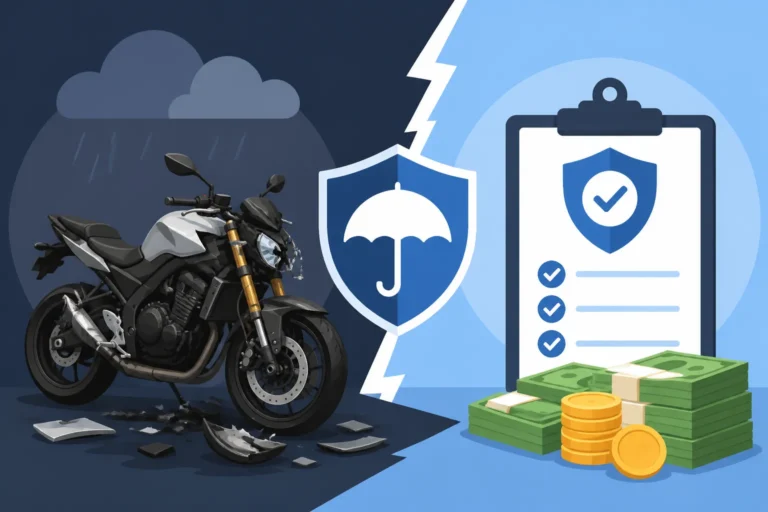
Gap coverage steps in to cover that financial "gap." It bridges the difference between your motorcycle's actual cash value (what your primary insurer pays) and the outstanding balance on your loan or lease. It doesn't pay for repairs, nor does it replace your bike. Its sole purpose is to make you financially whole with your lender, ensuring you don't carry debt for an asset you no longer possess. It’s a crucial add-on, especially if you’ve considered the nuances of What Happens if You Total a Financed Motorcycle?.
How Motorcycle Depreciation Creates the "Gap"
Motorcycles, much like cars, depreciate rapidly, especially in their first few years. Picture this: you buy a brand-new sportbike for $15,000 with a small down payment and a five-year loan. Six months later, it’s involved in a severe accident and declared a total loss. While you might still owe $14,000 on the loan, its actual cash value might only be $12,000 due to depreciation. Your collision coverage will pay out $12,000, leaving you with a $2,000 balance to pay your lender, all while you're without a bike and likely facing the stress of figuring out your next move.
This financial vulnerability is particularly pronounced with new bikes or those with long loan terms and minimal down payments. The longer the loan period, the slower you pay down the principal compared to how quickly the bike loses value. Factors like the make and model of the motorcycle, mileage, condition, and even regional market demand can all influence depreciation rates. For instance, a popular touring model might hold its value better than a niche, high-performance sportbike. Understanding your bike's potential for depreciation is key when deciding if gap coverage is a smart move for you. It’s a consideration that goes beyond just looking at how much motorcycle insurance costs alone.
Scenarios Where Gap Coverage Is a Lifesaver
For many riders, gap coverage isn't just an optional extra; it's a financial safety net that can prevent significant hardship. There are specific situations where this type of protection truly shines, offering peace of mind that's hard to put a price on.
When You Owe More Than Your Bike is Worth
This is the quintessential scenario where gap coverage proves its worth. Imagine you just bought a beautiful new Harley-Davidson or a sleek BMW touring bike, putting down a minimal amount and financing the rest. You’re excited to hit the open road. Fast forward a year, and despite your careful riding, an unfortunate incident – perhaps a distracted driver turns into your lane, or your bike is stolen from a public parking lot – leads to a total loss. The market value determined by your insurer is $15,000, but because of depreciation and your financing terms, you still have $18,000 left on your loan. Without gap coverage, you're suddenly out $3,000, not to mention the emotional toll of losing your ride.
This kind of financial bind can be devastating. You’re forced to continue making payments on a motorcycle you no longer own, potentially delaying your ability to purchase a replacement. This is especially common with long financing terms (48 months or more) or if you rolled negative equity from a previous vehicle into your new motorcycle loan. Gap coverage ensures that the financial institution that holds your loan, whether it's a major bank or a local credit union, gets fully paid, freeing you from that specific debt burden. If you're wondering Do You Need Gap Insurance on a Motorcycle? for your financed bike, the answer is often a resounding yes in these situations.
The Cost of Peace of Mind vs. Financial Ruin
Let's be realistic: nobody wants to pay for extra insurance coverage, but sometimes, the small investment is completely justified. The cost of gap coverage for a motorcycle is usually quite modest, often ranging from a few dollars a month if added to your insurance policy, or a few hundred dollars if purchased as a one-time fee through a dealership and rolled into your loan. For instance, a rider in Florida might pay an extra $30-60 a year for gap coverage through their insurer, or a flat fee of $300-700 through the dealership.
Compare that minor expense to the potential thousands of dollars you could be forced to pay if your bike is totaled without it. That $2,000 or $3,000 difference you’d have to cover out of pocket isn't just an inconvenience; for many, it's a significant financial setback that could impact their savings, credit, or ability to manage other monthly bills. The peace of mind that comes from knowing you won't be in debt for a non-existent vehicle allows you to enjoy your rides without that underlying worry. Companies like Progressive or Dairyland often offer gap coverage as an add-on, and it's always smart to compare these options through services like The Zebra to see where you can get the best value. This type of coverage is often a wise addition to your Types of Motorcycle Insurance Coverage Explained.
When You Might Not Need Gap Coverage
While gap coverage is a fantastic safety net for many, it’s not a one-size-fits-all solution. There are definitely situations where it might be an unnecessary expense, and understanding these can save you a few bucks that could be better spent on gear or a road trip.
Significant Down Payments or Short Loan Terms
If you put a substantial down payment on your motorcycle – say, 20% or more – you’re already significantly reducing the likelihood of being upside down on your loan. A larger down payment means you borrow less money to begin with, bringing your starting loan balance closer to the bike's actual cash value. As you make payments, the principal decreases faster relative to the bike's depreciation. For example, if you bought a $20,000 bike and put $8,000 down, your loan would be $12,000. Even with some initial depreciation, it's much harder for the loan balance to exceed the bike's value compared to if you only put $1,000 down.
Similarly, if you opt for a shorter loan term, like 24 or 36 months, you’re paying off the principal much more quickly. This aggressive payment schedule means your loan balance often depreciates at a faster rate than the bike’s market value, or at least keeps pace. By the time the bike has depreciated significantly, you've likely paid down a considerable portion of the loan, mitigating the "gap" risk. In these scenarios, the cost of gap coverage might outweigh its potential benefit, especially if your financial situation allows you to absorb a minor shortfall should the worst happen. It’s a good idea to crunch these numbers, perhaps even using a comparison tool from The Zebra, before committing to additional coverage.
Owning the Bike Outright
This might seem obvious, but it bears repeating: if you own your motorcycle free and clear, with no outstanding loan, then gap coverage is completely unnecessary. The entire premise of gap insurance is to cover the difference between your bike's market value and your loan balance. If there's no loan, there's no gap for the coverage to fill. Your standard collision and comprehensive policies will pay you the actual cash value of the bike if it's totaled or stolen, and since you don't owe anyone, that money is entirely yours.
This also applies to riders who’ve had their bikes for a while and have paid off their loans. Once that final payment is made, you can (and should) contact your insurance provider to remove gap coverage from your policy, as you're no longer receiving any benefit from it. Sometimes, older or vintage motorcycles, especially those bought with cash, simply don't have this concern. However, even for older bikes, understanding options like Agreed Value vs Stated Value vs Actual Cash Value can still be important for how a payout is determined in a total loss.
Making the Smart Decision for Your Ride
Deciding whether gap coverage is worth it for your motorcycle boils down to a personalized assessment of your financial situation, the specifics of your loan, and your comfort level with risk. It's not a decision to be made lightly, as the implications of being under or over-insured can have real financial consequences.
Assessing Your Personal Financial Situation and Risk Tolerance
Before adding gap coverage, take a hard look at your motorcycle loan. What’s the total amount financed? What was your down payment? How long is your loan term, and what are your monthly payments? Use online tools to estimate your bike’s current market value versus your outstanding loan balance. If you're clearly "upside down" – meaning you owe significantly more than the bike is worth – then gap coverage is a strong contender for your consideration. Think about your emergency fund. Could you comfortably absorb a $2,000 or $5,000 debt if your bike were totaled tomorrow? If the thought of carrying that debt while also needing to buy a new bike is stressful, then gap coverage offers valuable protection.
Your risk tolerance also plays a role. Are you someone who prefers to have every possible contingency covered, even for a small additional cost? Or are you comfortable taking a calculated risk if the numbers suggest the gap might be minimal or quickly closing? Factors like how often and where you ride, the likelihood of an accident or theft in your area, and even the type of motorcycle you own (e.g., a sportbike often has higher theft rates and repair costs) can influence your personal risk assessment. When looking at your policy, consider what full coverage means to you and if it truly covers all your financial exposure.
Where to Get Gap Coverage and What to Look For
You typically have a few options when it comes to purchasing gap coverage for your motorcycle. The most common place is directly through the dealership when you're financing your new bike. They often roll the cost into your loan, which can be convenient but might mean you pay interest on the gap coverage itself. Make sure to scrutinize these offers; sometimes, dealership-offered gap coverage can be pricier than other alternatives.
Another popular route is adding it to your existing motorcycle insurance policy. Many major insurers, including Progressive, Geico, and Dairyland, offer gap coverage as an optional add-on. This is often the most cost-effective way to get it, as it’s a small premium increase, and you’re already dealing with your insurance company. Some credit unions and banks that offer motorcycle loans also provide their own gap protection plans. It's always wise to shop around and compare quotes from multiple sources. Websites like The Zebra can help you get comparison quotes quickly, allowing you to see if adding it to your policy is cheaper than the dealership's offer. When you're ready to make a change, knowing How to Switch Motorcycle Insurance Companies seamlessly is invaluable. Remember to read the fine print of any gap policy to understand its limitations, such as maximum payout limits or exclusions, to ensure it truly meets your needs.
Gap Coverage Scenarios at a Glance
Let's break down when gap coverage is generally recommended versus when it might be less critical.
| Scenario | Gap Coverage Recommendation | Explanation |
|---|---|---|
| New Motorcycle, Low Down Payment | Highly Recommended | Rapid initial depreciation means the loan balance will likely exceed the bike's ACV quickly. |
| Long Loan Term (48+ months) | Recommended | Slower principal reduction means you stay "upside down" for longer, increasing risk. |
| Rolling Negative Equity into Loan | Highly Recommended | You start underwater on your loan, making the gap almost certain. |
| Financed Custom or High-Value Bike | Consider Carefully | While ACV can be tricky with custom mods, gap covers the loan, not custom parts beyond standard policy. Still good for loan protection. |
| Significant Down Payment (20%+) | Optional | A larger upfront payment reduces the initial gap, making it less likely to be upside down. |
| Short Loan Term (24-36 months) | Optional | Faster principal payoff means the loan balance keeps pace with or outruns depreciation. |
| Motorcycle is Paid Off | Not Needed | There is no loan balance to create a "gap" for. |
| Purchasing a Used, Older Motorcycle | Less Likely to be Needed | Older bikes have already depreciated significantly, and if financed, the loan amount is typically closer to actual value. |
Ultimately, gap coverage is a personal decision, but for many riders who finance their motorcycles, it offers a small price to pay for significant financial protection against an unfortunate total loss.
Disclaimer
This article is for general informational purposes only and does not constitute professional advice. Laws, prices and regulations vary by location and change over time. Consult a qualified professional for guidance on your specific situation.