Does Motorcycle Insurance Cover a Garage Fire?
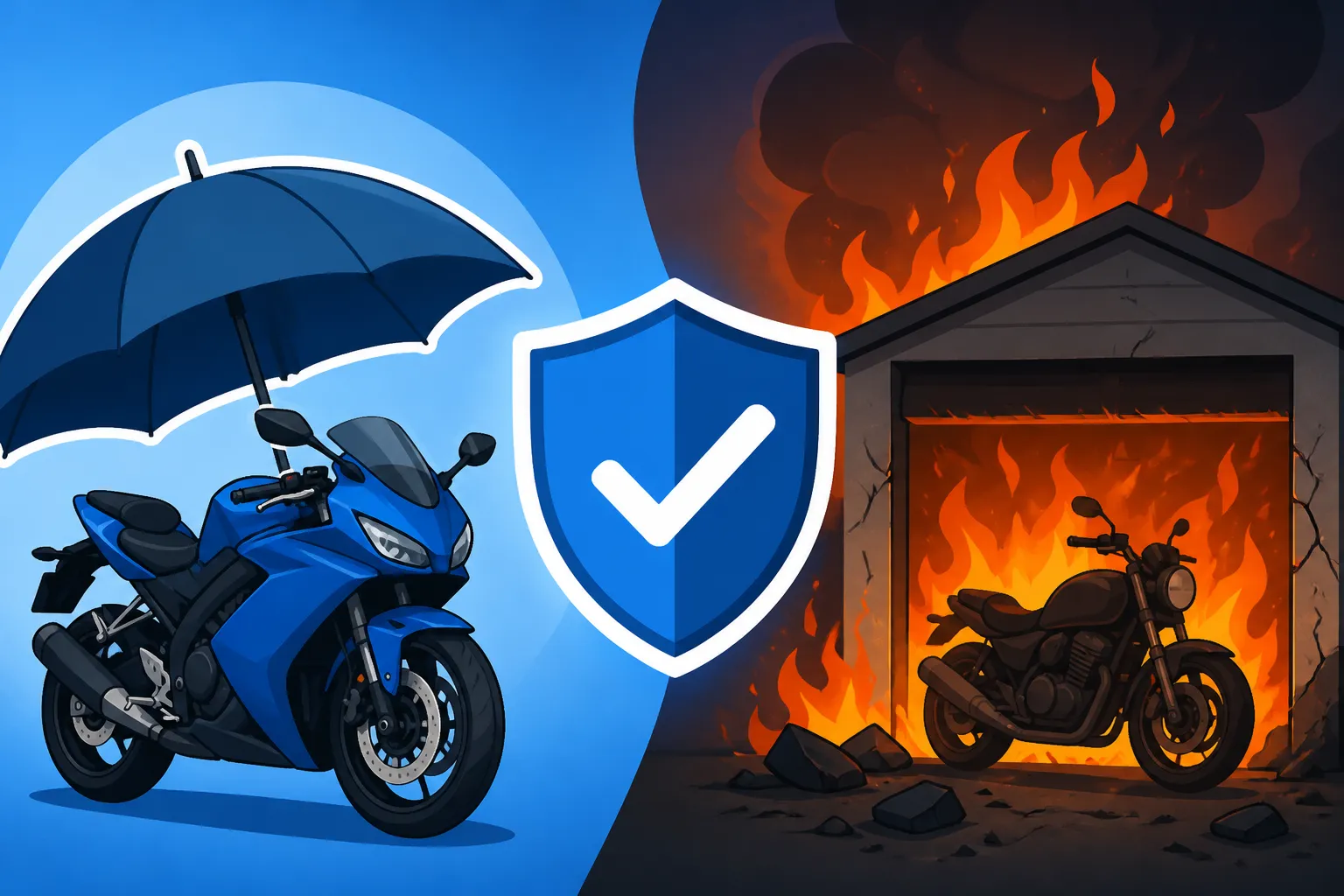
It’s a nightmare scenario no rider ever wants to imagine: you walk into your garage, or worse, see emergency lights, and your beloved motorcycle is caught in a devastating fire. The emotional toll is one thing, but the financial burden can be crushing. The big question looming in these awful moments is always, "Will my motorcycle insurance actually cover this?" This guide is here to shed light on exactly how your policy responds to a garage fire, giving you clarity and peace of mind before disaster strikes.
Understanding Fire Damage and Your Motorcycle Policy
When it comes to the unfortunate event of a fire affecting your motorcycle, the type of coverage you have in place is absolutely everything. Many riders opt for basic, minimal coverage to save a few bucks, but these bare-bones policies often leave you exposed to devastating losses that aren't collision-related. A fire, whether it starts in your garage, from an electrical issue, or even from the bike itself, falls squarely into this category of non-collision damage.
The Role of Comprehensive Coverage
This is where comprehensive motorcycle insurance becomes your best friend. Seriously, if you're worried about anything other than a crash with another vehicle or object, comprehensive is the unsung hero of your policy. It's designed to cover damages that aren't the result of a collision. Think about all those "what if" scenarios: theft, vandalism, natural disasters like floods or hail, falling objects (like a tree branch during a storm), and yes, fire.
Let's break down how it typically works. If a fire starts in your garage—say, from an overloaded circuit, a faulty water heater, or even spontaneous combustion of oily rags—and your motorcycle is damaged or totally destroyed, your comprehensive coverage steps in. It will cover the cost to repair or replace your motorcycle, up to its actual cash value (ACV) or an agreed-upon value, minus your deductible. For instance, if your 2018 Harley-Davidson Street Glide with an ACV of $15,000 is consumed by a garage fire, and you have a $500 comprehensive deductible, your insurance would pay out $14,500 towards its loss. This is the coverage that protects your investment from those unforeseen, often catastrophic, non-riding incidents. It’s also the coverage that would kick in if your motorcycle was stolen, or if it was damaged by falling debris during a heavy storm.
When Liability-Only Coverage Falls Short
Now, let's talk about the cold, hard truth for riders who only carry liability insurance. While liability coverage is absolutely essential for legal riding – it pays for damages and injuries you cause to others in an accident – it does precisely nothing for your own motorcycle if it's damaged in a fire. This is a tough pill to swallow for many, especially those who learn it the hard way after a tragic event.
Imagine this all-too-common scenario: you’ve got a seasoned Honda Gold Wing, paid off for years, and you’ve trimmed down your insurance to just the state-mandated minimum liability to save a few dollars a month. One day, a dryer vent fire starts in your attached garage and engulfs everything. You’re safe, but your beloved touring bike is a charred mess. Because you only had liability, your insurance company won't pay a dime for your motorcycle's damage. You’ll be left to shoulder the entire cost of replacing it out of pocket. This is why understanding Types of Motorcycle Insurance Coverage Explained is so crucial; each component serves a distinct purpose. Many riders often try to find the cheapest options, and while saving money is great, it’s vital to understand the trade-offs. If your bike is financed, most lenders will actually require you to carry comprehensive and collision coverage specifically to protect their investment against these kinds of losses.
What a Comprehensive Claim for Fire Damage Entails
If you've unfortunately experienced a garage fire that damaged your motorcycle, the process of filing a claim might seem daunting amidst the chaos. However, understanding the steps and what to expect can make a significant difference in how smoothly your claim progresses and how fair your payout ultimately is.
Documenting the Damage and Claim Process
The immediate aftermath of a fire can be overwhelming, but gathering documentation as soon as it's safe to do so is paramount. First and foremost, ensure everyone is safe and contact emergency services. Once the fire is extinguished and authorities deem it safe to enter, start documenting. Take numerous photos and videos from every angle, capturing the overall scene, the specific damage to your motorcycle, and any other affected property. Don’t forget close-ups of specific damaged components, custom parts, or gear that was on or near the bike.
Next, you'll need to contact your insurance provider as quickly as possible. Most insurers have 24/7 claims hotlines or online portals. Be prepared to provide your policy number, the date and time of the incident, and a brief description of what happened. An adjuster will be assigned to your case, who will then guide you through the next steps, which typically involve assessing the damage in person or requesting further documentation from you. Keep a detailed log of all communications, including dates, names of people you spoke with, and summaries of conversations. This meticulous record-keeping is vital, especially if your claim becomes complex. Remember, transparency and thoroughness on your part will aid in a quicker resolution. Understanding How to File a Motorcycle Insurance Claim is a critical step for any rider.
Valuation of Your Motorcycle After a Fire
One of the most contentious parts of any total loss claim, like a severe fire, is determining the value of your motorcycle. Insurance companies primarily use three methods: Actual Cash Value (ACV), Agreed Value, and Stated Value.
- Actual Cash Value (ACV): This is the most common valuation method. ACV pays out the replacement cost of your motorcycle minus depreciation. So, if your bike was worth $15,000 new, but it's five years old with 30,000 miles, the ACV might only be $8,000 due to wear and tear and market depreciation. This can be a huge source of frustration for riders who feel their bike was worth more. They don't factor in your emotional attachment or what you think it was worth.
- Agreed Value: This is a fantastic option for custom bikes, rare models, or bikes with significant aftermarket modifications. With agreed value coverage, you and your insurer agree on a specific value for your motorcycle before the policy is issued. In the event of a total loss from a fire or other covered peril, you receive that exact agreed-upon amount (minus your deductible), regardless of market depreciation. This avoids lengthy disputes about value.
- Stated Value: This is a bit of a tricky one, and often misunderstood. With stated value, you declare the value of your motorcycle, but the insurer reserves the right to pay out the stated value or the actual cash value, whichever is less, in the event of a total loss. This can leave riders feeling short-changed if they thought their bike was insured for a higher amount.
For riders with significant investments in custom parts or modifications, it's absolutely crucial to ensure your policy reflects the true value of your bike through either agreed value or specific endorsements for custom parts. If you have unique customizations, understanding the difference between Agreed Value vs Stated Value vs Actual Cash Value will be invaluable.
Factors Affecting Your Fire Damage Payout and Premiums
Dealing with the aftermath of a garage fire is stressful enough without having to decipher insurance jargon. Knowing how deductibles, coverage limits, and past claims affect your current payout and future premiums can help you navigate the process with a clearer head.
Deductibles and Coverage Limits
When it comes to a comprehensive claim for fire damage, your deductible is the amount you're responsible for paying out of pocket before your insurance coverage kicks in. For example, if your motorcycle sustains $10,000 in fire damage and your comprehensive deductible is $1,000, the insurance company will pay you $9,000. Choosing a higher deductible typically results in a lower monthly or annual premium, but it also means you'll pay more upfront in the event of a claim. It's a balance you need to strike based on your financial comfort level.
Your coverage limits also play a critical role. While comprehensive coverage typically applies to the actual cash value (ACV) of your motorcycle, some policies might have specific limits on what they'll pay out for certain types of damage or for accessories. For instance, if your motorcycle has extensive custom paintwork or expensive aftermarket parts, and you haven't specifically added Accessories & Custom Parts Coverage Explained to your policy, your standard comprehensive payout might not cover the full replacement cost of those modifications. Always review your policy declarations page to understand these limits clearly. It's worth comparing options and limits using tools like The Zebra to ensure you're not underinsured for those specific, often costly, additions to your bike.
Impact on Future Premiums and Claims History
It's a common and understandable worry: "Will my insurance rates skyrocket if I file a fire claim?" Generally speaking, filing a comprehensive claim, especially one for fire damage which is often considered an "act of God" or a non-at-fault incident, typically has less of an impact on your future premiums than an at-fault collision claim.
However, any claim made can potentially influence your rates. Insurance companies assess risk, and if you have a history of claims, regardless of fault, they might see you as a higher risk. The severity of the claim, the cost of the payout, and your overall claims history across all your insured vehicles will all factor into their calculations. If you've had multiple comprehensive claims (e.g., a theft, then a fire, then a hail storm), your rates are more likely to see an increase. It's not a guarantee, but it's a possibility you should be aware of. Many factors affect your rates, and a claim is certainly one of them. For a broader perspective on rate fluctuations, you might want to read about Why Is My Motorcycle Insurance So Expensive?. Always remember, a good driving and claims record is one of the best ways to keep your motorcycle insurance costs down in the long run.
Important Considerations Beyond Basic Fire Damage
When you're dealing with the destruction of your motorcycle by fire, it's not just the bike itself that you lose. There are often riding gear, personal items, and those unique touches you've added over time. Understanding how your policy treats these can prevent further heartache.
Coverage for Gear, Parts, and Customizations
Most standard motorcycle insurance policies provide some level of coverage for accessories and custom parts, but it’s rarely enough for serious riders. Your helmet, jacket, gloves, and other riding gear can be incredibly expensive. A standard comprehensive policy might offer a minimal amount, say $1,000 or $2,000, for riding gear and basic customizations. However, if you've invested in a top-of-the-line Sena-equipped Shoei helmet, a Dainese leather suit, and you've got thousands in custom exhaust, performance upgrades, or intricate paint on your bike, that standard amount will fall far short.
This is why it's so important to specifically add accessories and custom parts coverage to your policy. This is an endorsement that allows you to specify a higher coverage limit for those valuable extras. For instance, you might add an extra $5,000 or $10,000 in coverage to ensure that if your custom fairing, upgraded suspension, or those beautiful saddlebags are destroyed in a fire, you won't be paying out-of-pocket to replace them. When obtaining a quote, or reviewing your current policy, make sure to discuss these specific additions with your agent. You can even use comparison sites like The Zebra to see how different insurers handle these crucial add-ons and what they might cost. It's a small premium increase that can save you a massive headache and expense down the road. This also directly relates to the importance of checking Does Motorcycle Insurance Cover Custom Parts?.
Bundling and Homeowner's Insurance Overlap
Another area of confusion for many riders is the potential overlap between motorcycle insurance and homeowner's or renter's insurance, especially when a fire originates in the garage. While your homeowner's policy will typically cover the structure of your garage and any personal belongings inside it (like tools, lawn equipment, or general household items), it generally does not cover the motor vehicle itself. Cars, motorcycles, ATVs, and other registered vehicles are almost universally excluded from standard homeowner's policies because they require their own specific auto or motorcycle insurance.
However, there's a huge benefit to considering bundling your motorcycle insurance with your auto and/or homeowner's policy through the same insurer. Many companies, including prominent names like Progressive, Geico, and State Farm, offer multi-policy discounts that can significantly reduce your overall premiums. Not only can bundling save you money, but it can also simplify the claims process if an event like a garage fire impacts multiple aspects of your property. Instead of dealing with two different adjusters from two separate companies, you'll have a more streamlined process with a single point of contact. It’s always worth investigating if Should You Bundle Motorcycle Insurance? is the right choice for your financial situation.
Remember, while your homeowner's policy might cover the melted toolbox and charred workbench, it's your comprehensive motorcycle insurance that will be there for your bike. Making sure you have the right coverage on both fronts, ideally with the same insurer, can provide a comprehensive safety net against unpredictable events like a garage fire.
| Coverage Type | What It Covers Generally | Covers Motorcycle in Garage Fire? |
|---|---|---|
| Liability | Damages/injuries you cause to others | No (covers others' property) |
| Collision | Damage to your bike from an accident with another vehicle/object | No (fire is not a collision) |
| Comprehensive | Non-collision events: theft, vandalism, natural disasters, fire | Yes |
| Custom Parts/Accessories | Specific add-on for aftermarket parts and gear | Yes (if added to comprehensive) |
| Homeowner's/Renter's | Damage to garage structure, personal property inside garage | No (not the motorcycle itself) |
Disclaimer
Please remember that insurance policies can vary significantly by state, insurer, and the specifics of your individual policy. The information provided in this article is intended for general guidance only and should not be considered legal or financial advice. Always consult with a licensed insurance professional to understand the precise terms, conditions, and exclusions of your motorcycle insurance policy and to determine the best coverage for your specific needs.