Do You Need Liability Coverage on a Motorcycle?
It can feel overwhelming trying to figure out what motorcycle insurance you really need. With so many coverage options out there, it’s easy to get confused about the essentials versus the extras. One of the most common questions riders have is about liability coverage: do you absolutely need it, and what does it even do for you? This guide is here to break down everything you need to know about motorcycle liability insurance, why it’s non-negotiable, and how it protects you on the road.
Understanding Motorcycle Liability Insurance
When you're out on your bike, feeling the wind and enjoying the ride, the last thing you want to think about is an accident. But the reality is, mishaps can happen, and when they do, liability insurance is your financial superhero. It's not about covering your own bike or your own injuries; it's about protecting you from the costs if you're responsible for damage or injuries to others.
What Liability Coverage Actually Covers
Think of motorcycle liability insurance as your shield against financial ruin in the event of an at-fault accident. This coverage has two main components, and understanding them is key to appreciating its value.
First, there's bodily injury liability. This is crucial because it covers the medical expenses, lost wages, pain and suffering, and even funeral costs of other people if you cause an accident. Let's say you misjudge a turn on a busy street in Los Angeles and clip the side of a car, causing the driver to swerve and hit a lamppost. If that driver sustains injuries – perhaps whiplash or a broken arm – your bodily injury liability coverage steps in to pay for their emergency room visit, follow-up physical therapy, and any income they miss out on while recovering. Without this, those bills would land squarely on your shoulders, and we all know how quickly medical costs can skyrocket.
Then, there's property damage liability. This part of your coverage is designed to pay for repairs or replacement of another person's property if you're at fault. Using our previous example, if you damaged the other car's fender, headlight, and even that lamppost, your property damage liability would cover the costs to fix or replace them. This isn't just about other vehicles; it could be a fence you accidentally take out, a mailbox, or even damage to a building. The scope of what this coverage can protect you from is quite broad, preventing you from having to pay out of pocket for potentially expensive repairs.
How Liability Protects You Financially
Many riders, especially those on a budget, might be tempted to skimp on coverage. But understanding the profound financial protection that liability offers can change that perspective. It's not just about paying for damages; it's about safeguarding your entire financial future.
Imagine a scenario where you're involved in a serious accident. Perhaps you were distracted for a moment and caused a multi-car pile-up on I-5 in Washington state. The damages to vehicles could be tens of thousands of dollars, and the medical bills for multiple injured parties could easily climb into the hundreds of thousands, or even millions. Your liability insurance steps in to cover these exorbitant costs up to your policy limits. Without it, you would be personally responsible for every single cent. This means your savings could be wiped out, your assets – like your home or future earnings – could be at risk, and you could face years, if not decades, of financial hardship due to lawsuits and judgments against you. It truly protects your personal wealth from being seized to pay off accident-related debts. This is why understanding Financial Responsibility Laws for Riders is so critical.
Furthermore, liability coverage often includes legal defense costs. If the other party decides to sue you for damages or injuries, your insurance company will usually provide and pay for legal representation, even if the claim eventually proves to be unfounded. This is a massive relief, as attorney fees alone can be incredibly expensive, adding another layer of financial stress on top of an already difficult situation. So, while it might seem like an extra expense, liability coverage is actually an investment in your financial peace of mind.
The Legal Mandate: Is It Required?
The short answer is almost universally "yes." In nearly every state across the U.S., carrying some form of motorcycle insurance is a legal requirement if you plan to ride on public roads. This isn't just a suggestion; it's a law designed to protect everyone on the road.
State-by-State Requirements and Exceptions
The vast majority of states mandate that motorcyclists carry at least minimum liability coverage. These requirements are usually expressed in a series of three numbers, like 25/50/25. This shorthand means your policy would cover $25,000 for bodily injury per person, $50,000 for total bodily injury per accident, and $25,000 for property damage per accident. These limits vary significantly from state to state. For instance, California Motorcycle Insurance Requirements specifies certain minimums, while Texas Motorcycle Insurance Requirements has its own set of numbers.
There are a few exceptions, though they're becoming increasingly rare. New Hampshire, for example, doesn't require insurance, but its financial responsibility laws mean that if you cause an accident, you're personally on the hook for all damages. If you can't pay, you could lose your license and registration. Virginia also operates under a financial responsibility law where you can pay an uninsured motorist fee to legally drive without insurance, but again, it leaves you completely exposed financially in an accident. These states prove that even where insurance isn't strictly mandated, it's still an incredibly wise choice to protect yourself. It's always best to check the specific Motorcycle Insurance Requirements by State (2026 Guide) to know exactly what's expected where you live and ride.
Penalties for Riding Without Liability Coverage
Ignoring the legal requirement for motorcycle liability insurance can lead to some severe consequences that far outweigh the cost of a premium. These penalties are designed to deter uninsured riding and can be a huge headache, not to mention a drain on your finances.
Firstly, you could face hefty fines. In many states, these fines start in the hundreds of dollars and can increase significantly for repeat offenses. Beyond that, there's the risk of having your motorcycle impounded. Imagine being pulled over for a routine traffic stop in Florida and having your bike towed away because you don't have proof of insurance. Getting it back means paying towing fees, storage fees, and often proving you've purchased insurance, which adds up fast. Your driver's license or motorcycle endorsement could also be suspended, making it impossible to legally ride or drive for a period. In states like New York, riding without insurance can even lead to jail time in serious cases or repeat offenses.
Another common penalty is the requirement to file an SR-22 or FR-44. An SR-22 is a certificate of financial responsibility that your insurance company files with the state to prove you have coverage. It's often required for several years after an insurance violation, and it typically signals to insurers that you're a high-risk driver, which can make your future premiums much more expensive. Virginia and Florida use an FR-44 for more serious violations like DUIs, requiring much higher liability limits than a standard SR-22. The bottom line is that the Penalties for Riding Without Insurance are no joke, and they make the small cost of liability coverage look like a bargain in comparison.
Why You Need More Than Just the Minimum
Okay, so we've established that liability coverage is usually required and always a good idea. But here's where many riders make a critical mistake: they assume the state-mandated minimum coverage is enough. In most real-world accident scenarios, those minimums barely scratch the surface of actual costs.
The Dangers of Minimum Coverage
State minimums are designed to provide a very basic level of protection, often for the most minor of accidents. They are not designed to cover the full extent of damages in a serious collision. Let's revisit that 25/50/25 example ($25,000 bodily injury per person, $50,000 total bodily injury per accident, $25,000 property damage).
Imagine you're involved in an accident in a busy area, like downtown Chicago. You rear-end a brand new luxury SUV, causing significant damage. The repairs alone could easily exceed your $25,000 property damage limit. Now, if the driver and their passenger both sustain injuries requiring ambulance rides, ER visits, and a few weeks of physical therapy, their combined medical bills could easily surpass $50,000. In such a common scenario, your minimum coverage would be exhausted, and you would be personally responsible for the remaining balance. This isn't a hypothetical far-fetched event; it happens every day. The average cost of a hospital stay after an injury can easily reach tens of thousands of dollars, and a major vehicle repair can be just as much. Understanding Minimum Liability Insurance Explained (The Three Numbers) helps clarify these figures.
Protecting Your Future and Assets
Going beyond the minimum isn't just about avoiding a bill in the immediate aftermath of an accident; it's about safeguarding your entire financial life. If you have any significant assets – like a home, savings accounts, or investments – carrying low liability limits puts them all at risk.
When your insurance coverage runs out, the injured parties or their insurance companies can come after your personal assets to cover the remaining costs. This could mean a lawsuit that results in a judgment against you. They could garnish your wages, place a lien on your home, or even force the sale of your property to satisfy the debt. For many riders, especially those who have worked hard to build their wealth, this is a terrifying prospect. Increasing your liability limits, perhaps to 100/300/100 or even higher, provides a much stronger buffer against these kinds of catastrophic financial losses. It gives you peace of mind that a single mistake on the road won't unravel everything you've worked for. This is especially true for those with significant assets. Comparison tools, like those offered by The Zebra, can help you see how different liability limits affect your premiums, allowing you to choose a level of protection that aligns with your personal financial risk.
Factors Influencing Your Liability Premium
While liability coverage is essential, its cost isn't fixed. Several factors come into play, influencing how much you'll pay. Understanding these can help you find ways to manage your premiums.
Rider and Bike Specifics
Your personal profile as a rider and the characteristics of your motorcycle are big determinants of your liability insurance rate.
For instance, younger, less experienced riders typically pay more. Why? Because statistics show they're more likely to be involved in accidents. If you're under 25, you might see higher rates than a rider over 40. Your driving record is another huge factor; a history of accidents, speeding tickets, or other moving violations will almost certainly lead to higher premiums. A clean driving record, on the other hand, can help keep your costs down significantly. Insurers, including major carriers like Progressive, look at your risk profile very closely.
The type of motorcycle you ride also plays a role. Sport bikes, with their high-performance engines and greater likelihood of being involved in high-speed incidents, generally have higher liability rates than cruisers or touring bikes. A powerful 1000cc sport bike will almost always cost more to insure for liability than a 650cc cruiser, even if all other factors are equal. The less horsepower and the more sedate the bike, generally the lower the premium. This is part of what makes Sport Bike Insurance Cost (Why So High) a common frustration for many riders.
Location and Usage
Where you live and how you use your motorcycle are also key factors in determining your liability premium.
If you live in a densely populated urban area, like Miami or New York City, your rates will likely be higher than if you live in a rural area of, say, Montana. This is because urban environments have more traffic, higher rates of accidents, and often higher rates of theft and vandalism, even though liability primarily covers damage to others. More vehicles and more opportunities for collisions naturally lead to higher risk for insurers.
The amount you ride also impacts your premium. If you only ride seasonally, for example, you might qualify for certain discounts or lower rates, though you still need continuous coverage. Some insurers even offer "lay-up" coverage options for when your bike is stored in the winter, effectively reducing some coverage while maintaining comprehensive protection against non-riding perils. Using your motorcycle for commuting vs. purely recreational rides can also be a factor. The more miles you put on your bike, especially during peak traffic hours, the higher the perceived risk. It's not just about if you ride, but how much and where you ride that can sway your premiums.
How to Get the Right Liability Coverage
Finding the "right" amount of liability coverage can feel like a guessing game, but it's really about a realistic assessment of your personal risk and financial situation. It's not a one-size-fits-all solution, and what's sufficient for one rider might be disastrously inadequate for another.
Assessing Your Needs
The first step is to honestly evaluate your assets. Do you own a home, have significant savings, or a stable, high-income job? If so, you have more to lose in a lawsuit, and therefore, you should opt for higher liability limits. A good rule of thumb is to carry enough liability coverage to protect everything you own. If you have $300,000 in assets, aiming for at least $250,000-$500,000 in bodily injury liability coverage per accident, and similar property damage limits, would be a wise move.
Consider your riding habits and experience level too. Are you a brand-new rider still getting the hang of things, or a seasoned veteran with thousands of miles under your belt? Do you primarily cruise quiet country roads, or do you navigate congested city streets daily? While your own skill won't stop someone else from being careless, it can influence your risk of being at fault. If you frequently ride with passengers, you might also want to look into additional Motorcycle Insurance Requirements for Passengers that could be impacted by your liability limits. The more risk factors present, the more crucial higher liability coverage becomes.
Shopping for Quotes
Once you have a clearer idea of the coverage limits you need, it's time to shop around. Don't just settle for the first quote you get. Insurance rates can vary wildly between companies for the exact same coverage. Start by gathering quotes from several reputable insurers. Companies like Progressive, Geico, Dairyland, and Markel are well-known in the motorcycle insurance space, but don't overlook national carriers like State Farm or Allstate, especially if you can bundle policies.
Comparison websites like The Zebra can be incredibly helpful here. Instead of going to each insurer's website individually, you can input your information once and get multiple quotes side-by-side. This not only saves you a ton of time but also ensures you're comparing apples to apples. Make sure you're getting quotes for the same liability limits across all providers to accurately compare prices. Don't just look for the cheapest option; consider the company's reputation for claims handling and customer service. Sometimes paying a little more for a reliable insurer is worth the peace of mind. Bundling your motorcycle insurance with your car insurance or home insurance policy is another excellent way to save money, often unlocking significant multi-policy discounts. Be sure to ask about all available Motorcycle Insurance Discounts You're Missing.
| State (Example) | Bodily Injury Per Person | Bodily Injury Per Accident | Property Damage Per Accident |
|---|---|---|---|
| California | $15,000 | $30,000 | $5,000 |
| Texas | $30,000 | $60,000 | $25,000 |
| Florida | $10,000 | $20,000 | $10,000 |
| New York | $25,000 | $50,000 | $10,000 |
| Pennsylvania | $15,000 | $30,000 | $5,000 |
| Washington | $25,000 | $50,000 | $10,000 |
Note: These are minimum liability limits and may be subject to change. Always verify current requirements with your state's DMV or insurance regulator.
Frequently Asked Questions About Motorcycle Liability
Let's clear up some common misunderstandings about motorcycle liability coverage that often leave riders scratching their heads. Getting these questions answered can help solidify your understanding and ensure you're making informed decisions about your policy.
Does Liability Cover My Bike?
This is a big one, and the answer is a clear no. Liability insurance for your motorcycle is strictly for damages and injuries you cause to other people and their property. It does absolutely nothing to cover damage to your own motorcycle. If you're involved in an accident, even if it's your fault, your liability policy won't pay a dime to fix your scratched fairing, bent forks, or busted engine.
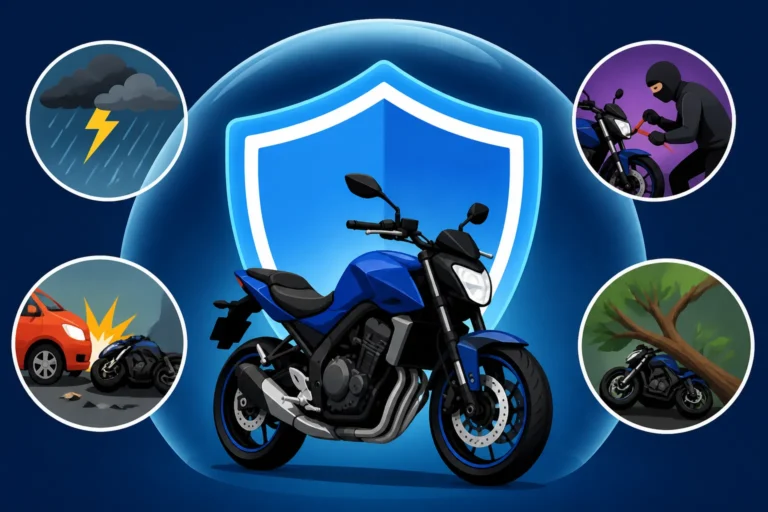
For that kind of protection, you need additional coverages like collision and comprehensive. Collision coverage specifically pays for damage to your bike if you hit another vehicle or object (like a guardrail or tree), or if it rolls over. Comprehensive coverage, on the other hand, covers non-collision events like theft, vandalism, fire, natural disasters, or hitting an animal. Many riders mistakenly believe their "full coverage" includes everything, but it's really a combination of liability, collision, and comprehensive, along with any other add-ons. If you're wondering what full coverage motorcycle insurance means for your ride, it's definitely worth a deep dive into the specifics of collision versus comprehensive.
What if I Only Ride Seasonally?
Many riders in colder climates, myself included, store their bikes for several months out of the year. The question often arises: do I still need liability coverage if my bike is just sitting in the garage? The short answer is yes, in most cases, you still need it if you want to be able to legally ride it when the weather warms up.
While some insurers offer "lay-up" or "seasonal" policies that might reduce certain coverages (like collision) during storage, you generally need to maintain at least liability coverage to keep your registration active. If you completely cancel your policy, you'll face the penalties for uninsured riding when you try to ride again, and it could lead to a lapse in coverage that makes future insurance more expensive. More importantly, if you decided to take your bike out for a quick spin on an unseasonably warm winter day and got into an accident, you'd be entirely uninsured. It's usually best to discuss Do You Need Insurance to Store a a Motorcycle? with your insurance provider to ensure you have the right kind of protection, even when you're not actively riding.
Can I Register Without It?
In almost every state, no, you cannot register your motorcycle without providing proof of insurance, specifically liability coverage. State motor vehicle departments require this proof to ensure that every vehicle on the road is financially responsible in case of an accident. When you go to register a new bike or renew an old registration, you'll typically be asked to provide your insurance company's name, policy number, and effective dates.
If you somehow manage to register your motorcycle without insurance (perhaps by canceling your policy immediately after providing proof), you're still breaking the law and face all the penalties we discussed earlier. Furthermore, if you're pulled over and can't provide valid proof of insurance, your registration could be suspended, along with your license. This is a common pitfall that new riders sometimes fall into, but the rule is pretty steadfast: if it's going on public roads, it needs liability insurance. So, the short answer to Can You Register a Motorcycle Without Insurance is generally no.
Disclaimer
Please remember that insurance laws and requirements can change, and state regulations vary widely. This guide provides general information and should not be considered legal or financial advice. Always consult with a qualified insurance professional or your state's Department of Motor Vehicles to understand the specific requirements and best coverage options for your individual situation.