Is Underinsured Motorist Coverage Worth It on a Motorcycle?
Riding a motorcycle comes with an incredible sense of freedom, but it also carries unique risks, especially when it comes to the actions of other drivers on the road. One of the most frustrating realities is that even if an accident isn't your fault, the at-fault driver might not have enough insurance to cover your substantial medical bills and property damage. This guide will dive deep into underinsured motorist (UIM) coverage for motorcyclists, helping you understand its critical importance and whether it's a worthwhile addition to your policy.
Understanding Underinsured Motorist UIM Coverage for Riders
It's a tough pill to swallow, but not everyone on the road carries enough insurance to properly cover the damage they might cause, especially when a motorcycle is involved. That's where Underinsured Motorist (UIM) coverage steps in, acting as a crucial safety net for riders.
What UIM Coverage Actually Does
Imagine this scenario: you're cruising down a scenic highway, minding your own business, when suddenly another driver veers into your lane, causing an accident. You're left with significant injuries, a totaled bike, and a mountain of medical bills. The other driver is clearly at fault, but their liability insurance policy only covers a fraction of your expenses. This is precisely the frustrating situation that Underinsured Motorist coverage is designed to address.
UIM coverage kicks in when the at-fault driver's bodily injury and property damage liability limits are insufficient to cover your expenses. It's not about covering the other driver; it's about protecting you. Think of it as your insurance company stepping in to make up the difference between what the at-fault driver's insurance pays and your actual damages, up to your policy's UIM limits. It’s distinct from Uninsured Motorist (UM) coverage, which protects you when the at-fault driver has no insurance at all. Many states bundle these coverages together as UM/UIM, acknowledging that drivers with minimal coverage pose a similar financial threat as those with none. It's a vital part of comprehensive protection, as outlined in guides like Uninsured & Underinsured Motorist Coverage UM/UIM.
Why Motorcyclists Are Particularly Vulnerable
Let's be brutally honest: motorcyclists are inherently more vulnerable in an accident than someone in a car or truck. There's no steel cage, no airbags, no crumple zones to absorb impact. Even a minor fender bender for a car can be a life-altering event for a rider. This translates directly to higher potential for severe injuries, including broken bones, head trauma, spinal cord injuries, and extensive road rash. The medical costs associated with these types of injuries can quickly skyrocket into the tens or even hundreds of thousands of dollars.
Consider a rider in Phoenix, Arizona, who suffers a compound fracture and spinal injury after being T-boned by a driver with minimum state liability coverage of $25,000 for bodily injury per person. That $25,000 might barely cover the ambulance ride and initial emergency room visit, let alone surgeries, physical therapy, lost wages, and long-term care. Without UIM coverage, that rider would be personally responsible for the vast majority of their recovery costs, potentially leading to financial ruin. Beyond physical injuries, the damage to a motorcycle itself can be extensive, often resulting in a total loss even from seemingly minor incidents. Your beautiful Harley-Davidson or Kawasaki Ninja could be irreparable, and the repair or replacement costs can quickly exceed basic property damage liability limits. This extreme vulnerability makes UIM coverage not just a good idea, but often a critical necessity for peace of mind on two wheels.
The Financial Risks of Riding Without UIM Protection
It's easy to think, "I'm a good rider, I'm careful, I won't cause an accident." And that's fantastic! But insurance isn't just about covering your mistakes; it's about protecting you from other people's mistakes and their lack of adequate coverage. Ignoring this vital protection can leave you exposed to devastating financial fallout.
When Another Driver's Coverage Falls Short
The sad truth is, many drivers on the road carry only the bare minimum liability insurance required by their state. This is often referred to as "minimum liability coverage," and the specific numbers can vary wildly. For instance, in Texas, the minimum liability coverage is 30/60/25, meaning $30,000 for bodily injury per person, $60,000 for bodily injury per accident, and $25,000 for property damage. In Florida, it's even lower, sometimes just $10,000 for bodily injury per person. You can check out more details about these requirements in guides like Minimum Liability Insurance Explained The Three Numbers or Motorcycle Insurance Requirements by State (2026 Guide).
Now, picture this all-too-common scenario: You're riding your motorcycle, and a driver talking on their phone pulls out in front of you. You can't avoid them, and you go down hard. You're fortunate to survive, but you're looking at $75,000 in medical bills, another $10,000 in lost wages from your job, and your custom-built motorcycle is a $20,000 write-off. The at-fault driver has only the Florida state minimums: $10,000 bodily injury per person and $10,000 for property damage. Their insurance pays out the $10,000 for your injuries and $10,000 for your bike. That leaves you with $65,000 in medical bills, $10,000 in lost wages, and another $10,000 for your bike that are completely uncovered. This isn't an exaggeration; it's a harsh reality that riders face every single day. The at-fault driver likely doesn't have personal assets to pursue for the remaining balance, leaving you holding the bag for tens of thousands of dollars.
The Burden of Out-of-Pocket Expenses
When the at-fault driver's insurance can't cover your damages, those costs don't magically disappear. They become your responsibility. This is where the true financial burden hits. First, there are the immediate medical expenses: ambulance rides, emergency room visits, surgeries, medications, and hospital stays. Then comes the long-term care: physical therapy, rehabilitation, follow-up doctor appointments, and possibly even adaptive equipment or home modifications if injuries are severe. These expenses can stretch on for months or even years.
Beyond medical costs, there's the income you lose because you can't work. If you're self-employed, a contractor, or simply don't have generous paid time off, missing weeks or months of work can be financially devastating. You might have dependents relying on your income, or bills that need to be paid regardless of your ability to work. And let's not forget the motorcycle itself. While your own collision coverage might help with your bike, if you don't have "full coverage" (which really means a combination of collision, comprehensive, and liability, as explained in What Does Full Coverage Motorcycle Insurance Mean?), or if your deductible is high, you'll still be out a significant amount. Without adequate UIM, you could face medical debt, wage loss, and the cost of replacing your motorcycle, potentially forcing you to tap into savings, take out loans, or even declare bankruptcy. It's a situation no rider ever wants to be in.
Deciding if Underinsured Motorist Coverage is "Worth It" for You
The question of whether UIM coverage is "worth it" isn't a simple yes or no; it depends on your individual circumstances, riding style, and risk tolerance. However, for most motorcyclists, the peace of mind and financial protection it offers far outweighs the additional cost.
Factors to Consider for Your Riding Lifestyle
When contemplating UIM, take a moment to honestly assess your riding life. Are you a daily commuter in a densely populated city like Los Angeles, where traffic is heavy and the chances of encountering distracted or underinsured drivers are higher? Or are you a weekend warrior who mostly sticks to rural roads? Your exposure to risk directly influences the potential need for robust coverage.
Beyond your riding habits, consider your personal financial situation. Do you have significant assets that you want to protect? Do you have a high-paying job where lost wages would be substantial? Or are you on a tighter budget where any unexpected medical bill could be catastrophic? If you have dependents or a mortgage, the financial stability UIM provides becomes even more critical. The cost of adding UIM to your policy is generally quite affordable compared to the potential payout, often just a few extra dollars a month. It's also worth thinking about what other coverage you carry, such as Medical Payments (MedPay) for your own injuries, which is explained further in What Is Medical Payments MedPay for Riders?. While MedPay helps with immediate medical costs, UIM can cover much larger long-term expenses like lost income and pain and suffering that MedPay typically doesn't. Many riders find comparing motorcycle insurance quotes through services like The Zebra helps them understand the various options and pricing. They can tailor their search to include or exclude UIM and see the actual cost difference.
Complementary Coverages to Strengthen Your Protection
While UIM is powerful, it’s not a standalone shield. It works best as part of a comprehensive insurance strategy. Think of your motorcycle insurance as layers of protection, each designed to cover a specific aspect of risk.
- Uninsured Motorist (UM) Coverage: As mentioned earlier, UM protects you when the at-fault driver has no insurance at all. This is a very real threat, as roughly one in eight drivers nationwide are uninsured, and in some states like Florida, that number can be even higher. UIM and UM are often sold together for a reason—they cover two sides of the same coin: other drivers not having enough, or any, insurance.
- Collision Coverage: This covers damage to your own motorcycle if you hit another vehicle or object, or if your bike is hit by an at-fault driver whose property damage liability is insufficient. While UIM can cover your bodily injury and lost wages in this scenario, collision coverage directly addresses your bike.
- Medical Payments (MedPay) or Personal Injury Protection (PIP): These cover medical expenses for you and your passengers, regardless of who is at fault for the accident. While UIM covers medical costs after the other driver’s insurance is exhausted (and if they're at fault), MedPay/PIP can provide immediate relief for smaller costs or if fault isn't immediately clear.
Combining these coverages ensures that you're protected from a wide range of scenarios, from severe personal injury and lost income due to an underinsured driver (UIM) to damage to your bike (collision) and immediate medical expenses (MedPay). It's a holistic approach that truly prepares you for the unpredictable nature of the road. For many, bundling these coverages can also lead to discounts, making a robust policy more affordable. Services like The Zebra can help you see how these different coverages stack up and compare total costs across various insurers. You can learn more about how different coverages work together in our guide on Types of Motorcycle Insurance Coverage Explained.
UIM Coverage Scenario Comparison
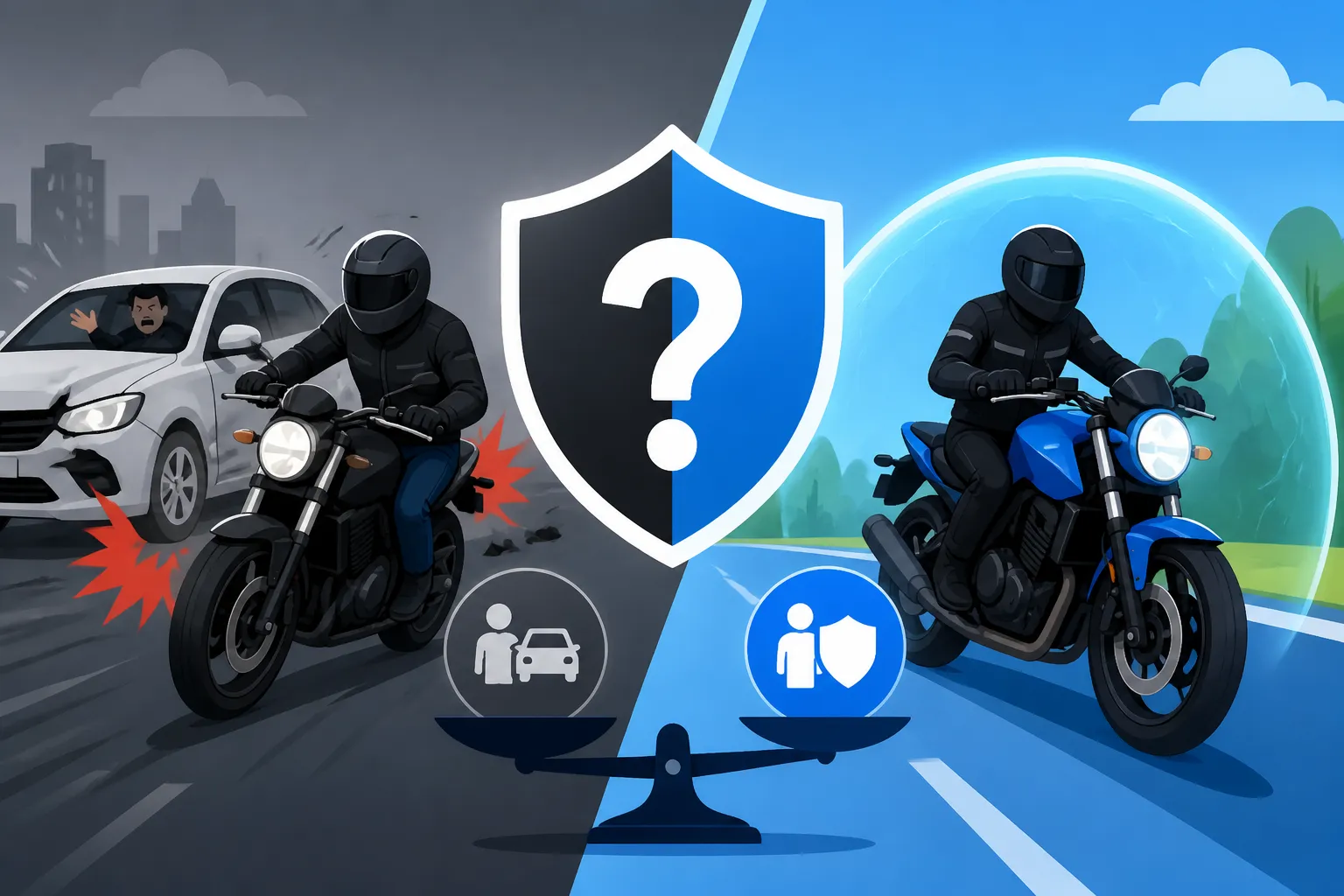
To put it into perspective, here's how a typical motorcycle accident scenario might play out with and without UIM coverage:
| Scenario Element | Without UIM Coverage | With UIM Coverage ($100,000 limit) |
|---|---|---|
| Your Injuries | Severe, $90,000 in medical bills | Severe, $90,000 in medical bills |
| Lost Wages | $15,000 | $15,000 |
| Motorcycle Damage | $20,000 total loss (assuming your own collision has $1,000 deductible) | $20,000 total loss (assuming your own collision has $1,000 deductible) |
| At-Fault Driver's Policy | State minimum: $25,000 bodily injury per person, $10,000 property damage | State minimum: $25,000 bodily injury per person, $10,000 property damage |
| Payout from At-Fault | $25,000 (bodily injury) + $10,000 (property damage) = $35,000 | $25,000 (bodily injury) + $10,000 (property damage) = $35,000 |
| Your Collision Payout | $19,000 (after $1,000 deductible) | $19,000 (after $1,000 deductible) |
| Your UIM Payout | $0 | UIM covers the gap: $90,000 (med bills) – $25,000 (driver) = $65,000. Your UIM pays $65,000. |
| Total You Receive | $35,000 (from driver's ins) + $19,000 (from your collision) = $54,000 | $35,000 (from driver's ins) + $19,000 (your collision) + $65,000 (UIM) = $119,000 |
| Total Expenses | $90,000 (med) + $15,000 (wages) + $20,000 (bike) = $125,000 | $90,000 (med) + $15,000 (wages) + $20,000 (bike) = $125,000 |
| Your Out-of-Pocket Cost | $125,000 – $54,000 = $71,000 (plus your collision deductible) | $125,000 – $119,000 = $6,000 (just your collision deductible and lost wages not covered by UIM) |
As you can see, the difference is staggering. Without UIM, you're looking at a mountain of debt. With UIM, a significant portion of your financial burden is lifted.
How to Get the Right Underinsured Motorist Coverage
Once you understand the value UIM coverage provides, the next step is to ensure you have the right amount for your needs. This isn't just about ticking a box; it's about tailoring your protection to your unique life on two wheels.
Reviewing Your Current Policy and Options
The first order of business is to pull out your current motorcycle insurance policy. Don't just glance at it; really dig into the declarations page. Look for sections related to "Uninsured Motorist" or "Underinsured Motorist" Bodily Injury and Property Damage. Pay close attention to the limits listed. Often, these limits are structured similarly to liability coverage, appearing as split limits like 25/50 or 50/100. This means $25,000 or $50,000 per person, and $50,000 or $100,000 per accident. It’s a smart move to match your UIM bodily injury limits to your own liability bodily injury limits. Why? Because if you expect your insurance to protect others up to a certain amount, you should expect at least that much protection for yourself if an underinsured driver hits you.
If you find that your current policy is lacking UIM, or if the limits are too low, don't hesitate to reach out to your insurance provider or agent. They can walk you through the process of adding or increasing this crucial coverage. Be prepared to ask questions about how UIM works in your specific state, as regulations can vary. For example, some states might allow UIM to stack across multiple vehicles or policies, potentially increasing your payout limits. Understanding these nuances can make a big difference if you ever need to file a claim. If you're unsure what all the numbers mean, our guide on What Is Liability Coverage on a Motorcycle? can help clarify.
Shopping for the Best UIM Rates
You might be thinking that adding or increasing UIM coverage will significantly bump up your premium. While it will add to the cost, the increase is often much less than you might anticipate, especially compared to the immense protection it provides. The best way to ensure you're getting a fair price for UIM, and your entire policy, is to shop around. Don't just stick with your current insurer if they're not offering competitive rates or the coverage you need.
Utilize online comparison tools, like The Zebra, to gather quotes from multiple providers simultaneously. This allows you to see how different companies—like Progressive, Geico, or Dairyland—price their UIM coverage and allows you to compare the overall cost of your entire policy. When you're comparing, make sure you're getting quotes for comparable coverage limits across the board, so you're doing an apples-to-apples comparison. Don't forget to inquire about any potential discounts you might qualify for, such as multi-policy discounts if you bundle your motorcycle and auto insurance, or discounts for completing a motorcycle safety course, which is covered in How to Get Cheap Motorcycle Insurance. Remember, every insurance company assesses risk differently, so what's expensive with one might be affordable with another. Take the time to compare; it could save you a significant amount in premiums and, more importantly, a fortune in potential out-of-pocket expenses down the line. To get started comparing, check out our guide on How to Compare Motorcycle Insurance Quotes.
Disclaimer
This article is for general informational purposes only and does not constitute professional advice. Laws, prices and regulations vary by location and change over time. Consult a qualified professional for guidance on your specific situation.