Do You Need Insurance for a Dirt Bike or Off-Road Motorcycle?
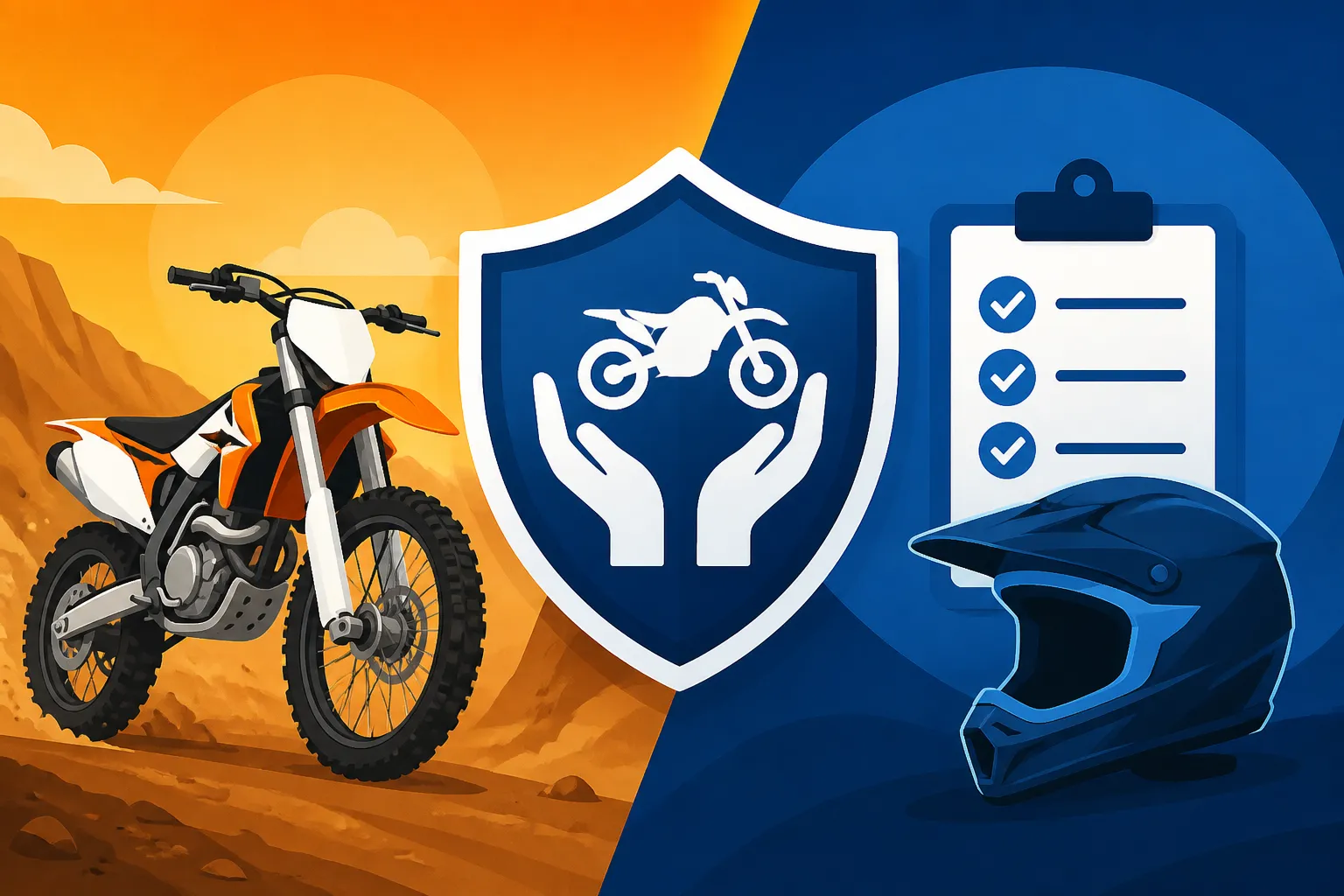
Riders often assume that because a dirt bike doesn't have a license plate or blinkers, it exists in a legal gray zone where insurance is unnecessary. However, facing a stolen bike from your garage or a lawsuit after a trail collision quickly reveals the high stakes of being uninsured. This guide clarifies exactly when off-road insurance is mandatory and why it is practically essential.
Understanding State Laws for Off-Road Vehicles
The legal requirement for insuring a dirt bike often feels like a moving target because it depends almost entirely on where you are riding rather than what you are riding. Most states do not require insurance for vehicles that are operated exclusively on private property. If you own fifty acres in rural Pennsylvania and never leave your fence line, you are likely not legally obligated to carry a policy. However, the moment that front tire touches a public trail, a state park, or a maintained forest road, the rules shift dramatically.
Many riders are surprised to find that Off-Road & Dirt Bike Insurance Requirements can vary by the specific patch of dirt they are standing on. In states like Arizona or California, certain public lands require you to show proof of liability insurance just to enter the trailhead. This is designed to ensure that if you lose control and injure another rider or damage public property, there is a financial safety net in place. Even if the state itself doesn't have a blanket mandate, the Bureau of Land Management (BLM) or the Department of Natural Resources (DNR) might have their own set of rules that carry the weight of law.
Public Lands versus Private Property
Riding on your own land offers the most freedom, but it also places the entire financial burden of an accident on your shoulders. Many people mistakenly believe their homeowners insurance will cover a dirt bike if it is stolen or if someone gets hurt while riding it on the property. In reality, most homeowners policies specifically exclude "motorized vehicles" from coverage, especially if they are designed for off-road use. This leaves a massive gap in your protection that only a dedicated policy can fill.
When you transition to public lands, you are entering a space where Minimum Liability Insurance Explained (The Three Numbers) becomes highly relevant. Even if you aren't on the street, liability works the same way: it pays for the other person’s medical bills or equipment repairs if you are at fault. Some off-road parks are now requiring riders to carry a minimum of 15/30/5 liability limits, mirroring street-legal requirements to ensure that the park itself isn't held liable for rider negligence.
Dual-Sport versus Dedicated Dirt Bikes
The line between a dirt bike and a street motorcycle has blurred with the rise of dual-sport machines. If your bike has a VIN that allows it to be registered for road use, the law treats it exactly like a Harley-Davidson or a sport bike. If you have a license plate, you are subject to Is Motorcycle Insurance Required? State-by-State mandates. In this scenario, you cannot legally ride to the trail without a valid insurance card in your pocket or a digital copy on your phone.
Even if you only ride that dual-sport bike off-road, the fact that it can be registered for the street often triggers insurance requirements during the registration process. For example, if you are looking into California Motorcycle Insurance Requirements, you will find that any vehicle with a license plate must be backed by a policy, regardless of whether it spends 99% of its life in the mud. Failing to insure a plated bike can result in the suspension of your registration, even if the bike never touches asphalt.
Why Optional Insurance Might Be Necessary
Beyond the "must-do" of the law, there is the "should-do" of common sense. Dirt bikes are high-risk assets. They are light, easy to roll away, and often lack the sophisticated ignition locks found on street bikes. Furthermore, the way we transport them adds another layer of risk. Many riders don't realize that their auto insurance generally covers the trailer, but it does not cover the "contents" of the trailer. If your truck is hit while you are heading to the track and your $10,000 KTM is totaled, your car insurance will likely pay zero for the bike.
This is where a service like The Zebra can be incredibly helpful for off-road enthusiasts. By using The Zebra to compare specialized policies, you can find coverage that specifically protects your bike while it is "in transit." This fills the gap between your auto and homeowners policies, ensuring that a highway mishap doesn't result in a total financial loss of your riding gear and machinery.
Theft and Vandalism Risks
Dirt bikes are among the most frequently stolen motorized vehicles because they are difficult to track once they hit the secondary market. A bike can be stripped for parts or sold via a "bill of sale only" on social media within hours of a theft. If you don't have comprehensive coverage, you are simply out of luck. When you look into a Motorcycle Theft Claim: How It Works, you see that having a policy in place provides a payout based on the actual cash value of the bike, which can be the difference between getting back on the trails next weekend or saving up for another three years.
Vandalism is another often-overlooked factor. If you leave your bike at a campsite or in the back of an open truck bed while grabbing a meal, it is a sitting duck. Comprehensive insurance covers more than just someone taking the whole bike; it covers someone cutting the seat, damaging the engine, or stripping the plastics. For many, the peace of mind knowing their investment is protected at a hotel or a trailhead is worth the relatively low cost of an off-road policy.
Liability on the Trails
We tend to think of trails as wide-open spaces where we are alone, but popular riding areas can be as crowded as a suburban intersection. "Whiskey throttle" is a real phenomenon, and even the most experienced riders can have a mechanical failure that sends them careening into a group of parked riders or another person coming around a blind corner. Without liability insurance, you are personally responsible for the other rider's broken leg or their totaled bike.
Lawsuits in the powersports world are becoming more common. If you are found negligent in a crash, a lawyer could go after your personal assets, including your home or savings. A basic liability policy for a dirt bike is often less than $10 a month, making it one of the cheapest ways to protect your financial future. You can check What Insurance Do You Need to Ride a Motorcycle Legally? to see how these liability limits protect you in various scenarios, including off-road environments where traditional rules of the road might not apply but general negligence laws still do.
Types of Coverage for Dirt Bikes and Off-Road Motorcycles
When shopping for dirt bike insurance, you shouldn't just grab the first "full coverage" policy you see. Off-road riding has specific needs that a standard street policy might not address correctly. For example, do you have aftermarket exhaust systems, specialized suspension, or expensive handguards? A standard policy might only cover the bike as it came from the factory. You need to ensure your policy includes "Custom Parts and Equipment" (CPE) coverage.
Using tools like The Zebra allows you to filter for companies that offer these specific add-ons. It is important to be realistic about how you use your bike. If you are racing in sanctioned events like GNCC or local motocross, most standard insurance policies will explicitly exclude coverage for "organized racing." However, for the casual trail rider or the weekend warrior, standard off-road policies provide a robust safety net.
Comprehensive and Collision Coverage
Collision coverage pays for damage to your bike if you hit another object or another rider. In the world of dirt bikes, "hitting an object" usually means a tree, a rock, or the ground after a failed jump. Because dirt bikes are meant to be dropped, some riders skip collision coverage, thinking they can just buy new plastics. However, if you bend the frame or crack the engine case, the repair costs can quickly exceed the value of the bike.
Comprehensive coverage, as discussed, handles the "non-crash" stuff. This includes fire, theft, vandalism, and even damage from falling objects (like a tree limb falling on your bike in the woods). If you're wondering Is Comprehensive Worth It on a Cheap Motorcycle?, the answer for dirt bikes is usually yes because of the high theft rate. Even an old $2,500 Honda CRF is a prime target for thieves.
Medical Payments and Transport Coverage
Medical Payment coverage, or MedPay, is vital for dirt bikers. Health insurance often has high deductibles, and some health policies have "extreme sport" exclusions. MedPay can help cover your emergency room co-pays or the cost of an ambulance ride from a remote trailhead. When you analyze Medical Payments (MedPay) for Riders, you realize that even a small $2,000 limit can be a lifesaver when you're hit with unexpected medical bills after a spill.
| Coverage Type | What It Protects | Recommended For |
|---|---|---|
| Liability | Damage/Injuries you cause to others | Everyone (Mandatory in some parks) |
| Comprehensive | Theft, fire, vandalism, transport damage | High-value bikes or high-theft areas |
| Collision | Damage to your bike from a crash | Newer bikes or expensive builds |
| MedPay | Your own medical bills regardless of fault | Riders with high-deductible health plans |
| Uninsured Motorist | Coverage if an uninsured rider hits you | Riders in busy public OHV areas |
How Much Does Dirt Bike Insurance Cost?
The good news is that dirt bike insurance is significantly cheaper than street motorcycle insurance. Because dirt bikes are generally not ridden at 80 mph on highways surrounded by heavy traffic, the "risk" to the insurance company is lower. Most riders can find a very solid policy for between $75 and $200 per year. That is a small price to pay for thousands of dollars in theft and liability protection.
You can get a quick idea of the market by looking at the How Much Is Motorcycle Insurance? 2026 Cost Guide. Prices will vary based on your age, your riding experience, and the displacement (cc) of your bike. A 450cc race-ready four-stroke will generally cost more to insure than a 125cc trail bike designed for beginners.
Factors Affecting Rates
Insurance companies look at your "claims history" just as much as they look at the bike. If you have a history of car accidents, your dirt bike premiums might be slightly higher. Location is another massive factor. If you live in a city with high vehicle theft rates, your comprehensive coverage will reflect that risk. Conversely, if you live in a rural area and keep your bike in a locked garage, you'll see some of the lowest rates in the country.
One way to keep costs down is to bundle your dirt bike policy with your existing auto or homeowners insurance. Many carriers offer a "multi-policy" discount that can shave 10% to 15% off your total bill. Using The Zebra to see which companies offer the best bundling options is a smart move for anyone looking to maximize their savings while maintaining high coverage limits.
Finding the Best Rates
Don't assume that your current car insurance provider is the best choice for your dirt bike. Some companies "specialize" in powersports and offer much better terms for off-road riders. For instance, some specialized insurers include "replacement cost" coverage for riding gear like helmets and boots, which can easily cost over $1,000 to replace after a single crash.
When you are ready to buy, make sure you have your VIN and your riding history ready. You might also want to look into Motorcycle Insurance Discounts You're Missing. Many companies offer a discount if you have completed a safety course, such as those offered by the Motorcycle Safety Foundation (MSF). Even if the course was for a street bike, the skills and the "safety-conscious" profile it creates can help lower your dirt bike premiums.
Ultimately, while you might not "need" insurance to kickstart your bike on a Saturday morning, you certainly need it the moment something goes wrong. Whether it's a legal requirement at your local state park or a personal requirement to protect your bank account, having a solid policy is part of being a responsible rider.
Disclaimer
This guide is for informational purposes only and does not constitute legal or financial advice. Insurance requirements and state laws regarding off-road vehicles change frequently. Always check with your local Department of Motor Vehicles or a licensed insurance agent to confirm the specific requirements for your location and vehicle type before riding.