What Insurance Do You Need to Ride a Motorcycle Legally?
Riding a motorcycle without insurance is a massive risk that could lead to heavy fines, license suspension, or financial ruin after an accident. This guide breaks down the specific coverage types you need to stay legal on the road and protects your ride from the unexpected, ensuring you can twist the throttle with total peace of mind.
Understanding the Legal Minimum Liability Coverage
When we talk about what is legally required to get your bike on the pavement, we are almost always talking about liability insurance. In the eyes of the law, the state isn't necessarily worried about your bike or your medical bills; they are worried about the person you might accidentally hit. Liability insurance is designed to pay for the injuries and property damage you cause to others in an at-fault accident. If you’ve ever looked at a policy and seen a string of numbers like 25/50/10, you’re looking at the Minimum Liability Insurance Explained (The Three Numbers) which dictates exactly how much your insurer will cough up in a crisis.
Bodily Injury Liability
Bodily injury liability is the heavy hitter of your policy. If you take a corner too wide and clip a pedestrian or collide with another vehicle, this coverage pays for their medical bills, emergency room visits, and even long-term rehabilitation. In our community, we often underestimate how quickly these costs spiral. A single night in a trauma center can easily exceed $50,000. If your state requirement is only $25,000, you are personally on the hook for the remainder. This is why many veteran riders suggest going well above what is legally required.
The legal mandate for bodily injury usually comes in two forms: per person and per accident. The "per person" limit is the maximum the policy will pay for one individual’s injuries, while the "per accident" limit is the total cap if multiple people are hurt. Understanding these nuances is vital because if you carry a passenger, some states have specific Motorcycle Insurance Requirements for Passengers that differ from standard auto policies. It’s a frustrating reality of the road, but being underinsured here is a gamble with your entire financial future.
Property Damage Liability
The second half of the legal minimum is property damage liability. This covers the "stuff" you break. Usually, this means the other person’s car, but it also applies to fences, lampposts, or even storefronts. If you’ve ever seen a bike slide out and take out a row of expensive parked Harleys, you know exactly why this matters. Most states require a relatively low amount for property damage, often around $10,000 to $25,000.
However, think about the cars on the road today. A modern electric SUV can easily cost $80,000. If you total one of those, a $10,000 limit is like bringing a toothpick to a sword fight. While the law says you are "legal" with that minimum, the reality is that the owner of that car can sue you for the difference. Sites like The Zebra can help you compare how much it costs to bump these limits up. Often, doubling your property damage coverage only adds a few dollars to your monthly premium, which is a small price for the sleep-at-night factor it provides.
The 25/50/25 Rule
Most states follow a specific ratio for their legal minimums, often referred to as the Motorcycle Insurance Minimums: 25/50/25 Meaning or similar variations. The first number is bodily injury per person ($25,000), the second is bodily injury per accident ($50,000), and the third is property damage ($25,000). While this is the "golden ticket" to getting your registration tags, it is truly the bare basement of protection.
I always tell new riders that hitting these numbers makes you a legal rider, but it doesn't make you a protected one. If you’re riding in a high-traffic area like Los Angeles or Houston, the odds of a multi-car pileup are higher, and $50,000 for total bodily injuries will vanish in seconds. When you are shopping for quotes on The Zebra, take a moment to look at the "middle-of-the-road" options rather than just clicking the cheapest one available. It’s the difference between a minor insurance claim and a life-altering lawsuit.
State Specific Variations and Legal Nuances
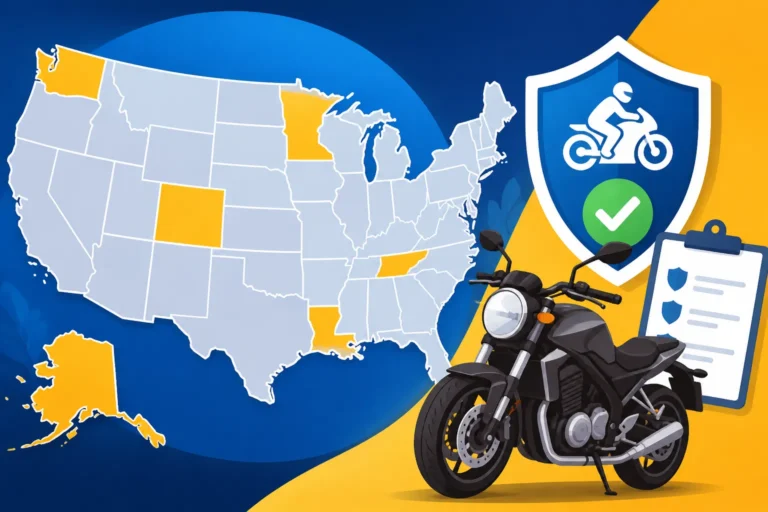
One of the most confusing things for riders is that the law changes the second you cross an invisible line on a map. What keeps you legal in Nevada might get you a ticket in Utah. This is why understanding Motorcycle Insurance Requirements by State (2026 Guide) is so important for touring riders. Every DMV has its own quirks, and some states are much more aggressive about electronic reporting than others. If your insurance lapses, some states' computers notify the DMV immediately, leading to an automatic suspension of your registration.
States With No Insurance Requirements
Believe it or not, there are still a few places where you can technically ride without a standard insurance policy. For a long time, riders pointed to Florida Motorcycle Insurance Requirements as the wild west of the biking world. In Florida, you aren't required to show proof of insurance to register your bike or get a tag. However, if you cause an accident and don't have insurance, you are in deep trouble. You can lose your license and be forced to purchase an SR-22 filing for years.
Then there is New Hampshire, which is famous for its "Live Free or Die" motto. They don't require insurance for most riders, but they do have Financial Responsibility Laws for Riders. This means that while you don't need a policy to ride, you must be able to prove you have the funds to pay for an accident if one happens. For 99% of us, that "proof" is an insurance policy. It’s a bit of a legal loophole that sounds great until you realize the personal liability you're taking on.
No-Fault States and PIP
If you live in a place like Michigan, you’re dealing with a whole different beast. Michigan Motorcycle Insurance (No-Fault) Explained is a topic that can make even experienced riders’ heads spin. In no-fault states, your own insurance often pays for your medical bills regardless of who caused the crash. This is usually handled through Personal Injury Protection (PIP).
The catch? PIP for motorcycles is notoriously expensive—sometimes costing more than the rest of the policy combined. Some states allow you to opt-out of PIP if you have high-quality health insurance, but you have to be very careful. If your health insurance has a "motorcycle exclusion" (which many do!), and you opt out of PIP, you could end up with zero medical coverage after a wreck. Always double-check your health insurance summary of benefits before deciding you’re "legally" covered.
Proof of Insurance at Registration
In the vast majority of the country, you cannot even get your license plate without showing a valid insurance ID card. This process is known as Proof of Insurance & Registration for Motorcycles. Most states now accept digital ID cards on your phone, but I always recommend keeping a hard copy in your jacket or a waterproof stash box on the bike. Electronics fail, batteries die, and cell service in the mountains is spotty.
If you are buying a bike from a private seller on a Saturday, you need to know if your state has a Motorcycle Insurance Grace Period When Buying. Some states give you 7 to 30 days to add a new purchase to an existing policy, while others require the bike to be insured before it even touches a public road. Using a service like The Zebra can help you get a policy bound in minutes so you can ride your new toy home legally without sweating every time you see a patrol car.
| State Type | Primary Requirement | Common Limits | Mandatory PIP? |
|---|---|---|---|
| Standard States | Liability Coverage | 25/50/25 | No |
| No-Fault States | Liability + PIP | Varies | Yes |
| Optional States | Financial Responsibility | N/A | No |
| Financed Bikes | Liability + Collision/Comp | High | Usually |
Beyond the Law Why Legal Is Not Always Safe
The biggest mistake I see riders make is thinking that "legal" means "fully covered." If you only carry the state-mandated liability, and someone steals your bike or you slide on some gravel and total it yourself, your insurance company will pay you exactly zero dollars. To truly protect your investment and your body, you need to look past the Minimum Coverage to Ride Legally in Each State and consider what happens if the "other guy" isn't the problem.
Collision and Comprehensive Coverage
If you want your insurance to pay for repairs to your bike, you need Collision and Comprehensive coverage. Collision vs Comprehensive Motorcycle Coverage are the two pillars of what people call "Full Coverage." Collision covers you if you hit another car, a tree, or even if you just drop the bike in a parking lot. Since motorcycles are so easy to total (a bent frame or even expensive fairing damage can do it), collision is often the most expensive part of a policy.
Comprehensive coverage, on the other hand, is for everything else. This includes fire, vandalism, weather damage, and the big one: theft. Motorcycles are stolen at an alarming rate compared to cars. If you don't have comprehensive coverage and your bike vanishes from your apartment complex, you are stuck with the loss. For many riders, especially those with newer bikes, this isn't just an "add-on"—it's a necessity for sanity.
Uninsured and Underinsured Motorist Protection
This is perhaps the most important coverage that the law doesn't usually require. Uninsured & Underinsured Motorist Coverage (UM/UIM) protects you if you are hit by someone who either has no insurance or has limits that are too low to pay for your injuries. Statistics show that in some states, up to 20% of drivers are uninsured. As a rider, you are the most vulnerable person on the road. If an uninsured driver hits you and puts you in the hospital, and you don't have UM/UIM, you might never see a dime for your pain, suffering, or lost wages.
I’ve seen too many riders think they are safe because they are "legal," only to find out the person who hit them has nothing. By adding UM/UIM to your policy—which you can easily toggle on and off while comparing rates on The Zebra—you are essentially buying an insurance policy for the other guy. It is the single best way to protect your physical and financial well-being on two wheels.
Custom Parts and Equipment Coverage
If you’ve spent thousands of dollars on a custom exhaust, Chrome upgrades, or high-end touring luggage, a standard "legal" policy won't cover them. Most base policies only cover the bike as it came from the factory. If you wreck, the insurance company will give you the "blue book" value for a stock bike, leaving you out of pocket for all your mods.
You generally need Accessories & Custom Parts Coverage Explained to ensure your upgrades are protected. Many companies include a small amount, like $1,000 or $3,000, for free, but if you’re riding a fully decked-out bagger, you’ll likely need to increase that limit. Keep your receipts! If you can't prove what you spent, the insurance adjuster will have a hard time justifying the higher payout.
How to Verify Your State Requirements and Get Covered
Staying legal shouldn't be a full-time job, but it does require a bit of homework. Your first stop should always be your state's official DMV or Department of Insurance website. However, those sites are often written in "government-speak" that is hard to decipher. This is where tools like The Zebra come in handy, as they can quickly filter the legal requirements based on your specific zip code and bike type.
Using Comparison Tools
The days of calling ten different agents to find the best rate are over. Comparison engines like The Zebra allow you to see how different companies handle your state's requirements. Some insurers love cruisers but hate sportbikes; others offer massive discounts if you have a clean driving record but will double your rates for a single speeding ticket. By looking at multiple quotes at once, you can see who is offering the best value for the Motorcycle Insurance Requirements for Financed Bikes or whatever your specific situation requires.
When comparing, make sure you are looking at "apples to apples" coverage. Don't just look at the monthly price. Look at the deductibles and the specific limits. A policy that is $10 cheaper a month but has a $1,000 higher deductible might actually cost you more in the long run if you ever have to file a claim.
Handling Special Situations
Sometimes, staying legal is a bit more complicated. If you have a DUI or a series of major violations on your record, you might be required to file an SR-22 for Motorcycles: When It's Required. An SR-22 isn't actually insurance; it’s a document your insurance company files with the state to prove you have the required liability coverage. It usually results in higher premiums and limits your choices of insurance carriers.
Similarly, if you are a young rider, you might find that getting "legal" is incredibly expensive. In these cases, look into Motorcycle Insurance Cost by Age to see how your rates might change over time. Taking a certified safety course is one of the fastest ways to lower your premium and satisfy the state that you are a responsible operator. Most insurers offer a 10% to 15% discount just for passing a weekend class, which pays for the course itself in no time.
Motorcycle Insurance Legal Requirements Disclaimer
This guide is intended for informational purposes only and does not constitute legal or financial advice. Motorcycle insurance laws, state requirements, and coverage options are subject to frequent changes by state legislatures and insurance providers. While we strive to provide the most accurate and up-to-date information, you should always verify specific legal mandates with your local Department of Motor Vehicles (DMV) or a licensed insurance agent in your jurisdiction before operating a motorcycle. Riding without the proper legal coverage can result in criminal penalties, loss of license, and significant personal financial liability.