California Motorcycle Insurance Minimum Coverage
Riding a motorcycle in California offers some of the most iconic experiences in the world, from the sweeping curves of the Pacific Coast Highway to the dense, lane-splitting-friendly traffic of Los Angeles. However, the thrill of the open road comes with a heavy dose of legal responsibility that can be incredibly frustrating to navigate when you just want to ride. This guide settles the confusion around California motorcycle insurance minimum coverage, ensuring you stay legal and protected without overpaying for things you don't need.
Understanding the California 15/30/5 Rule
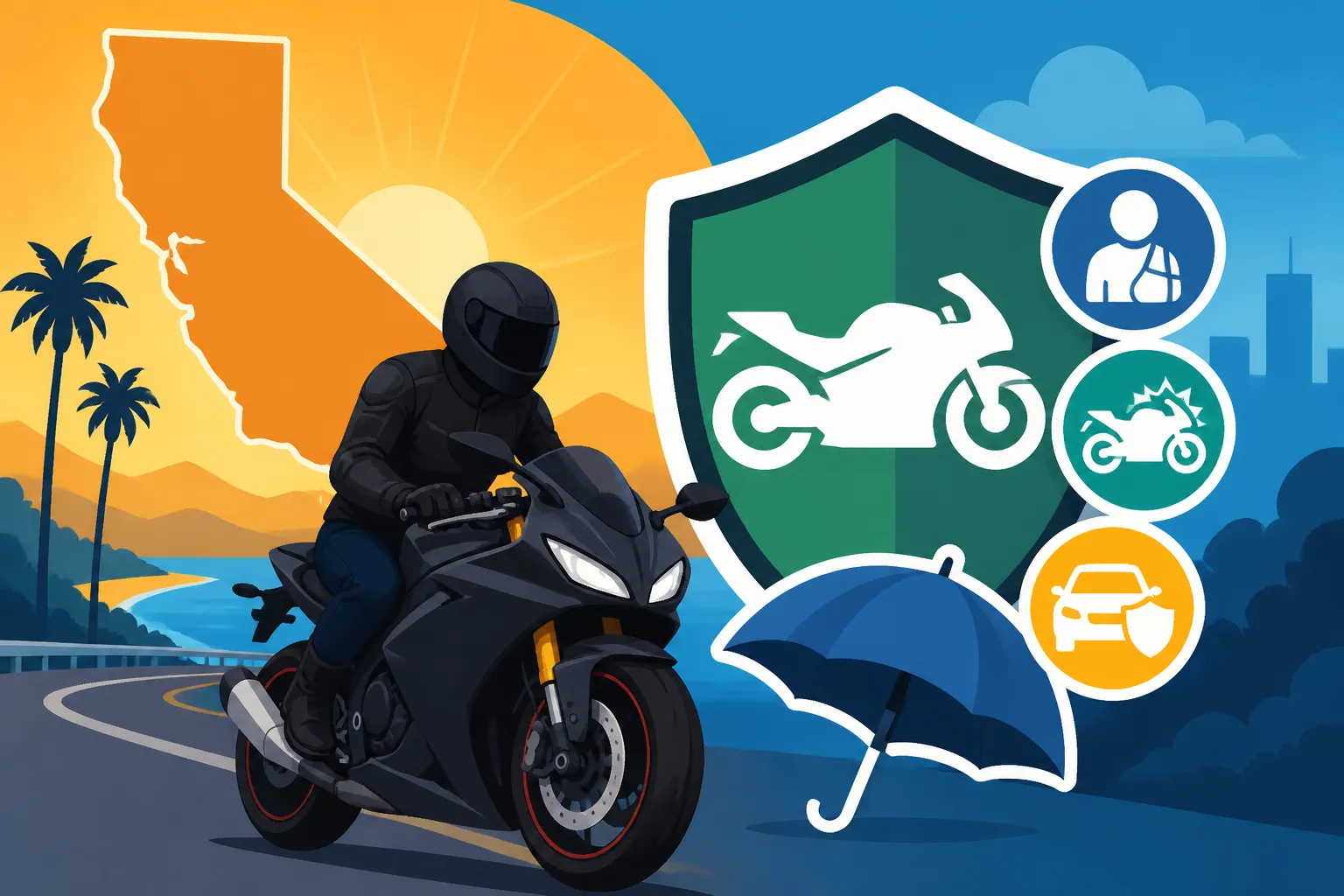
If you have spent any time looking at insurance documents, you have likely seen three numbers separated by slashes. In the Golden State, the legal baseline is 15/30/5. While these numbers might look like a secret code, they are actually the bedrock of your financial responsibility as a rider. If you are stopped by the California Highway Patrol or involved in a mishap on a busy stretch like the I-10, these are the limits the state requires you to carry to avoid immediate legal trouble.
Bodily Injury Liability Per Person
The first number, 15, represents $15,000 for bodily injury or death to one person. In the context of a motorcycle accident, this is often the most critical part of your Minimum Liability Insurance Explained (The Three Numbers) coverage. If you are found at fault for an accident that injures another person—whether that is a pedestrian, a driver, or even your own passenger in some cases—this coverage pays for their medical bills and lost wages up to that $15,000 limit.
The reality for many California riders is that $15,000 does not go very far in a modern emergency room. If you are navigating the tight streets of San Francisco or the suburban sprawl of San Jose, a minor error can lead to a hospital bill that dwarfs this minimum. When you are looking for quotes, services like The Zebra can help you see how much it costs to bump this number up, as relying solely on the state minimum often leaves your personal assets vulnerable if a lawsuit exceeds your policy limits.
Bodily Injury Liability Per Accident
The middle number, 30, stands for $30,000 for bodily injury or death to all persons involved in a single accident. This is the total pot of money your insurance company will pay out regardless of how many people were injured. If you happen to collide with a car carrying four people, that $30,000 is all that is available to be split among them under your minimum policy.
This is where California's [State Requirements] can feel a bit outdated. Considering the high cost of living and medical care in cities like San Diego or Sacramento, $30,000 is a relatively small safety net. If the total medical claims from an accident you caused reach $50,000, you are personally responsible for the remaining $20,000. It is a terrifying prospect for many riders, which is why understanding California Motorcycle Insurance Requirements is just the starting point of a conversation about true financial protection.
Property Damage Liability
The final number, 5, is $5,000 for property damage. This is arguably the most dangerous "minimum" in the state of California. This coverage pays to repair or replace someone else’s property—usually their car—if you are at fault. Think about the vehicles you see daily on the 405 or the 101. A $5,000 limit might cover a dented bumper on an older sedan, but if you slide into a late-model Tesla or a high-end SUV, you will blow through that $5,000 in the blink of an eye.
Most veteran riders will tell you that What Is the Minimum Motorcycle Insurance in California? is barely enough to cover a minor fender bender. If you total someone else’s car, the owner or their insurance company will likely come after you for the difference. This is a common pain point for riders who choose the cheapest option possible only to realize later that they are one mistake away from financial ruin. Using a platform like The Zebra allows you to compare different property damage limits to find a balance between a low monthly premium and a realistic level of protection for California’s expensive roads.
Why Minimum Coverage Might Not Be Enough
It is tempting to just check the box for the cheapest policy and get back to planning your weekend trip to Joshua Tree. However, California is an "at-fault" state, meaning the person responsible for the accident pays for the damages. If you only have the bare minimums, you are essentially gambling that you will never have more than a very minor incident. The frustration for many is that even if you are a perfect rider, the environment around you is unpredictable.
The Reality of Medical Costs in California
California has some of the highest healthcare costs in the nation. A single night in a Los Angeles hospital can cost thousands of dollars before a doctor even steps into the room. When you realize that Is Motorcycle Insurance Required in California? is only the legal baseline, you start to see the gap between being "legal" and being "protected." Minimum coverage does not cover your own medical bills or the damage to your own bike; it only covers the other guy.
Imagine you are riding through the canyons of Malibu and a patch of gravel sends you and your bike into a ditch. If you only have 15/30/5 liability coverage, your insurance company will pay $0 toward your broken leg or your smashed fairings. This is why many riders eventually look into comprehensive vs collision motorcycle coverage to ensure their own investment is protected. The peace of mind that comes from knowing you won't be out $10,000 for a new bike is often worth the extra few dollars a month.
Uninsured Motorist Coverage in the Golden State
While California law requires all drivers to have insurance, the reality on the ground is much different. A significant percentage of drivers in California are either completely uninsured or carry such low limits that they cannot cover a serious accident. This is where Uninsured & Underinsured Motorist Coverage (UM/UIM) becomes a literal lifesaver for motorcyclists. UM/UIM coverage protects you if you are hit by someone who doesn't have insurance or flees the scene of the accident.
Given the high rate of hit-and-runs in congested urban areas, this coverage is almost as important as the liability minimums themselves. When you are comparing rates on The Zebra, pay close attention to the UM/UIM options. It specifically covers your medical bills and lost wages when the at-fault party can't pay. Since motorcyclists are so much more vulnerable to injury than car drivers, having this extra layer of protection is one of the smartest moves a California rider can make.
Managing the Risks of Lane Splitting
California is unique because it was the first state to formally legalize lane splitting. While this is a huge benefit for beating the stifling traffic in the Inland Empire or the Bay Area, it also increases the likelihood of minor "mirror clips" or low-speed collisions. Even a tiny scrape on a luxury car can exceed that $5,000 property damage minimum.
If you are a frequent lane splitter, your risk profile is higher in the eyes of insurance companies. This makes California Motorcycle Insurance Minimum Coverage even more precarious. If you are found even partially at fault for a lane-splitting accident, those low limits could be exhausted instantly. It is worth looking into How Much Liability Insurance Do You Need on a Motorcycle? to see if doubling or tripling your limits provides the buffer you need for daily commuting.
| Coverage Type | CA State Minimum | Recommended for CA Riders | Why It Matters |
|---|---|---|---|
| Bodily Injury (Per Person) | $15,000 | $100,000 | Covers high CA medical costs |
| Bodily Injury (Per Accident) | $30,000 | $300,000 | Protects against multi-person claims |
| Property Damage | $5,000 | $50,000 | CA cars are expensive to repair |
| Uninsured Motorist | Not Required | Matches Liability | High rate of uninsured CA drivers |
| Collision/Comprehensive | Not Required | Actual Cash Value | Protects your bike from theft/crashes |
Financial Responsibility and Legal Requirements
Beyond just having a policy, California has specific rules about how you prove you are insured. The frustration of being pulled over is bad enough; not having your paperwork in order can turn a simple warning into a nightmare of fines and impound fees. The DMV is very strict about electronic reporting, so your insurance company must be licensed to do business in the state and report your coverage directly to them.
Proof of Insurance and Registration
In California, you cannot legally register your motorcycle without proof of insurance. If your insurance lapses, the insurance company will notify the DMV, which can lead to the suspension of your registration. Many riders ask Motorcycle Registration Without Insurance: Possible? and the short answer is no, not if you want to ride on public roads. You can file for a "Planned Non-Operation" (PNO) status if you are storing the bike, but the moment it touches a public street, it needs that 15/30/5 coverage.
You should always carry a physical or digital insurance card when you ride. Whether you are cruising through the Redwood forests or parked at a bike night in Huntington Beach, being able to produce proof of coverage is essential. If you are using a comparison tool like The Zebra, they usually provide immediate access to your digital ID cards as soon as you sign up, which is a lifesaver if you are buying a bike on short notice and want to ride it home the same day.
Penalties for Riding Uninsured
The state of California does not take kindly to uninsured riders. If you are caught riding without the minimum California Motorcycle Insurance Minimum Coverage, the penalties are steep. A first offense can result in a fine ranging from $100 to $200, plus significant state-imposed assessments that can triple that base amount. For many, the real pain comes from the Penalty for No Motorcycle Insurance in California which often includes the impoundment of your bike.
Once a motorcycle is impounded, you are responsible for the towing fees and daily storage fees, which can easily reach $500 or more in just a few days. Furthermore, the court may suspend your driver’s license for up to four years if you are involved in an accident while uninsured. This doesn't just affect your riding; it affects your ability to get to work or live your life. It is far cheaper to pay for a basic policy than to deal with the fallout of being caught without one.
The SR-22 Requirement
If you are caught riding without insurance or have a serious violation like a DUI on your record, you may be required to file an SR-22. This is not insurance itself, but a certificate your insurance company files with the DMV to prove you have at least the minimum SR-22 for Motorcycles: When It's Required coverage.
Finding affordable coverage when you have an SR-22 requirement is famously difficult. Many standard insurers will drop you or charge exorbitant rates. This is where shopping around becomes mandatory. Tools like The Zebra specialize in helping high-risk riders find the most competitive rates available, even when they are dealing with the baggage of a past mistake.
Strategies for Affordable and Effective Coverage
Finding the balance between the legal minimums and the coverage you actually need doesn't have to be a financial burden. California is a massive market with dozens of insurers competing for your business. The key is to understand what drives your costs and how to use the system to your advantage.
How to Compare Quotes and Find Discounts
The price of motorcycle insurance in California varies wildly depending on whether you live in a rural area like Modoc County or a dense urban center like San Francisco. Your age, riding experience, and the type of bike you own all play a role. To get the best deal, you should never settle for the first quote you get. Comparing multiple options through a service like The Zebra can often save you hundreds of dollars a year by highlighting different company algorithms.
Don't forget to look for common discounts. Most California insurers offer a break if you have completed a Motorcycle Safety Course Lower Insurance approved by the CMSP (California Motorcycle Safety Program). Other common discounts include multi-policy bundles, being a member of certain riding organizations, or even just having a clean driving record for three years. These small percentages add up, making it easier to afford higher coverage limits than the 15/30/5 minimum.
Does Your Equipment Affect Your Premium?
In California, the law requires all riders to wear a helmet. Not only is the California Motorcycle Helmet Law a safety mandate, but it also has implications for your insurance. While wearing a helmet might not directly lower your premium, being caught without one can lead to tickets that eventually drive your rates up. Furthermore, some specialized policies offer coverage for your riding gear, which is a great add-on if you have invested in a high-quality leather suit or an airbag vest.
The type of motorcycle you choose is perhaps the biggest factor in your insurance cost. A 600cc sportbike will almost always be more expensive to insure than a 1200cc cruiser because the "risk of loss" is higher for sportbikes. Before you buy that new bike, check the Average Motorcycle Insurance Cost by State and run a few quotes for that specific model. You might find that a slightly different bike saves you enough on insurance to pay for your gas for the whole year.
Seasonal Riding and Storage
While most of California enjoys year-round riding weather, those in the Sierra Nevada or the northernmost counties may need to store their bikes for the winter. Some riders think they can just cancel their insurance during the off-season, but this is a mistake. A lapse in coverage can lead to higher premiums when you try to restart, and it leaves your bike unprotected against theft or fire while in the garage.
Instead, look for a policy that offers a "lay-up" period. This keeps your California Motorcycle Insurance Minimum Coverage active for legal purposes but reduces the cost while the bike is stored. This keeps your continuous insurance history intact and ensures that if someone breaks into your garage in January, you aren't left holding the bag. It is a much more sophisticated way to save money than simply letting your policy expire.
California Motorcycle Insurance Disclaimer
This guide provides a general overview of motorcycle insurance requirements in California and should not be construed as legal or professional insurance advice. Insurance laws and DMV regulations are subject to change. Always consult with a licensed insurance agent or legal professional to ensure your specific policy meets all current state mandates and your personal needs.