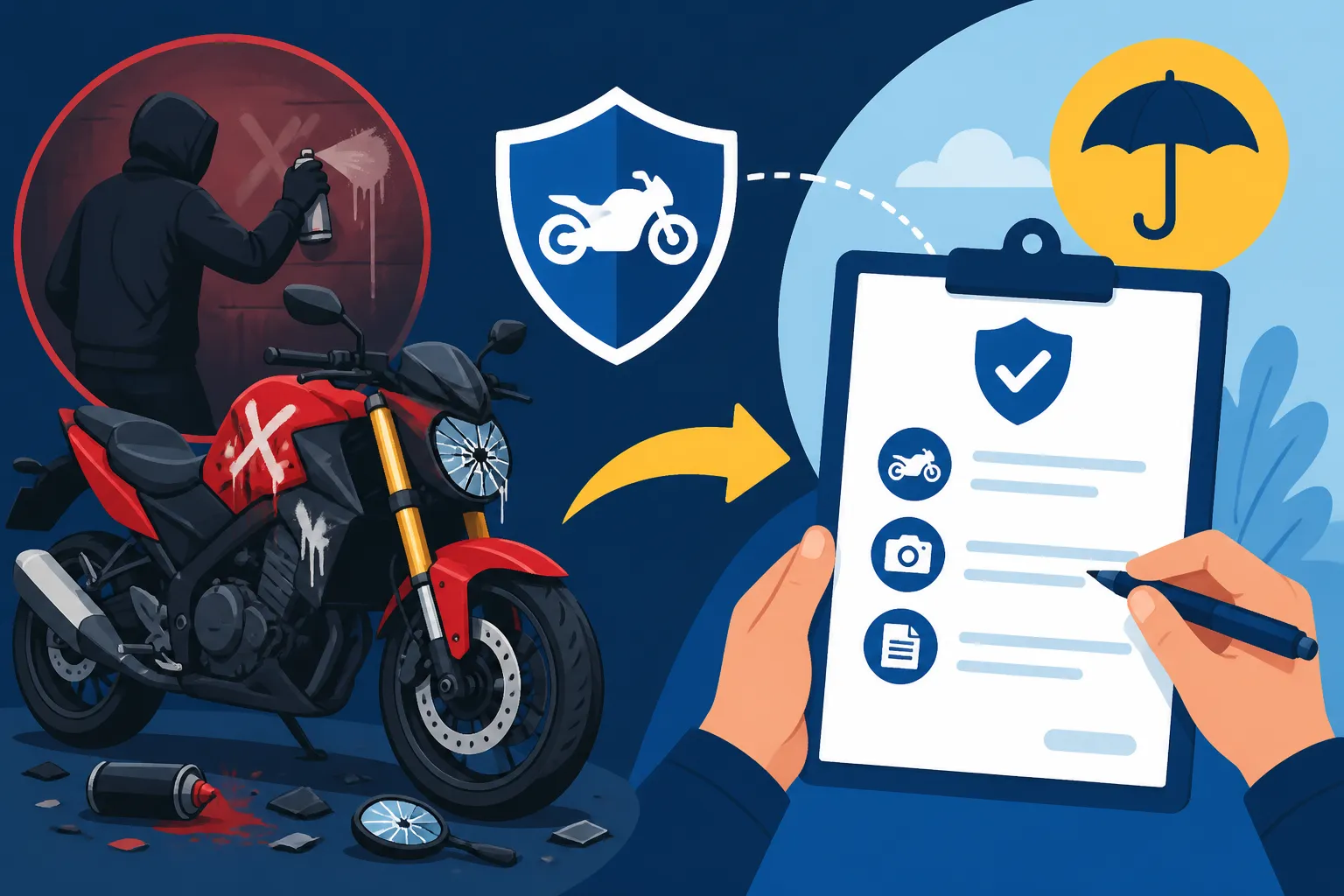
How Do I File a Claim if My Bike Is Vandalized?
There’s almost nothing worse for a rider than that gut-wrenching moment you walk out to your garage, apartment parking lot, or even a public street, and find your motorcycle has been vandalized. That sinking feeling of seeing your pride and joy scratched, dented, tires slashed, or worse, is infuriating. It’s not just the monetary damage, but the disrespect for your property and passion. This guide is here to walk you through the precise steps to take when your bike is vandalized, ensuring you know exactly how to file a claim with your motorcycle insurance and navigate the process successfully.
What is Motorcycle Vandalism and What Does Comprehensive Coverage Actually Cover?
When your motorcycle suffers damage that isn't the result of a collision, and it’s clearly an intentional act of malice, you're looking at vandalism. This isn't just accidental bumps or dings; it's a deliberate act by someone else to harm your property. Understanding what constitutes vandalism in the eyes of an insurer and how your policy responds is the first crucial step.
Defining Vandalism in an Insurance Context
Vandalism, from an insurance perspective, refers to any damage to your motorcycle that is caused maliciously by another party, and it doesn't involve your bike hitting another vehicle or object (which would be a collision). Think about it: someone keying your tank, spray-painting your fairings, breaking off a mirror, slashing your tires, or even attempting to disable your ignition. These are all acts of vandalism. The key here is the intent behind the damage. It wasn't an accident; someone actively chose to harm your bike.
Sometimes, it can be tricky. Is a dropped bike vandalism? If someone intentionally pushed it over, yes. If it just fell over due to a strong gust of wind or an unstable kickstand, that’s not vandalism. Similarly, if parts are stolen off your bike, like a catalytic converter or saddlebags, this generally falls under the same comprehensive coverage umbrella as vandalism, as it’s a non-collision event where your property is intentionally damaged or taken.
The Role of Comprehensive Coverage
Here’s the essential truth: if you want your insurance to cover vandalism, you absolutely need comprehensive coverage on your motorcycle policy. Many riders, especially those with older bikes or who have paid off their loans, sometimes opt for liability-only coverage to save a few bucks. While liability is crucial for covering damages you might cause to other people or their property, it does absolutely nothing for your own bike if it's damaged, stolen, or vandalized.
Comprehensive coverage, on the other hand, is specifically designed to protect your motorcycle from non-collision events. This includes things like theft, fire, natural disasters (hail, floods, wind), hitting an animal, and, yes, vandalism. If you only have liability coverage, you'll be footing the entire bill for repairs out of your own pocket. It's a hard lesson many learn too late. If you’re unsure about what your current policy covers, it’s worth reviewing your declarations page or talking to your agent. Understanding exactly What Is Comprehensive Motorcycle Insurance? can save you a lot of heartache.
Immediate Steps After Discovering Vandalism
Finding your motorcycle vandalized is shocking. Your first instinct might be to clean it up or move it, but resisting that urge and following a specific set of actions immediately after discovery can make all the difference in a smooth insurance claim.
Documenting the Damage Thoroughly
This step is absolutely critical and often overlooked in the heat of the moment. Before you touch anything, start documenting. Think of yourself as a crime scene investigator.
- Photos and Videos: Use your smartphone to take a plethora of photos and videos. Get wide shots that show the entire bike and its surroundings. Then, zoom in on every single area of damage. Take pictures from different angles. If there's graffiti, get close-ups. If a tire is slashed, show the cut. If a mirror is broken, photograph the shattered glass. Don't forget any fluids that might have leaked, or any parts that are clearly missing. The more visual evidence you have, the stronger your claim will be. Time-stamping these photos can also be beneficial if your phone allows it.
- Detailed Notes: While the incident is fresh in your mind, write down everything.
- Date and Time of Discovery: When exactly did you find the damage?
- Location: Where was your motorcycle parked? Be specific (e.g., "front of building at 123 Main Street," "my assigned parking spot in the apartment complex garage").
- Description of Damage: List every single item that was damaged or is missing. Be as precise as possible. "Large scratch on the left side of the fuel tank, approximately 10 inches long," "right rearview mirror snapped off," "both tires deflated and visibly cut."
- Witnesses: Did anyone see anything? If so, get their contact information. Even if they didn't see the act of vandalism, they might have noticed something unusual before or after.
This meticulous documentation will be invaluable when you speak with law enforcement and your insurance company. It provides undeniable proof of the extent of the damage.
Contacting Law Enforcement
Reporting the vandalism to the police isn't just about seeking justice; it's a mandatory step for most insurance claims. Your insurance provider will almost certainly require a police report number to process a claim for vandalism or theft.
- Call Non-Emergency Line: Unless you witness the act of vandalism in progress and there's an immediate threat, use your local police department's non-emergency line. Explain what happened, where it happened, and when you discovered it.
- File a Report: An officer may come to the scene to assess the damage and take your statement. If they can't come to the scene, they might direct you to file a report online or at the station. Either way, make sure a formal police report is created.
- Obtain a Police Report Number: This number is paramount. Your insurance company will ask for it. Write it down, and get the officer's name and badge number if possible. This report serves as an official third-party validation that the incident occurred. In a hypothetical scenario, if someone broke into your garage in a city like Philadelphia and slashed your tires, the police report from the Philadelphia Police Department would be essential evidence for your claim. This is also important if you need to file a claim because your Motorcycle Stolen: What to Do Step by Step.
Prioritizing Your Safety and Preventing Further Damage
After documenting and reporting, your next concern should be your safety and the security of your motorcycle.
- Assess Safety: If there are broken components that could be sharp, or if fluids have leaked, be cautious. Don't risk injury trying to move or fix things on the spot.
- Secure Your Bike: If your bike is in a public area and rendered unrideable, you'll need to arrange for safe transport. If parts are missing or exposed, try to cover or secure them temporarily to prevent further theft or weather damage. For example, if your ignition wires were tampered with, covering the area can deter further attempts or protect from rain. Your comprehensive coverage often includes roadside assistance or towing, so check your policy or call your insurer for options.
Navigating the Motorcycle Insurance Claims Process for Vandalism
Once the immediate shock and documentation are handled, it's time to officially open a claim with your insurance company. This part can feel daunting, but knowing the steps and what to expect will help.
Notifying Your Insurance Provider
Don't delay contacting your insurance company. The sooner you report the damage, the better.
- Initiate the Claim: You can usually start a claim by calling their claims department, using their mobile app, or submitting an online form. Many major insurers, like Progressive, have streamlined processes where you can even upload your photos and police report number directly through their app, making the initial report quick and easy. When you call, have all your documented information ready: policy number, date of incident, location, detailed description of damage, and your police report number.
- Be Honest and Detailed: Explain exactly what happened and the extent of the damage. Provide all the information you gathered in the previous steps. Remember, consistency in your story and details is key.
- Understand the Timeline: Your insurer will give you a claim number and explain the next steps. They'll likely assign a claims adjuster to your case. Filing a claim is often a similar process whether it's for vandalism or if you need to know How to File a Motorcycle Insurance Claim After a Crash?.
The Role of the Claims Adjuster
The claims adjuster is your primary point of contact from the insurance company. Their job is to investigate the claim, verify the damage, and determine the appropriate payout.
- Initial Contact: The adjuster will reach out to you, often within a day or two of you filing the claim. They'll ask for your account of the events and any supporting documentation you have.
- Damage Assessment: The adjuster will arrange for an inspection of your motorcycle. This might involve you taking it to a preferred repair shop, or the adjuster might send an inspector to your location. They'll compare the damage to your description and photos, and gather repair estimates. They'll also review your police report.
- Negotiation (if needed): Once they have the repair estimates, they'll work with you to approve a repair plan or offer a settlement if the bike is deemed a total loss. Remember, they are looking out for the insurance company's interests, so it's okay to ask questions and understand their reasoning. If the initial offer seems low, especially if you have custom parts, be prepared to provide your own documentation, like receipts for parts and labor. Sometimes, it's a bit of a back-and-forth process.
Understanding Your Deductible and Payout
When it comes to comprehensive claims, your deductible plays a significant role.
- Your Deductible: This is the amount you agreed to pay out-of-pocket before your insurance coverage kicks in. For example, if your comprehensive deductible is $500 and the approved repairs cost $1,500, you would pay the first $500, and your insurance company would cover the remaining $1,000. If the damage is very minor – say, a small scratch that costs $300 to fix – it might not even be worth filing a claim, as the repair cost is less than your deductible. You need to weigh the repair costs against your deductible and the potential impact on your future premiums.
- Actual Cash Value (ACV) vs. Other Valuations: Most standard comprehensive policies pay out based on the Actual Cash Value (ACV) of the damaged parts or the entire bike. ACV is the replacement cost minus depreciation. This means the older your bike or its parts, the less they might be valued. However, some specialized policies or endorsements offer "Agreed Value" or "Stated Value" coverage, which can be particularly beneficial for vintage, classic, or heavily customized bikes. If you have significant custom work, make sure you understand Agreed Value vs Stated Value vs Actual Cash Value as it directly impacts your potential payout. For instance, a vintage Harley-Davidson with custom paint and engine work might be worth far more than its depreciated value, and agreed value coverage would protect that investment. If the damage is extensive enough that your bike is deemed a "total loss," the payout will be based on its value according to your policy, minus your deductible.
Common Challenges and Tips for a Smooth Claim
While filing a vandalism claim should be straightforward with comprehensive coverage, a few things can complicate the process. Being prepared for these challenges can lead to a much smoother experience.
Dealing with Minor vs. Extensive Damage
Deciding whether to file a claim for vandalism isn't always clear-cut, especially if the damage is minor.
- When to File: If the repair cost significantly exceeds your comprehensive deductible, it's usually worth filing a claim. For example, if you have a $500 deductible and the damage is $2,000, you'll save $1,500 by filing.
- When to Pay Out-of-Pocket: If the damage is minor – say, a small scratch that costs $300 to fix, and your deductible is $500 – it makes no sense to file a claim. You'd pay the full $300 anyway, and you might see a slight increase in your premiums for filing a claim, even if it wasn't your fault. Filing multiple small claims, even for vandalism, can sometimes lead to your insurer viewing you as a higher risk, potentially impacting future rates. Understanding What Happens to My Rate After a Motorcycle Claim? is an important consideration here.
- The "Annoyance Factor": Sometimes, even minor damage is incredibly annoying and you want it fixed properly. Weigh the financial cost against the emotional cost of looking at that damage every day.
Custom Parts and Accessories Coverage
Many riders invest heavily in customizing their bikes, adding expensive aftermarket parts, paint jobs, or accessories. Standard comprehensive coverage might have limitations on how much it will pay for these enhancements.
- Check Your Policy: Review your policy's details regarding custom parts and accessories coverage. Many policies offer a basic amount, like $1,000 or $3,000, but anything above that usually requires an additional endorsement or rider. If your custom exhaust, saddlebags, or elaborate paint job was damaged, and you don't have adequate coverage, you might be surprised at the limited payout.
- Provide Documentation: For custom parts, it's always a good idea to keep receipts, photos, and even professional appraisal documents. This documentation will be crucial in proving the value of your modifications to the adjuster. Without it, your claim for these items might be denied or significantly undervalued. Learn more about Does Motorcycle Insurance Cover Custom Parts?.
Tips for a Successful Vandalism Claim
To ensure your vandalism claim goes as smoothly as possible, keep these tips in mind:
- Be Prompt: Report the incident to both the police and your insurance company as soon as you discover it. Delays can raise questions or make it harder to gather evidence.
- Be Organized: Keep all your documentation – photos, videos, notes, police report number, repair estimates, custom parts receipts – in one easily accessible file. This will save you time and stress during the process.
- Be Patient, But Persistent: Insurance claims can take time, especially if the damage is extensive or unique. Follow up regularly with your adjuster, but understand that they have other claims to manage. Don't be afraid to ask questions if you don't understand something.
- Consider a Repair Shop's Expertise: If your bike needs specialized repairs (e.g., custom paint matching, frame repair), make sure the repair shop you choose or that your insurer recommends has experience with motorcycles and the specific type of damage.
- Shop Around for Future Policies: After any claim, it's always a good idea to re-evaluate your insurance needs. Sites like The Zebra allow you to compare quotes from multiple providers, including major players like Progressive, to ensure you're getting the best coverage and rates. This can be especially useful if your rates adjust after a claim.
Here’s a quick overview of what to do and what to avoid:
| DO | DON'T |
|---|---|
| Document everything (photos, video, notes) | Touch or clean up before documenting |
| Contact police for a report | Delay reporting to your insurer |
| Secure your bike if unrideable | Exaggerate the damage |
| Have policy info and police report number ready | Accept the first offer if it seems too low (for total loss) |
| Keep all receipts for custom parts | Forget your deductible when weighing a claim |
| Ask questions to your adjuster | Assume liability-only covers vandalism |
Disclaimer
This article is for general informational purposes only and does not constitute professional advice. Laws, prices and regulations vary by location and change over time. Consult a qualified professional for guidance on your specific situation.