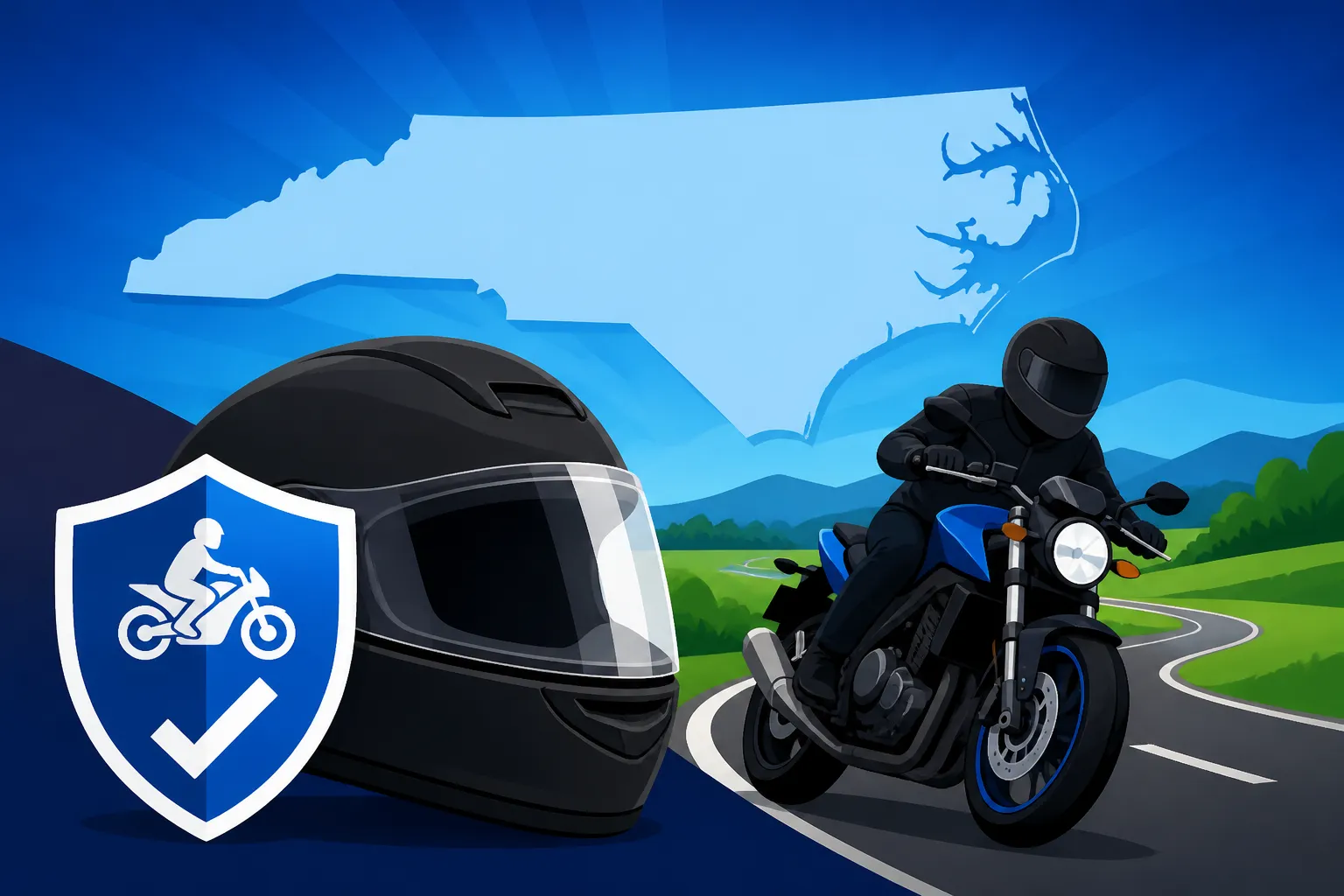
North Carolina Motorcycle Helmet Law
Riding through the Blue Ridge Parkway or cruising along the Outer Banks is a dream for many riders, but the sudden realization that your gear doesn't meet strict state mandates can turn a perfect Sunday into a legal headache. This guide breaks down the North Carolina motorcycle helmet law to ensure you stay compliant, safe, and fully protected against legal and financial liabilities.
The Reality of North Carolina’s Universal Helmet Mandate
If you are planning to ride anywhere within the borders of the Tar Heel State, there is one rule that stands above all others: everyone wears a helmet. Unlike some states that allow riders over a certain age or those with specific insurance limits to go lidless, North Carolina is a universal helmet law state. This means that regardless of your age, your years of experience, or the amount of coverage you carry, you and your passenger must be buckled up.
The law is governed by North Carolina General Statute 20-140.4, which is surprisingly specific. It’s not just about having something on your head; it’s about having the right equipment. This often frustrates riders who prefer the "wind in the face" freedom found in neighboring states like South Carolina, where the laws are much more relaxed for adults. However, in North Carolina, the highway patrol is notoriously vigilant about this.
Understanding Motorcycle Insurance Requirements by State (2026 Guide) is a great first step, but gear compliance is what keeps you from being pulled over in the first place. The mandate applies to all public streets, highways, and public vehicular areas. Whether you are on a high-performance sport bike or a vintage cruiser, the law treats you exactly the same.
Who Exactly Is Required to Wear a Helmet
The law is all-encompassing. It explicitly states that no person shall operate a motorcycle or moped on a highway or public vehicular area unless the operator and all passengers wear safety helmets. This includes children, adults, residents, and even tourists passing through from states where helmets are optional.
There is often confusion regarding sidecars and three-wheeled vehicles. If you are on a traditional motorcycle with a sidecar, the passenger in that sidecar must still wear a helmet. The state views the sidecar as part of the motorcycle unit, and therefore, the safety requirements remain unchanged. The only real wiggle room comes with autocycles that have enclosed cabs, which we will break down later in this guide.
The Specifics of DOT Compliance
Simply wearing a plastic shell isn't enough to satisfy a North Carolina state trooper. The law requires that helmets must comply with Federal Motor Vehicle Safety Standard (FMVSS) 218. This is commonly referred to as the DOT standard. A legal helmet must have a thick inner liner of firm polystyrene foam, sturdy chin straps, and a weight of approximately three pounds.
Many riders attempt to bypass this with "novelty helmets" or "brain buckets" that lack the internal padding required by federal standards. In North Carolina, these are illegal for road use. If your helmet doesn't have the permanent DOT sticker applied by the manufacturer, you are technically out of compliance. While some riders try to slap aftermarket stickers on non-compliant helmets, troopers are trained to look for the thickness of the padding and the rivets on the chin straps to verify authenticity.
Penalties and Legal Consequences of Non-Compliance
Getting caught without a helmet in North Carolina is more than just a slap on the wrist. While the fine itself might seem manageable at first glance, the secondary costs and the impact on your driving record can be significant. The state views this as a safety violation, and they treat it with the same seriousness as other moving infractions.
Many riders ask, Is Motorcycle Insurance Required in North Carolina? and the answer is a resounding yes. But even if you have the best insurance in the world, it won't stop a police officer from issuing a citation if you're riding lidless. The intersection of gear laws and traffic enforcement is where many riders find themselves in financial trouble.
Traffic Citations and Fines
The base fine for a helmet violation in North Carolina is typically around $25.50. On paper, that sounds like a bargain. However, in North Carolina, court costs are added to almost every traffic citation. These court costs often exceed $150 to $190 depending on the county. By the time you finish paying the clerk of court, that $25 mistake has turned into a $200 expense.
Furthermore, these citations are often accompanied by other checks. If a trooper pulls you over for a helmet violation, they are definitely going to ask for your license and proof of coverage. If you can't produce them, you might find out quickly What Happens If You Get Caught Riding Without Insurance? and the penalties for that are far more severe than the helmet fine itself.
Impact on Your Insurance and Driving Record
While a helmet violation in North Carolina does not currently carry "driver license points," it can still impact your insurance. In North Carolina, insurance companies use a different point system than the DMV. While the DMV might not care as much about a helmet ticket, your carrier might see it as an indicator of high-risk behavior.
If you are already paying a high premium, adding any type of equipment violation can prevent you from qualifying for "safe driver" discounts. Before you head out, it is wise to check the Average Motorcycle Insurance Cost by State to see how North Carolina compares and ensure your policy is active so a simple helmet stop doesn't escalate into a vehicle impoundment scenario.
| Helmet Feature | DOT Compliant (Legal) | Novelty/Non-Compliant (Illegal) |
|---|---|---|
| Inner Liner | At least 1-inch thick firm foam | Thin plastic or soft craft foam |
| Chin Strap | Sturdy, riveted straps | Flimsy or clip-on straps |
| Weight | Usually 3 lbs or more | Very light, often under 1 lb |
| Labels | Permanent "DOT" manufacturer label | No label or "Novelty Use Only" |
| Design | No protrusions over 1/10 inch | May have spikes or irregular shapes |
The Impact on Personal Injury Claims and Insurance
This is perhaps the most critical section of this guide. North Carolina is one of the few remaining states that follows a legal doctrine called "pure contributory negligence." This is a harsh rule that can absolutely devastate a rider's ability to recover money after an accident.
If you are involved in a crash that wasn't your fault, but you weren't wearing a helmet, the insurance company for the other driver will argue that your "negligence" (not wearing a helmet) contributed to your injuries. In North Carolina, if you are even 1% at fault for your own injuries, you are legally barred from recovering any compensation from the other party.
Comparative Negligence and the Helmet Defense
Imagine you are sitting at a red light and a distracted driver rear-ends you. Clearly, the accident is their fault. However, if you hit your head and suffer a concussion while not wearing a helmet, the defense will use the "helmet defense." They will argue that had you followed the law, your head injury would not have occurred or would have been significantly less severe.
This is why understanding Helmet Law & Insurance: Does Not Wearing One Affect Claims? is so vital for North Carolina riders. By failing to wear a helmet, you are essentially giving the at-fault driver's insurance company a "get out of jail free" card. They can use your lack of gear to deny your medical bills, lost wages, and pain and suffering claims entirely.
Protecting Your Right to Compensation
To avoid these legal pitfalls, you must not only wear a helmet but ensure it is the correct type. If you ever have to go to court, the quality of your gear will be scrutinized. Keeping receipts for your safety gear and ensuring you have the right Motorcycle License, Endorsement & Insurance will make your legal standing much stronger.
If you find yourself in the unfortunate position of having to file a claim, knowing How to File a Motorcycle Insurance Claim in North Carolina will be much easier if you can prove you were fully compliant with state safety laws at the time of the incident. It removes one of the biggest hurdles insurance adjusters use to lower or deny payouts.
Exceptions and Special Cases in North Carolina
While the law is universal, there are a few very specific scenarios where a helmet might not be required. It is important to note that these are narrow exceptions and do not apply to the vast majority of people riding two-wheeled motor vehicles on public roads.
Being aware of what constitutes a "motorcycle" versus an "autocycle" or "moped" is key. You should also be clear on What Insurance Do You Need to Ride a Motorcycle Legally? because the type of vehicle you operate determines both your gear requirements and your insurance obligations.
Autocycles and Enclosed Cabs
In recent years, vehicles like the Polaris Slingshot have become popular. North Carolina classifies these as "autocycles." Under state law, if the autocycle is equipped with a roll cage or a completely enclosed cab, and it has three wheels, a steering wheel, and seating that does not require the operator to straddle it, a helmet is not required.
However, if you are on a three-wheeled motorcycle (like a traditional Trike or a bike with a sidecar) where you still straddle the seat and use handlebars, the helmet law still applies in full force. Always check the specific classification of your vehicle before assuming you fall under the autocycle exception.
Off-Road Riding and Private Property
The North Carolina helmet mandate specifically applies to "highways and public vehicular areas." This means if you are riding a dirt bike on strictly private property—such as your own farm or a private closed-course track—the state law does not mandate a helmet.
That said, as soon as you cross a public road or use a gravel path that is open to public traffic, you are back under the jurisdiction of the law. Furthermore, many private riding parks have their own insurance requirements that mandate full safety gear. It is always better to stay protected, as Proof of Insurance & Registration for Motorcycles is still something you may need to produce if you are loading or unloading near a public access point.
Choosing the Best Coverage for North Carolina Riders
Compliance with the helmet law is just one part of being a responsible rider in North Carolina. Because the state is so strict regarding contributory negligence, you need to ensure your insurance policy is robust enough to protect you when others are at fault.
Many riders start by looking for How Much Is Motorcycle Insurance in North Carolina? to get a baseline for their budget. While finding a cheap rate is great, you should prioritize coverages that protect you, not just the other person. This includes Medical Payments (MedPay) and Uninsured/Underinsured Motorist coverage. These are essential in a state where a single equipment mistake could bar you from suing an at-fault driver.
Why MedPay Is Essential Here
Since North Carolina’s contributory negligence laws are so tough, Medical Payments coverage is a lifesaver. MedPay is a "no-fault" coverage. This means that even if the insurance company tries to argue that your lack of a helmet (or any other factor) makes you partially responsible for your injuries, MedPay will still pay out for your medical bills up to your policy limit. It provides a safety net that bypasses the legal arguments of the courtroom.
Final Thoughts on Riding in the Old North State
North Carolina offers some of the best riding in the country, but it comes with a "play by the rules" requirement. The helmet law is designed to keep you safe, but its legal implications extend far beyond the strap under your chin. By wearing a DOT-compliant helmet, you protect your life, your license, and your right to seek financial recovery if someone else hits you.
Before you kick up the kickstand, make sure you have all your documents in order. Having Proof of Insurance & Registration for Motorcycles tucked away in your saddlebag is just as important as the helmet on your head. Ride smart, stay covered, and enjoy everything the North Carolina roads have to offer without the fear of those blue lights in your rearview mirror.
Disclaimer
This guide is provided for informational purposes only and does not constitute legal or professional insurance advice. Laws regarding motorcycle safety and insurance can change; always consult with the North Carolina Department of Transportation or a qualified legal professional to verify current statutes and how they apply to your specific situation.