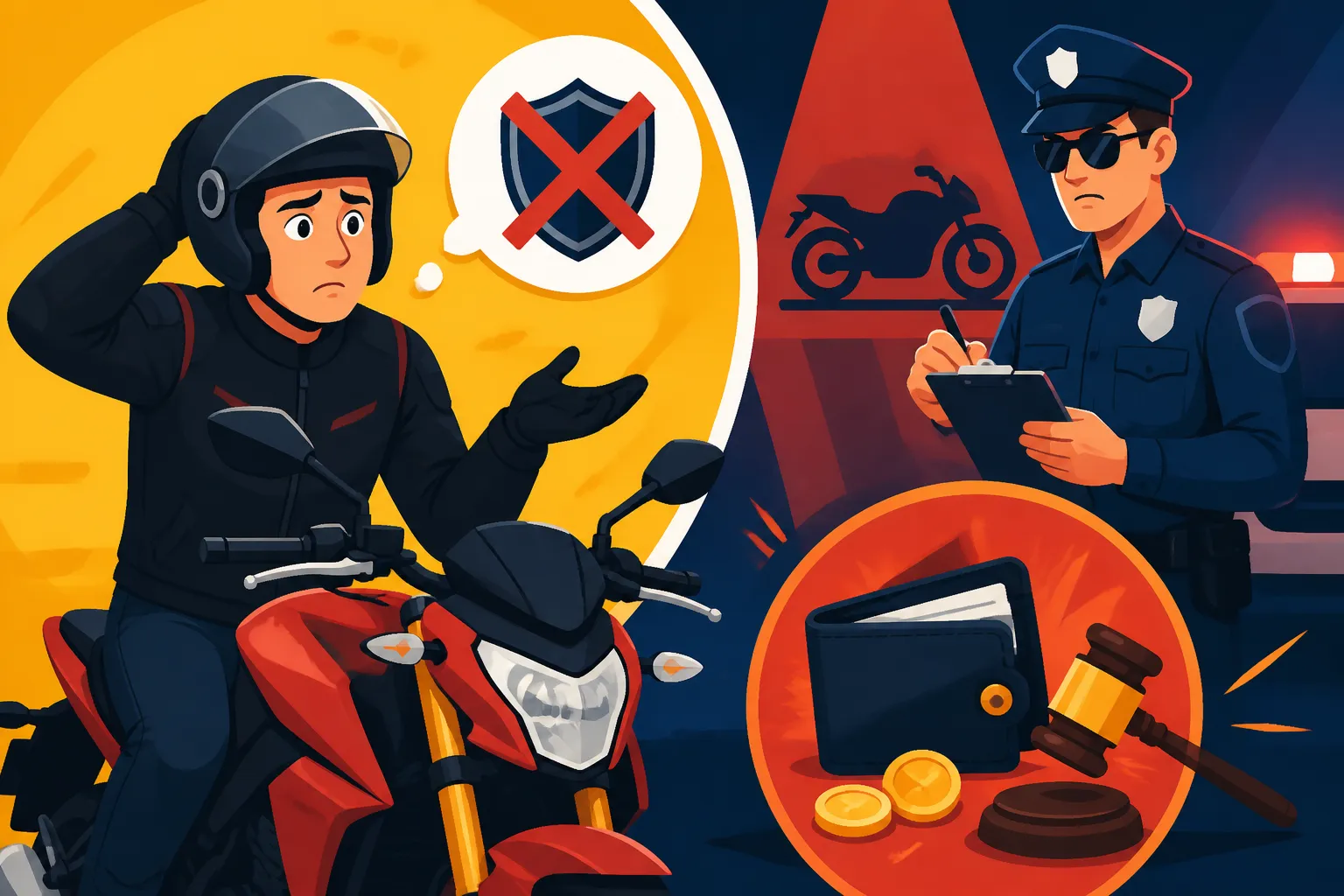
Penalties for Riding Without Insurance
Riding a motorcycle offers an unmatched sense of freedom, but rolling onto public roads without valid coverage turns that excitement into a serious legal gamble. Getting caught without minimum liability coverage can lead to heavy court fines, immediate vehicle impoundment, driver license suspension, and long-lasting financial consequences. This comprehensive guide breaks down the legal, financial, and personal penalties for riding uninsured and explains how to regain legal compliance.
Immediate Legal Consequences of Riding Uninsured
Fines Court Fees and Legal Surcharges
The moment a law enforcement officer pulls you over and asks for proof of financial responsibility, failing to provide a valid policy card initiates a costly legal sequence. Initial citations for uninsured operation can range from a few hundred dollars to several thousand, depending on the jurisdiction and your prior driving history. However, the base fine listed on your ticket is rarely the total amount you end up paying at the clerk of court window. Most local and state jurisdictions attach mandatory court administrative fees, emergency medical service surcharges, and state law enforcement fund contributions that can easily double or triple the initial penalty amount.
Beyond the immediate ticket cost, courts frequently impose mandatory penalty assessments that support trauma care networks or highway safety initiatives. If you choose to contest the citation or request a payment plan, additional docket fees and processing surcharges accumulate quickly. In many states, paying a ticket for operating without insurance counts as an automatic admission of guilt, triggering an administrative notice to the local department of motor vehicles. This notice often carries a separate civil penalty or reinstatement fee that must be settled before your driving record is cleared.
Understanding the full financial scope of an uninsured citation requires looking past the face value of the ticket. A single stop can result in a cascade of invoices, including court clerk filing fees, state treasury surcharges, and county justice assessments. For riders operating on a tight monthly budget, a routine traffic stop for a broken taillight or minor speeding infraction can instantly turn into a multi-thousand-dollar legal obligation. Reviewing the explicit rules outlined in Penalties for Riding Without Insurance helps demonstrate why rolling the dice on coverage is rarely worth the underlying risk.
Suspension of Riding Privileges and Registration
Failing to maintain continuous financial coverage often triggers an automatic administrative suspension of both your motorcycle endorsement and your vehicle registration. When a law enforcement agency or database ping identifies an uninsured rider, state authorities issue an administrative order instructing you to surrender your physical license plates and driver license. Operating a motor vehicle while under an active registration or license suspension converts a simple civil infraction into a criminal offense in almost every state, which dramatically escalates the potential penalties you face.
The duration of a registration or driver license suspension varies based on whether the incident is a first-time offense or a repeat violation. First-time suspensions might last anywhere from thirty to ninety days, while secondary infractions can strip your riding privileges for a full calendar year or longer. During this suspension window, you are legally prohibited from operating any motorcycle on public roadways, even if you subsequently purchase a brand-new insurance policy the day after receiving the suspension notice.
Restoring your legal status requires navigating a tedious administrative process with your local motor vehicle bureau. To clear a suspension, you must typically present verifiable proof of active coverage, pay administrative reinstatement fees, and sometimes retake written or practical motorcycle safety examinations. In severe cases involving prolonged coverage gaps, state agencies may flag your vehicle identification number, preventing you from selling, transferring, or re-registering the motorcycle until all outstanding state penalties are settled in full.
Impoundment and Vehicle Towing Protocols
When an officer confirms during a traffic stop that a motorcycle lacks valid insurance, state law often mandates or strongly encourages the immediate impoundment of the vehicle. Officers will not allow an uninsured motorcycle to be driven away from the scene, as doing so exposes the department and the public to unmitigated liability. Instead, a licensed commercial towing service is dispatched to hoist your motorcycle onto a flatbed truck and transport it to a designated impound lot, leaving you stranded at the side of the road.
The financial bleed begins the moment the tow truck winch pulls your bike onto the bed. Towing companies charge standardized hook-up fees alongside per-mile haulage rates that are significantly higher than standard commercial roadside assistance tariffs. Once the bike arrives at the impound yard, daily storage fees begin accruing immediately. Because impound lots operate on strict business hours and require extensive paperwork verification before releasing a vehicle, bikes often sit in storage for several days, compounding the total release fee dramatically.
Retrieving a impounded motorcycle requires satisfying multiple legal prerequisites before the yard manager will hand over the keys. You must present proof of ownership, pay all accumulated towing and storage fees in cash or certified funds, and present a valid, active insurance policy that meets state compliance standards. If you are unable to obtain coverage or pay the mounting impound fees within a state-specified timeframe, the towing facility acquires a possessory lien on the motorcycle and can legally put it up for public auction to settle the unpaid balance.
Long-Term Financial Impact and Rate Spikes
High-Risk Rider Classification and Insurance Gaps
Beyond immediate court fines and impound bills, riding without valid coverage creates a severe blotch on your consumer insurance profile. Insurance companies rely heavily on historical underwriting data to evaluate risk, and a documented lapse in coverage—even for a few days—flags you as an unstable or high-risk applicant. When you eventually apply for a new policy, underwriters look past your riding experience and focus heavily on the lapse, categorizing you alongside drivers with multiple moving violations or recent accidents.
This high-risk classification causes future premium quotes to skyrocket compared to rates offered to riders who maintain continuous coverage. Insurance carriers routinely revoke standard billing discounts, such as continuous coverage credits, multi-policy bundles, and loyalty incentives, for anyone with an uninsured violation on their driving record. In many instances, mainstream preferred insurance providers will decline to issue a policy altogether, forcing you to seek coverage from specialized non-standard carriers that charge premium rates for minimal coverage limits.
Maintaining continuous coverage is one of the single most effective ways to secure reasonable policy rates over time. When underwriters observe a gap caused by non-payment or deliberate cancellation without a replacement policy, they assume an elevated statistical probability of future claims. Exploring Financial Responsibility Laws for Riders illustrates how state insurance mandates directly interact with underwriting risk matrices, demonstrating that a lapse in coverage can easily double your monthly insurance costs for three to five consecutive years.
Mandatory SR-22 and FR-44 Filings
In many jurisdictions, getting caught riding without insurance results in a state mandate requiring you to maintain an administrative financial responsibility filing, commonly known as an SR-22 or FR-44 certificate. An SR-22 is not an insurance policy itself, but rather an official endorsement attached to your underlying policy that obligates your insurance company to notify the state motor vehicle bureau immediately if your policy is altered, canceled, or allowed to lapse for any reason.
| Feature | SR-22 Filing | FR-44 Filing |
|---|---|---|
| Target Violators | Uninsured driving, minor offenses | Severe violations, DUIs, serious |
| uninsured bodily injury crashes | ||
| Required Coverage Limits | Standard state minimum liability | Significantly higher liability |
| limits | limits (often double or triple) | |
| Average Duration | 3 consecutive years | 3 consecutive years |
| Primary Purpose | DMV state monitoring of active | High-liability state monitoring |
| financial coverage | for severe high-risk offenders |
Securing an SR-22 for Motorcycles: When It’s Required endorsement adds ongoing administrative costs to your regular policy payments. Insurance carriers charge a processing fee to file the form with the state, but the real expense stems from the high-risk premium category you are automatically moved into. If your policy lapses even by a single day during a mandatory three-year filing period, the insurer files an immediate cancellation notice with the state, which instantly triggers a license re-suspension and restarts your mandatory three-year filing timeline from day one.
In certain states, extreme violations or uninsured accidents trigger an even stricter requirement known as an FR-44. Designed for high-liability situations, an FR-44 requires the policyholder to purchase liability coverage limits that are substantially higher than standard state minimums—frequently requiring double or triple the standard minimum limits for bodily injury and property damage. Requiring such high liability caps on top of high-risk underwriting rates creates a heavy financial burden that can easily cost thousands of dollars per year.
Out-of-Pocket Liability and Personal Asset Exposure
Operating a motorcycle without liability insurance exposes your personal savings, property, and future income to massive financial risk. Liability insurance is designed specifically to pay for bodily injuries and property damage you cause to other people in a crash. When you ride uninsured, that defensive financial buffer disappears entirely. If you cause a collision that damages another vehicle or injures a pedestrian, passenger, or driver, you become personally and individually responsible for every dollar of the resulting loss.
The medical costs associated with motor vehicle accidents accumulate rapidly, particularly when serious injuries require emergency transport, surgery, intensive hospital care, and long-term physical rehabilitation. In a multi-vehicle accident or a collision involving severe harm, total medical bills and property replacement costs can quickly surpass hundreds of thousands of dollars. Without an insurance company to absorb these costs up to policy limits, injured parties and their health insurers will file civil lawsuits against you directly to recover their expenditures.
When a court enters a civil judgment against an uninsured rider, the legal remedies available to collect that judgment are aggressive and persistent. Courts can authorize the attachment of your bank accounts, place real estate liens on your home or real property, and issue wage garnishment orders that automatically deduct a percentage of your regular paycheck until the debt is satisfied. Civil judgments remain enforceable for many years and can easily force an uninsured rider into severe personal insolvency or bankruptcy.
Civil and Criminal Repercussions After an Accident
Uninsured At-Fault Collisions and Wage Garnishment
When an uninsured rider causes a serious traffic collision, the immediate legal focus shifts from simple administrative traffic violations to comprehensive civil debt collection. If you hit another motorist, damaged public infrastructure, or injured a bystander, the victim’s insurance policy will often step in to pay the victim’s bills through their own uninsured motorist coverage. However, that does not mean you are off the hook. The insurance company will immediately initiate a legal process known as subrogation to collect every penny paid out back from you directly.
Subrogation departments at major insurance carriers employ dedicated legal teams and collection agencies whose sole responsibility is recovering claim payouts from uninsured at-fault drivers. These entities will file lawsuits against you in civil court, securing default judgments if you fail to retain defense counsel. Once a legal judgment is entered against you, the collection team can secure wage garnishment orders through local court systems, forcing your regular employer to divert a chunk of your earnings directly to the creditor before your paycheck hits your bank account.
The continuous drain of wage garnishment can drag on for decades depending on the size of the judgment and your ongoing income. In addition to regular wage deductions, post-judgment interest accumulates on the unpaid principal balance, meaning the total amount you owe can grow even as monthly payments are withheld from your salary. For a rider trying to maintain a household, build savings, or purchase a home, carrying an active subrogation judgment creates a severe and long-lasting obstacle to financial stability.
License Revocation and Mandatory Restitution
In scenarios where an uninsured crash results in significant bodily injury or extensive property damage, state departments of motor vehicles work in tandem with civil courts to enforce mandatory restitution requirements. Unlike a standard administrative suspension, license revocation completely cancels your driving privileges until specific legal criteria are satisfied. Many state motor vehicle codes mandate that an uninsured at-fault driver’s license remain completely revoked until all outstanding civil damage judgments are paid in full or a formal, court-approved payment plan is actively established with the injured parties.
Setting up a formal payment arrangement with an injured party or their subrogation carrier allows you to apply for a conditional license reinstatement, but the margin for error is razor-thin. If you miss a single scheduled installment payment under the court-mandated agreement, the creditor can immediately file an affidavit of default with the court clerk. Upon receipt of this filing, the DMV will re-impose an immediate, indefinite revocation of your driving privileges without requiring a separate hearing.
In addition to civil judgments, criminal courts handling reckless driving or uninsured operating charges can order direct criminal restitution as a condition of probation or sentencing. Failing to pay court-ordered criminal restitution can lead to formal probation violations, additional court hearings, and potential jail time. Reviewing the fundamental mechanics of Minimum Liability Insurance Explained (The Three Numbers) highlights how maintaining basic, legally required coverage limits protects you from facing devastating personal restitution obligations down the road.
Criminal Misdemeanor Charges and Probation
While operating without insurance is categorized as a civil traffic infraction in some jurisdictions for a first offense, repeat occurrences or uninsured driving involving major traffic violations often escalate to criminal misdemeanor charges. A misdemeanor conviction results in a permanent criminal record, which must be disclosed on job applications, housing background checks, and professional licensing disclosures. Facing formal criminal charges requires retaining a criminal defense attorney or navigating the legal system with a public defender, adding substantial legal defense fees to your total expenses.
Judges sentencing individuals for criminal uninsured operation have wide discretion to impose punitive penalties beyond mere financial fines. Sentence structures often include conditional probation terms ranging from six months to two years. Under formal probation, you must report regularly to a probation officer, submit to random checks, pay monthly supervision fees, and strictly adhere to court-ordered conditions, such as maintaining full-time employment and attending mandatory traffic safety or driver rehabilitation courses.
In severe scenarios—particularly those involving repeat convictions, driving while suspended, or causing crashes that result in serious bodily injury or death—courts can and do impose active jail sentences. Spending time behind bars results in immediate job loss, severe interruption to family life, and long-term personal disruption. Understanding the escalation from a basic traffic citation to a formal criminal trial emphasizes why staying legal on the road is a fundamental responsibility for every rider.
How Enforcement Systems Catch Uninsured Riders
Automated License Plate Readers and Police Traffic Stops
The methods law enforcement agencies use to identify uninsured riders have evolved far beyond relying on chance observations during routine traffic stops. Modern police cruisers are routinely equipped with sophisticated Automated License Plate Reader (ALPR) technology. These roof-mounted optical cameras automatically scan thousands of vehicle license plates per hour as officers patrol highways, city streets, and parking lots, cross-referencing scanned registration numbers against real-time state databases in milliseconds.
| System / Method | How Uninsured Riders Are Identified |
|---|---|
| Automated License Plate Readers | Optical cameras scan plates in real-time and match against |
| (ALPR) | state DMV databases for active insurance verification. |
| Electronic DMV Verification | Insurers feed daily policy changes directly to state databases, |
| Systems | triggering automated warning letters upon coverage drop. |
| Routine Traffic Stops | Officers request physical/digital proof of insurance during |
| stops for minor equipment or moving violations. | |
| On-Scene Accident Investigations | Officers demand insurance verification for all involved |
| parties to compile mandatory crash reports. |
When an ALPR system flags a motorcycle license plate associated with an unverified or flagged insurance status, the in-vehicle computer immediately alerts the patrol officer. This gives the officer valid legal reasonable suspicion to initiate an immediate traffic stop, even if you were obeying every speed limit and traffic signal perfectly. What started as a smooth, peaceful ride can instantly transform into an enforcement stop, vehicle search, towing scenario, and court summons simply because an automated camera scanned your plate as you rode past a patrol car.
Even without ALPR units, routine law enforcement encounters frequently expose uninsured status. Officers regularly conduct traffic stops for minor equipment issues, such as a burned-out license plate bulb, a non-functional turn signal, or an aftermarket exhaust that exceeds local noise ordinances. The very first documents requested during any traffic encounter are your driver license, registration, and proof of financial responsibility. Failing to produce valid paper or digital proof immediately expands the scope of the stop from a simple verbal warning into a full enforcement investigation.
Electronic DMV Database Cross-Checking Systems
Many riders operating without coverage assume they can avoid detection simply by riding carefully and avoiding traffic stops. However, state departments of motor vehicles utilize electronic verification systems that actively track your policy status behind the scenes. In most states, licensed insurance companies are legally required to maintain direct electronic data links with the state DMV, transmitting daily updates regarding policy originations, adjustments, non-renewals, and immediate cancellations.
When an insurance carrier submits an electronic notification that a policy has been canceled or allowed to lapse due to non-payment, the state’s automated database flags the corresponding vehicle registration record instantly. The system then automatically generates a formal warning notice, which is mailed to your registered address giving you a strict, time-sensitive window—typically ten to thirty days—to provide verifiable proof of replacement coverage. If you fail to respond with verified insurance documentation, the system automatically suspends your vehicle registration without requiring any intervention from a judge or law enforcement officer.
This automated cross-checking process means that a gap in coverage is almost guaranteed to be flagged by state authorities, regardless of whether your motorcycle is sitting parked in a garage or being ridden down the interstate. Attempting to trick the system by presenting an expired insurance card or a fraudulent certificate of insurance carries severe criminal penalties, including felony charges for presenting false legal documents to law enforcement. Reviewing the operational steps of What Happens If You Ride Without Insurance? reveals how these behind-the-scenes tracking systems make riding uninsured a losing proposition.
Mandatory Proof Requests During Accidents and Title Transfers
Traffic collisions create an immediate, inescapable requirement to present proof of active liability coverage. State laws mandate that all drivers and riders involved in a vehicular accident—regardless of who appears to be at fault—exchange insurance details and present physical or digital policy documentation to investigating law enforcement officers. When an officer completes the official state crash report, insurance verification numbers are logged into the permanent record. Failing to supply verifiable insurance information at the scene results in immediate citations and administrative flagging.
Similarly, administrative transaction points at county tag offices and DMV branches act as strict enforcement checkpoints. When you attempt to buy, sell, title, or renew the registration tags on a motorcycle, state regulations require staff to verify active insurance coverage before completing the transaction. Attempting to register a newly acquired motorcycle or transfer a title without active coverage halts the process immediately, leaving you with an unregisterable vehicle that cannot legally be operated or parked on public roads.
In many jurisdictions, applying for a replacement title, requesting personalized license plates, or removing a legal lien from a vehicle record requires passing through automated verification queues. If the state system detects an unverified coverage status attached to your rider profile, all pending administrative transactions are frozen until outstanding compliance fees are paid and active policy documentation is confirmed. Reading through Proof of Insurance & Registration for Motorcycles illustrates how tightly integrated administrative processes have become across modern state agencies.
State-by-State Penalty Variations and Exceptions
Strict Compliance States vs Financial Responsibility States
Motorcycle insurance statutes vary widely across the nation, creating a complex patchwork of legal requirements depending on where your bike is registered. Broadly speaking, states fall into two primary regulatory categories: strict mandatory compliance jurisdictions and financial responsibility jurisdictions. In strict compliance states, operating or maintaining registration on any motorcycle requires continuous liability insurance coverage, with zero exceptions allowed for personal financial standing or seasonal storage preferences.
| Jurisdiction Category | Key Legal Requirements & Enforcement Mechanics |
|---|---|
| Strict Compliance States | Continuous liability insurance required at all times. |
| Automated DMV tracking triggers immediate registration fees. | |
| Financial Responsibility States | Permits alternate proof of assets (e.g., surety bonds, cash |
| deposits with state treasury) in lieu of traditional insurance. | |
| Hybrid / Exemption States | Insurance optional only under narrow statutory conditions |
| (e.g., proving high individual medical coverage limits). |
Financial responsibility jurisdictions offer a slightly different framework, allowing riders to fulfill state mandates through alternative mechanisms rather than traditional insurance policies. In these states, a rider can satisfy legal requirements by posting an approved cash deposit, security bond, or certificate of self-insurance directly with the state treasury or DMV. However, setting up an approved self-insurance trust requires depositing tens of thousands of dollars in unencumbered personal capital with state officials, making traditional policy coverage the only practical option for the vast majority of motorcyclists.
A tiny minority of states operate under unique statutory frameworks where traditional liability coverage is not strictly mandatory for every rider under every circumstance. However, these exceptions come with severe catches. For instance, in states where insurance is optional for certain adult riders, you must typically demonstrate personal financial capacity to cover potential damages, or satisfy strict health insurance thresholds. Furthermore, if an uninsured rider causes an accident in these non-mandatory jurisdictions, they remain fully exposed to civil liability, license suspension, and mandatory restitution judgments.
Penalties for First-Time vs Repeat Violators
State judicial codes draw sharp distinctions between a first-time administrative oversight and a persistent pattern of operating uninsured. For a initial offense without an accompanying accident, courts often display moderate leniency, particularly if the rider secures valid coverage prior to their scheduled court appearance date. Judges may elect to reduce the base fine or stay a portion of the suspension, provided the rider pays mandatory court administrative costs and presents verified proof of a newly bound insurance policy.
Repeat violations, however, trigger aggressively escalating statutory penalties. A second or third conviction within a specified lookback period (typically three to five years) converts mandatory statutory minimums into severe punitive measures. Fines often increase exponentially, license and registration suspensions are extended from weeks to years, and judges lose the discretionary authority to waive court fees or offer alternative diversion programs. In many states, a second uninsured conviction carries mandatory jail time ranging from forty-eight hours to thirty days.
For repeat offenders, the path back to legal riding privileges is steep and expensive. State agencies frequently demand multi-year high-risk filing guarantees, require the completion of probation periods, and impose hefty administrative restoration surcharges. Additionally, repeat convictions can trigger habitual traffic offender designations, which carry extended multi-year license revocations and turn subsequent driving violations into severe felony charges. Examining specific regional penalties like the Penalty for No Motorcycle Insurance in California or the Penalty for No Motorcycle Insurance in Texas underscores how quickly local courts crack down on repeat uninsured operation.
Out-of-State Violations and Interstate Compacts
Riding across state lines without insurance creates complex legal trouble that spans multiple jurisdictions. Many riders falsely assume that if they receive an uninsured citation while traveling through another state, the penalty will remain isolated within that foreign state’s court system without affecting their home driver license or registration status. This assumption is completely wrong, thanks to nationwide administrative agreements known as interstate compacts.
The Driver License Compact (DLC) and the Non-Resident Violator Compact (NRVC) are formal agreements shared by almost all states. When you are cited for operating without insurance in a foreign state and fail to pay the court fine, appear in court, or satisfy the local sentence, the out-of-state court notifies your home state’s DMV. Your home state is then legally obligated to process the out-of-state conviction or failure-to-appear notice as if the offense had occurred right on your hometown streets, initiating local license suspensions and administrative points.
Furthermore, getting into an uninsured accident while traveling out of state exposes you to multi-jurisdictional lawsuits and enforcement actions. The victim can file civil actions in the state where the accident occurred, and any resulting civil judgment will be transferred to your home state for asset collection and wage garnishment under full faith and credit legal doctrines. Traveling beyond your home state lines without verifiable financial coverage creates massive personal and legal exposure with zero legal safe harbors.
What to Do If Your Motorcycle Insurance Lapses
Immediate Steps to Reinstate Your Coverage
If you suddenly discover that your motorcycle coverage has lapsed—whether due to an expired credit card, an administrative oversight, or a temporary cash flow issue—taking rapid, deliberate action is critical to limit legal and financial damage. The very first rule of handling an active lapse is simple: stop riding the motorcycle immediately. Park the bike securely in a private driveway or garage, remove the ignition keys, and do not ride it under any circumstances until continuous, verified policy coverage is officially re-established.
Contact your previous insurance company immediately to inquire whether your policy falls within an allowable administrative reinstatement window. Some insurance providers offer a brief grace period—typically ranging from a few days to a couple of weeks—during which you can catch up on overdue premium payments and reinstate your existing coverage without a formal gap showing on your record. If you act quickly, review options surrounding the Motorcycle Insurance Grace Period When Buying or renewing policies to see if your insurer can reinstate coverage retroactively.
If your previous carrier declines reinstatement or demands an exorbitant rewrite fee, immediately shop for a new policy with standard or non-standard carriers. Be completely honest about the recent lapse during the application process; hiding a coverage gap will result in denied claims later if an underwriter discovers misrepresentation on your application. Once your new policy is bound, secure a physical copy of your new insurance card and request that your insurer submit an electronic proof of coverage filing to your state’s DMV immediately.
Communicating with the DMV to Avoid Suspensions
Securing a new insurance policy is only half the battle; you must also actively resolve any pending administrative tracking flags with your state department of motor vehicles. If your previous insurer already notified the state of your policy cancellation, an automated clock is ticking toward administrative registration and license suspension. Do not wait for a formal suspension notice to arrive in your mailbox before taking action with the state tag office.
Log onto your state DMV online portal or visit a local office in person to check the active status of your vehicle registration and driver license. Present your new proof of coverage documentation, along with any required compliance verification forms, to clear flagged status flags on your profile. If the state has already assessed an administrative non-coverage fee or late response penalty, pay it immediately to prevent your record from escalating to full suspension status.
If you plan to store your motorcycle for an extended period and deliberately choose to drop coverage, manage the administrative process proactively rather than letting the policy lapse passively. Most states allow you to file an official Affidavit of Non-Use or temporarily surrender your license plates to the DMV before canceling your policy. This administrative step formally notifies the state that the motorcycle is off public roads, protecting you from automated registration suspensions and non-coverage fines.
Securing Affordable Non-Owner or Basic Coverage
For riders who find standard policy quotes unaffordable following a lapse or traffic citation, maintaining basic legal compliance should remain the absolute top priority. If high rates prevent you from purchasing comprehensive or collision coverage, consider scaling back your policy to state mandatory liability limits temporarily. While a liability-only policy will not pay to fix your own bike if you drop it, it satisfies legal financial responsibility mandates, clears DMV suspension flags, and halts the compounding damage of an extended coverage gap on your underwriting record.
If you do not currently own a operational motorcycle but want to maintain continuous coverage on your driver record after a lapse, a non-owner motorcycle policy can be an effective legal strategy. Non-owner policies provide liability coverage when you operate borrowed vehicles, satisfying state compliance requirements and keeping your continuous coverage record intact at a fraction of the cost of a standard vehicle policy.
Another critical step to lower your rates after a lapse is taking advantage of state-approved safety training programs. Completing a certified Motorcycle Safety Foundation (MSF) or state rider training course often qualifies you for mandatory policy discounts that help offset high-risk premium spikes. Combining basic liability limits, proactive DMV communication, and safety course discounts creates a realistic path back to full legal compliance without breaking the bank. Understanding What Happens if My Motorcycle Insurance Lapses? empowers you to make smart choices that protect your license and financial security.
Comparing Penalties Across Rider Scenarios
First-Time Traffic Stop Without Insurance
Experiencing a routine traffic stop without valid proof of insurance represents the least severe tier of non-compliance penalties, but it remains a costly and nerve-wracking ordeal. In a typical scenario, an officer pulls a rider over for a minor infraction, such as a burned-out tail light bulb or failing to signal a lane change. When the rider cannot present active paper or digital coverage cards, the officer issues a citation for operating without required financial responsibility alongside the primary equipment warning or ticket.
The immediate consequences of a first-time traffic stop citation usually involve a court appearance, standard statutory fines, and administrative court fees. Depending on local municipal policies, the officer may exercise discretion to have the motorcycle towed, or allow the rider to park the bike safely in a commercial parking lot until proper transport is arranged. If the rider purchases a valid insurance policy before their court date and presents proof to the prosecutor, courts in many jurisdictions will reduce the base fine or dismiss the charge upon payment of court administrative costs.
However, even a first-time citation that gets resolved in court leaves an administrative paper trail. The state DMV logs the conviction or administrative finding, which drops your continuous coverage history to zero and flags your profile for potential premium increases at your next policy renewal. Handling a first offense cleanly and quickly is essential to avoid compounding administrative mistakes that lead to repeat offender status.
Repeat Offender Caught Operating Uninsured
A repeat encounter with law enforcement for operating an uninsured motorcycle carries harsh, unavoidable penalties that dramatically restrict your personal mobility. When an officer or ALPR unit flags a rider who already has a prior uninsured citation or active suspension on their record, officer discretion evaporates entirely. The officer will issue criminal misdemeanor summonses, impound the motorcycle immediately, and demand immediate surrender of your physical driver license card.
The financial and legal fallout from a repeat offense escalates rapidly across multiple fronts. Fines double or triple, administrative reinstatement fees multiply, and local judges routinely impose extended license suspensions ranging from six months to two full years. To regain driving privileges after completing the suspension period, the rider is almost universally mandated to obtain an SR-22 high-risk insurance filing, maintain it without interruption for three years, and complete formal probation terms.
| Enforcement Level | Primary Legal, Financial, and Administrative Penalties |
|---|---|
| First-Time Traffic Stop | – Base court fine plus mandatory administrative surcharges. |
| (No Accident Involved) | – Potential temporary vehicle towing and storage fees. |
| – DMV gap record established; loss of continuous discounts. | |
| Repeat Uninsured Offense | – Substantial statutory fines and potential misdemeanor status. |
| (Within Lookback Period) | – Mandatory vehicle impoundment and extended license drop. |
| – Required multi-year SR-22 filing; major high-risk rates. | |
| Uninsured At-Fault Collision | – Personal liability for all bodily injury and property damage |
| (With Severe Injuries / Damage) | – Civil court lawsuits, wage garnishments, and asset liens. |
| – Long-term or permanent license revocation until paid. |
At this stage, finding affordable coverage becomes exceptionally challenging. Preferred insurance carriers will decline to write a policy for a repeat violator, leaving non-standard, high-risk insurance markets as the only alternative. Premiums in this category can easily exceed the actual market value of the motorcycle being insured, creating a heavy ongoing financial burden that serves as a harsh penalty for ignoring state financial responsibility mandates.
Uninsured Rider Involved in a Serious Crash
The most devastating scenario possible for an uninsured motorcyclist is causing a severe traffic collision. When an uninsured rider collides with another vehicle, pedestrian, or fixed structure, administrative fines and traffic citations become the least of their worries. If emergency medical personnel and law enforcement respond to a crash scene involving injuries, officers conduct an exhaustive on-scene investigation, logging driver details, insurance status, and fault determinations into official state records.
If you are determined to be at fault for the crash, you face immediate civil and criminal consequences. The injured parties and their insurance carriers will hire legal counsel to file civil injury lawsuits against you personal assets. Courts can enter multi-hundred-thousand-dollar judgments against you, leading to long-term wage garnishment, bank account levies, and real estate liens. Furthermore, your driving privileges will be revoked indefinitely under state financial responsibility laws until every dollar of restitution or civil debt is satisfied in full.
The emotional and psychological toll of an uninsured crash is equally severe. Struggling through legal battles, facing insolvency, and managing personal recovery from motorcycle crash injuries without medical payment coverage creates overwhelming personal stress. Maintaining proper liability coverage on your motorcycle is not just about avoiding traffic tickets—it is an essential personal shield that protects your health, family, assets, and future financial stability every time you turn the key.
Disclaimer
This article is for general informational purposes only and does not constitute professional advice. Laws, prices and regulations vary by location and change over time. Consult a qualified professional for guidance on your specific situation.