Florida Motorcycle Helmet Law
Riding through the Florida Keys or cruising down Ocean Drive in Miami is a dream for many motorcyclists, but the legal reality can quickly turn into a headache if you don't understand the state's specific equipment mandates. Florida operates under a partial helmet law that often confuses both residents and tourists, leading to unnecessary traffic stops or, worse, significant financial liability after an accident. This guide provides a comprehensive breakdown of the Florida motorcycle helmet law, explaining exactly who is exempt, the insurance proof you must carry, and how these choices impact your legal rights on the road.
The Age and Insurance Threshold for Helmet Exemptions
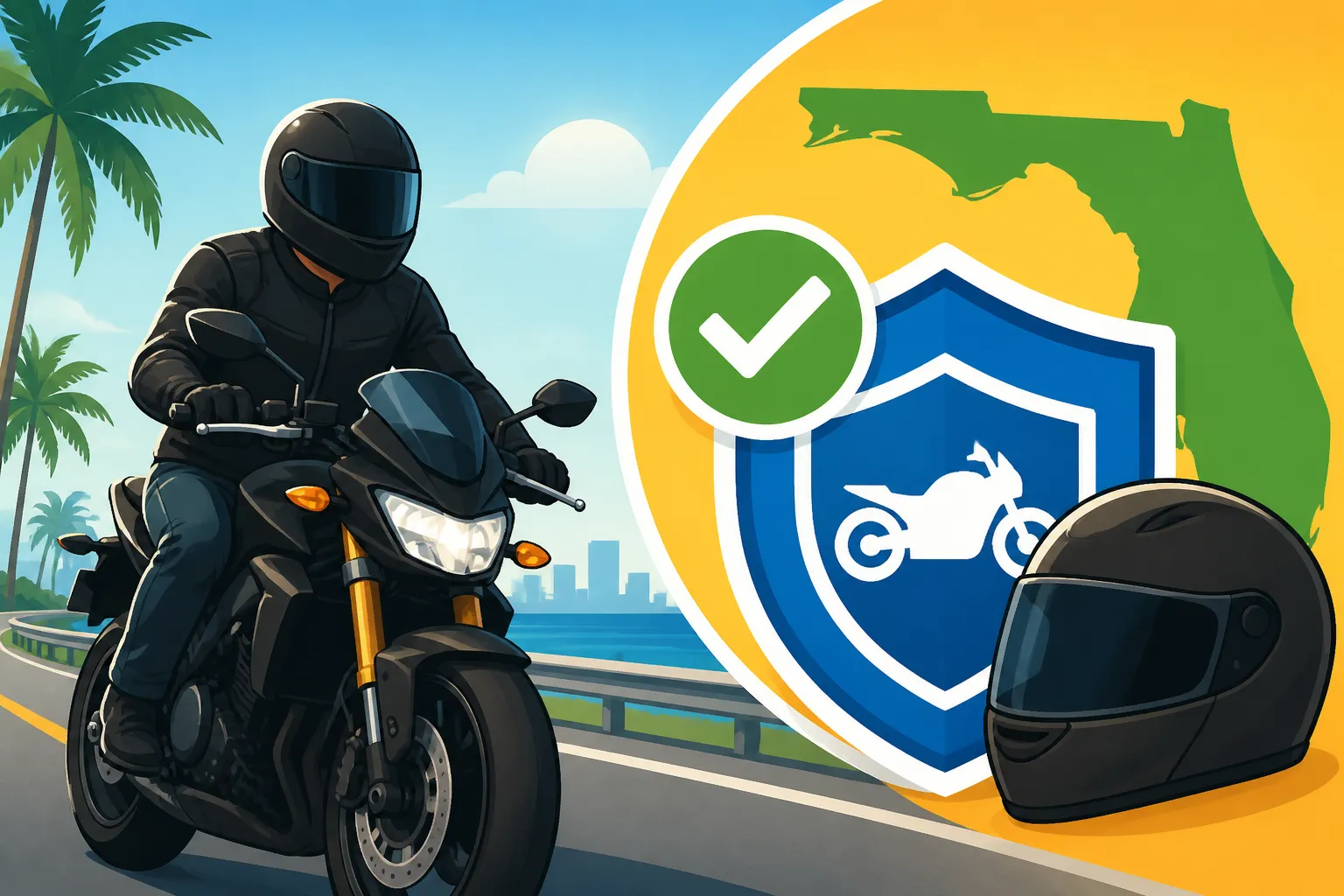
Florida is one of several states that moved away from a universal helmet law in favor of a choice-based system for experienced adults. Under Florida Statutes Section 316.211, the general rule is that all riders and passengers must wear a helmet that is securely fastened and meets the standards established by the Department of Transportation (DOT). However, there is a very specific "out" for those who prefer to ride without a lid. To legally ride without a helmet in Florida, you must meet two concurrent criteria: you must be at least 21 years of age, and you must be covered by an insurance policy providing at least $10,000 in medical benefits for injuries incurred as a result of a crash while operating or riding upon a motorcycle.
This is where many riders get into trouble. Simply being over 21 is not enough. If a Florida Highway Patrol officer pulls you over and you are not wearing a helmet, they will likely ask for proof of that specific $10,000 medical benefit. It is important to note that this is not the same as standard liability insurance. Many riders wonder Is Motorcycle Insurance Required in Florida? because the state has unique rules regarding No-Fault coverage. While Florida is a No-Fault state for four-wheeled vehicles, motorcycles are generally excluded from the requirement to carry Personal Injury Protection (PIP). However, the helmet exemption creates a back-door requirement for medical coverage that functions similarly to a small health or accident policy.
If you are under the age of 21, there are no exceptions. You must wear a helmet, period. This applies even if you have a million dollars in medical insurance and a perfect driving record. The state views younger riders as being at a higher risk level, necessitating the extra layer of physical protection. For those navigating these rules for the first time, understanding Minimum Liability Insurance Explained (The Three Numbers) can help clarify how different types of coverage—liability versus medical benefits—protect your assets and your health differently under Florida law.
The Mandatory Eye Protection Rule
A common misconception among riders visiting the Sunshine State is that if you are exempt from the helmet law, you are exempt from all headgear requirements. This is factually incorrect and a frequent cause for citations during major events like Daytona Bike Week. Regardless of your age or the amount of insurance you carry, Florida law mandates that no person shall operate a motorcycle unless he or she is wearing an eye-protective device over his or her eyes of a type approved by the Department of Highway Safety and Motor Vehicles.
This means that even if you are a 50-year-old veteran rider with high-limit medical coverage, you must still have goggles, a face shield, or safety glasses. Standard prescription glasses or sunglasses usually suffice in the eyes of local law enforcement, provided they are made of shatterproof material, but specialized motorcycle eyewear is always recommended to deal with the high-speed winds and debris common on Florida's interstates. The logic behind this is simple: a bug, a pebble, or even heavy rain at 70 mph can momentarily blind a rider, leading to a catastrophic loss of control.
When looking at Florida Motorcycle Insurance Requirements, you’ll see that the state is quite focused on the immediate environment of the rider. The eye protection rule is strictly enforced because it directly impacts the safety of others on the road, not just the rider themselves. A rider who can’t see becomes a projectile. If you are caught without eye protection, the fines are relatively modest compared to other moving violations, but the stop itself can lead to a more intrusive inspection of your Motorcycle License, Endorsement & Insurance status. Officers in coastal areas like Fort Lauderdale or Destin are particularly keen on spotting riders without eye protection, as the sandy air can frequently cause visibility issues.
The $10,000 Medical Benefit Reality Check
Let’s talk about that $10,000 medical insurance requirement. While the law says $10,000 is the magic number to ride without a helmet, any experienced rider or medical professional will tell you that $10,000 is a drop in the bucket if you actually end up in a Florida emergency room. A single night in a Level 1 Trauma Center in Orlando or Tampa can easily exceed $30,000 before you even step foot in an operating room.
Riders often ask Do You Need Insurance for a Motorcycle in Florida? specifically to satisfy this helmet law. If you choose to go lidless, you must be able to show Proof of Insurance: Digital vs Paper for Riders that specifically highlights your medical benefit limit. If your policy only provides liability coverage—meaning it pays for the other person’s car or medical bills—you are legally required to wear a helmet. You are essentially "self-insuring" your own head at a very low threshold.
Furthermore, it is vital to understand the difference between a dedicated motorcycle medical payment (MedPay) policy and your standard private health insurance. While some law enforcement officers may accept a private health insurance card as proof of medical benefits, others may argue that unless the policy specifically covers motorcycle accidents without exclusions, it doesn't meet the statutory requirement of Section 316.211. This nuance is why many Florida riders choose to add What Is Medical Payments (MedPay) for Riders? directly to their motorcycle-specific policy. It provides a clear, undeniable document that satisfies the legal requirement for helmet-free riding and ensures that there is immediate money available for your deductible if you are injured.
| Requirement Category | Riders Under 21 | Riders 21+ With $10k Med Insurance | Riders 21+ Without $10k Med Insurance |
|---|---|---|---|
| Helmet Required? | Yes, Always | No, Optional | Yes, Mandatory |
| Eye Protection? | Yes, Mandatory | Yes, Mandatory | Yes, Mandatory |
| Insurance Proof? | Standard ID | Proof of $10k Medical Benefit | Standard ID |
| Can Carry Passenger? | Yes (with proper gear) | Yes (passenger must meet same rules) | Yes (passenger must meet same rules) |
How Helmet Choice Impacts Accident Claims and Liability
Choosing not to wear a helmet in Florida doesn't just affect your safety; it fundamentally changes your legal standing if you have to file a lawsuit after a crash. Florida follows a "comparative negligence" system. This means that if you are involved in an accident that was 100% the other driver's fault, but your injuries were made worse because you weren't wearing a helmet, your financial recovery can be slashed.
Insurance adjusters are notorious for using the lack of a helmet to reduce settlement offers. They will argue that while the driver of the car caused the broken leg, the traumatic brain injury (TBI) was a result of your choice to ride unprotected. This is a critical factor discussed in Helmet Law & Insurance: Does Not Wearing One Affect Claims?. Even if you are legally riding without a helmet because you have the required insurance, a jury might still decide that a "reasonable person" would have worn one, and thus, you are partially responsible for the severity of your own injuries.
This legal hurdle is why many riders, even those who value the freedom of the Florida sun, still choose to wear a helmet in high-traffic areas like the I-4 corridor or during peak tourist seasons. If you are injured, the difference between a $500,000 settlement and a $200,000 settlement often comes down to the comparative negligence defense. When you consider How Much Is Motorcycle Insurance in Florida?, the cost of the policy is negligible compared to the potential loss of a settlement because of the "helmet defense." Understanding Motorcycle Insurance vs Car Insurance Requirements is helpful here, as motorcycle claims are handled very differently than standard auto claims in Florida's civil courts.
Practical Enforcement and Potential Penalties
What actually happens if you are caught violating the Florida helmet law? If you are under 21 or don't have the $10,000 medical coverage and you're caught without a helmet, you're looking at a non-criminal traffic infraction. This is a "moving violation," which means it can lead to points on your license and an increase in your monthly premiums. You might find yourself searching for What Happens If You Get Caught Riding Without Insurance? after a simple stop for a missing helmet turns into a deeper check of your registration and equipment.
Law enforcement in Florida generally doesn't pull people over only to check if they have $10,000 in medical insurance. Usually, the helmet check happens as an "add-on" to another stop, such as speeding or a lane splitting violation. However, in "hot zones" like the outskirts of major rallies or near the beaches, officers may be more proactive. They are well aware that many out-of-state riders from places like Georgia or Alabama (which have universal helmet laws) come to Florida and assume it's a "free for all," forgetting the insurance and age caveats.
If you are a resident, a lapse in your coverage can lead to more than just a equipment fine. If the DMV is notified that your insurance has been cancelled and you are still operating the bike, you could face a suspended registration. This is why many riders look into the Average Motorcycle Insurance Cost by State to see if they are getting a fair deal or if they should switch providers to maintain that crucial $10,000 medical threshold. Keeping your paperwork in order is the only way to ensure that a fun weekend ride doesn't turn into a series of court dates and hefty reinstatement fees.
Making an Informed Decision for Your Florida Ride
Ultimately, the Florida motorcycle helmet law is about balancing personal liberty with financial and physical responsibility. The state allows you the freedom to choose your gear, provided you are an adult and have accounted for the initial medical costs of a potential accident. However, "legal" does not always mean "safe" or "financially sound."
When deciding whether to take advantage of Florida's partial helmet law, consider the environment. A quiet ride through the Everglades at dawn is a very different risk profile than navigating the frantic six-lane highways of Jacksonville. Many riders choose a "hybrid" approach: they wear a high-quality full-face helmet for the highway segments of their journey and perhaps switch to a DOT-approved "brain bucket" or no helmet once they reach slower-paced coastal roads.
No matter what you choose, ensure your insurance is bulletproof. The $10,000 requirement is the bare minimum to stay legal, but it won't protect your family from the costs of a long-term recovery. Take the time to audit your policy and ensure that the "medical benefits" section is clearly defined so you can produce it if asked by an officer. Riding in Florida is one of life's great pleasures; keeping it legal ensures that the only thing you have to worry about is the next sunset on the horizon.
Florida Motorcycle Law Disclaimer
This guide is provided for informational purposes only and does not constitute legal or professional insurance advice. Florida's traffic laws and insurance requirements are subject to change by the state legislature. Always consult with the Florida Department of Highway Safety and Motor Vehicles (FLHSMV) or a qualified attorney to confirm current statutes before operating a motorcycle. The effectiveness of safety gear and the outcomes of insurance claims depend on specific individual circumstances and the details of your insurance contract.