What Is the Best Coverage for a New Sport Bike?
Bringing home a brand-new sport bike is an absolute thrill – the gleaming paint, the powerful engine, the promise of the open road. But that excitement can quickly turn to a knot of anxiety when you start thinking about how to properly protect such a significant investment. Navigating the world of motorcycle insurance, especially for a high-performance machine, can feel like trying to read a wiring diagram blindfolded. This comprehensive guide is here to untangle the complexities, walking you through the essential and smart coverage options to safeguard your new sport bike and give you peace of mind on every ride.
Understanding Your New Sport Bike's Unique Needs
When it comes to insuring a sport bike, you're not dealing with just any motorcycle. These machines have characteristics that make them a special case for insurance providers, and understanding these factors is the first step toward securing the best protection. It’s not just about the sticker price; it's about the entire risk profile associated with these thrilling machines.
The High-Performance Factor and Risk Profile
Sport bikes are, by their very nature, built for speed, agility, and exhilarating performance. Think about models like a new Yamaha R1, a Kawasaki Ninja, or a Ducati Panigale – they're engineered with powerful engines, advanced braking systems, and lightweight frames designed for aggressive riding. While this is precisely what makes them so much fun to ride, it also means they come with a higher perceived risk in the eyes of insurance companies. Their performance capabilities can lead to higher speeds and, statistically, a greater chance of more severe accidents. This isn't to say every sport bike rider pushes the limits, but the potential is there, and insurers price their policies accordingly. Factors like the engine size (cc), horsepower, and even the type of frame materials can influence your premiums. You might notice that a 1000cc sport bike will almost always cost more to insure than a cruiser with similar displacement, simply because of its performance-oriented design.
Beyond the bike's inherent capabilities, the typical demographic of sport bike riders also plays a role. Often, these bikes attract younger, less experienced riders, who statistically present a higher risk for accidents and claims. While this might feel unfair if you're an experienced rider getting your first sport bike, it's a broad actuarial trend that impacts pricing. This is why knowing How Much Is Motorcycle Insurance for a Beginner? can give you a heads-up. Insurance companies also consider the theft rate for certain models; popular sport bikes can be attractive targets for thieves due to their high value and demand for parts. A bike that's more likely to be stolen or involved in a high-speed accident naturally carries a higher insurance premium.
Depreciation and Replacement Value Concerns
One of the biggest headaches when insuring any new vehicle, but especially a new sport bike, is dealing with depreciation. The moment you ride that bike off the lot, its value starts to drop. This can be a real problem if your bike is totaled in an accident, even just a few months after you bought it. Most standard insurance policies pay out based on the Actual Cash Value (ACV) of your bike at the time of the claim. ACV takes into account depreciation, meaning the payout might not be enough to cover the remaining balance on your loan or to buy a brand new equivalent model. Imagine financing a $20,000 sport bike, only for it to be totaled six months later when its ACV is only $16,000. You'd be on the hook for the $4,000 difference, plus any remaining loan balance.
This is where understanding options like Agreed Value vs Stated Value vs Actual Cash Value becomes crucial. For a new sport bike, especially one you're financing, standard ACV coverage might leave you exposed. You want to ensure that if the worst happens, you're not left financially upside down. Some specialized coverages are designed to mitigate this, which we'll discuss later, ensuring you can truly replace your pride and joy without breaking the bank. Always consider how much your bike is actually worth at the time of purchase and how quickly its value will change.
Essential Coverage for Every Sport Bike Rider
When you're looking for the best coverage for a new sport bike, there are certain bedrock policies you simply cannot go without. These are the fundamental layers of protection that address the most common and financially devastating risks you face as a rider. Ignoring any of these is like riding without a helmet – risky and potentially disastrous.
Liability: Protecting Others
This is the non-negotiable cornerstone of almost every vehicle insurance policy, and motorcycle insurance is no exception. Liability Coverage for Motorcycles Explained covers the costs if you're at fault in an accident and cause injury to another person or damage to their property. Without it, you could be facing astronomical medical bills, repair costs for other vehicles, and even legal fees directly out of your own pocket. Most states legally require you to carry a minimum amount of liability coverage. For example, in California, the minimum liability limits are 15/30/5, meaning $15,000 for bodily injury per person, $30,000 for bodily injury per accident, and $5,000 for property damage.
While state minimums might seem like a way to save a few bucks, they are almost never enough to truly protect you, especially when riding a sport bike. Imagine you're riding through downtown Los Angeles, and due to a momentary lapse in judgment, you cause an accident involving a luxury car and injure its driver. State minimums would be quickly exhausted, leaving your personal assets vulnerable. Many experienced riders recommend carrying much higher liability limits, often $100,000/$300,000 for bodily injury and $50,000 or $100,000 for property damage. The incremental cost for higher limits is usually quite small compared to the potential financial ruin of an insufficient policy. It’s about protecting your financial future as much as your bike.
Comprehensive: Protecting Against the Unexpected
Unlike collisions with other vehicles or objects, comprehensive coverage steps in for those "acts of God" or situations not involving a direct impact with another moving vehicle. This is particularly vital for a new, high-value sport bike. Think about instances like theft, vandalism, fire, natural disasters (hail, floods, wind), or even hitting an animal on the road. For many riders, the thought of their brand-new machine being stolen is a constant worry, and comprehensive coverage is your shield against that.
A common scenario for sport bike owners: you park your gleaming new Kawasaki Ninja ZX-10R outside a coffee shop in Portland, only to return and find it gone. Comprehensive coverage would handle the claim for the stolen bike, minus your deductible. Or, perhaps a severe hailstorm rolls through while your bike is parked, pelting it with ice and leaving dents and damage. Again, comprehensive coverage would cover the repairs. Given the higher theft rates for sport bikes and their exposure to various environmental elements when parked, having this coverage is a no-brainer. It provides crucial protection for your investment when it's not actually being ridden and covers incidents that are beyond your control. This coverage is distinct from collision, and understanding their differences is key. For a deeper dive, read our guide on Collision vs Comprehensive Motorcycle Coverage.
Collision: Protecting Your Bike from Crashes
This is the coverage that protects your own motorcycle if it's damaged in an accident, regardless of who is at fault. Whether you slide out on a patch of gravel, hit a guardrail, or are involved in a multi-vehicle collision, collision coverage will pay for the repairs or the actual cash value of your bike if it's totaled, after your deductible. For a new sport bike, which can be quite expensive to repair or replace, collision coverage is absolutely essential. The intricate fairings, advanced electronics, and specialized components of a sport bike mean that even a minor low-side incident can result in thousands of dollars in damage.
When you're riding a powerful machine, accidents, unfortunately, can happen. Imagine taking a corner a little too hot on a backroad outside Austin, Texas, and laying your new Triumph Daytona 660 down. The damage might include a bent lever, scraped fairings, and a dinged exhaust. Without collision coverage, you'd be looking at paying for all those repairs yourself. This coverage is arguably the most important for protecting your actual investment in the bike itself. When combined with comprehensive and liability, these three components often make up what people commonly refer to as What Does Full Coverage Motorcycle Insurance Mean?. Choosing the right deductible for collision is also important, as a higher deductible means lower premiums but more out-of-pocket expense if you need to make a claim.
Smart Add-On Coverages for Sport Bikes
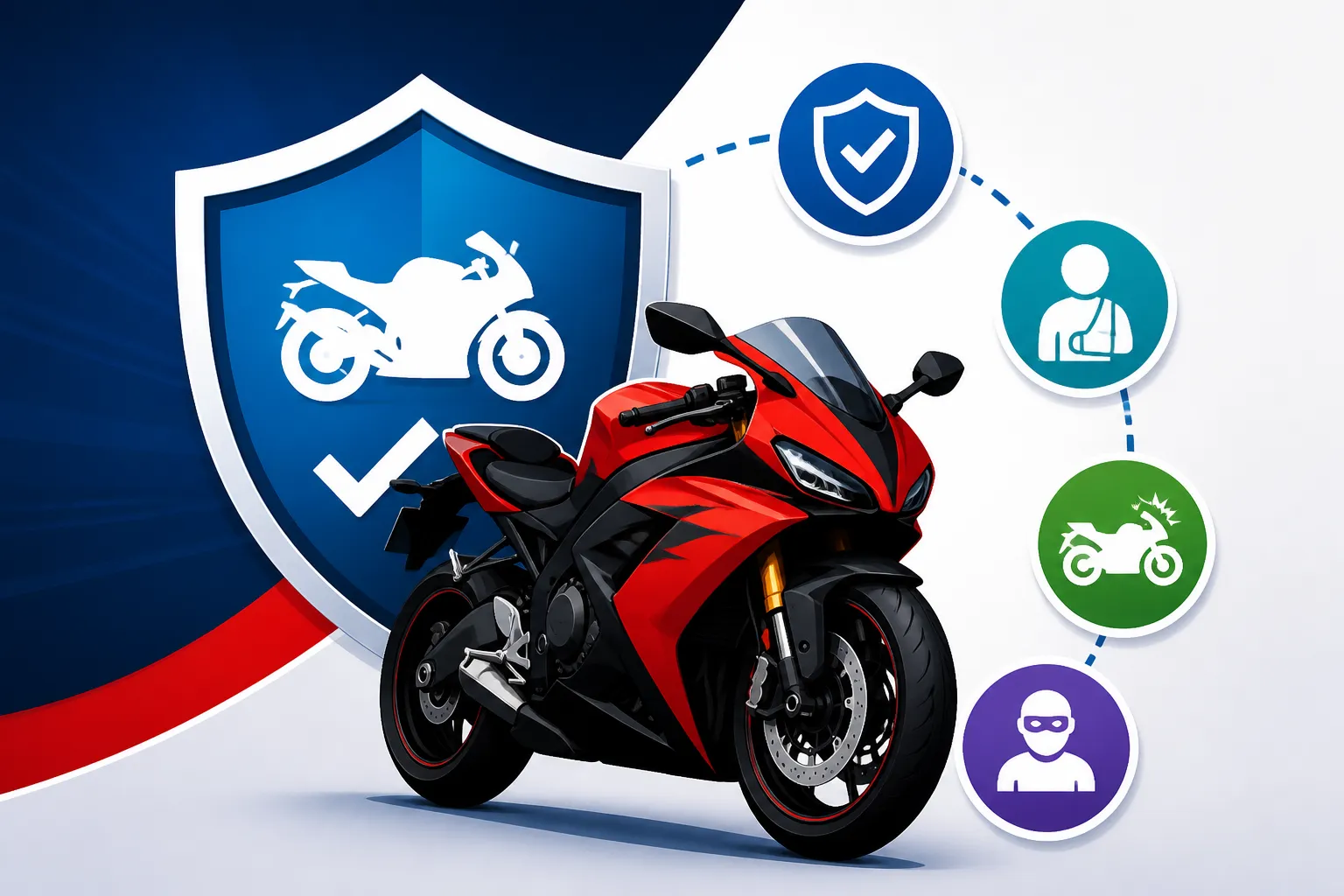
While the essential coverages form your safety net, there are several smart add-on options that are particularly beneficial for new sport bike owners. These coverages go the extra mile to provide a truly robust layer of protection, addressing specific concerns that often arise with high-performance motorcycles.
Uninsured/Underinsured Motorist Coverage
This coverage is incredibly important, especially in states where there's a higher percentage of uninsured drivers. Uninsured & Underinsured Motorist Coverage (UM/UIM) protects you if you're involved in an accident with a driver who either doesn't have insurance or doesn't have enough insurance to cover your injuries and damages. As a motorcyclist, you are inherently more vulnerable in an accident than someone in a car, meaning your medical bills and lost wages can be substantial. If the at-fault driver has no insurance, your UM coverage steps in to pay for your medical expenses and, in some cases, property damage. If they have some insurance, but it’s not enough to cover everything, UIM takes over.
Consider this: you're riding your new Honda CBR600RR through downtown Miami, and an uninsured driver blows through a stop sign, hitting you. Even if the accident isn't your fault, you could be facing serious injuries and a totaled bike. Without UM/UIM, you might have to sue the at-fault driver (who likely has no assets to seize) or shoulder the costs yourself. This is a real risk many riders face, and the cost of UM/UIM is usually quite reasonable for the immense protection it offers. It's an often-overlooked but crucial layer of financial security for any rider.
Accessories and Custom Parts Coverage
Sport bike riders love to personalize their machines, whether it's an aftermarket exhaust, custom fairings, upgraded levers, or specialized suspension components. The standard collision and comprehensive coverages usually only cover the factory-installed parts of your bike. If you've invested significant money in aftermarket accessories or custom modifications for your new sport bike, Accessories & Custom Parts Coverage Explained is an absolute must-have. Without it, if your bike is damaged or stolen, those expensive upgrades won't be covered, and you'll be out of luck.
Many policies include a small amount of accessories coverage by default (perhaps $1,000-$3,000), but for serious modifications, you'll need to increase these limits. Be sure to meticulously document all your aftermarket parts, including receipts and photos, and provide this information to your insurance provider. For example, if you just installed a full Akrapovič exhaust system and carbon fiber bits on your new Suzuki GSX-R1000, those parts could easily add thousands to your bike's value and replacement cost. Don't let your passion for customization become a financial vulnerability.
Gap Insurance: Bridging the Financial Divide
Remember our earlier discussion about depreciation? This is where Do You Need Gap Insurance on a Motorcycle? comes into play, especially for a new sport bike that you've financed. Gap insurance covers the "gap" between what you owe on your loan and the actual cash value your insurance company will pay out if your bike is totaled or stolen. Since new bikes depreciate quickly, and many riders finance a significant portion of their purchase, this gap can be substantial early in the loan term.
Let's say you bought a new Yamaha MT-09 for $10,000, financed completely, and it's totaled six months later when you still owe $9,000. If its actual cash value (ACV) at that point is only $7,000, your standard collision or comprehensive coverage would pay out $7,000 (minus your deductible). That leaves you with a $2,000 bill for a bike you no longer own. Gap insurance would cover that $2,000 shortfall, ensuring you're not stuck making payments on a phantom motorcycle. For anyone with a new, financed sport bike, this coverage provides significant peace of mind.
Roadside Assistance and Trip Interruption
While not directly related to accident damage, these coverages are invaluable for keeping you on the road and minimizing stress when things go wrong. Roadside Assistance & Towing for Motorcycles can be a lifesaver if you experience a flat tire, run out of gas, or have a mechanical breakdown far from home. Sport bikes often use specialized tires that aren't easily repaired by just any tow truck driver, and having a plan that includes proper motorcycle towing (often on a flatbed) is crucial.
Trip interruption coverage, on the other hand, comes in handy if a covered loss (like an accident or breakdown) occurs far from your home, preventing you from continuing your journey. It can help reimburse you for expenses like lodging, alternative transportation, and food while your bike is being repaired or you arrange to get back home. If you plan on taking your new sport bike on long-distance rides or weekend trips, these add-ons can turn a frustrating situation into a manageable inconvenience, allowing you to focus on the joy of riding, knowing you have support when needed.
| Coverage Type | What It Covers | Why It's Crucial for a New Sport Bike |
|---|---|---|
| Liability | Injuries/damages you cause to others. | High-performance bikes increase accident risk; protects your assets from expensive claims. |
| Collision | Damage to your bike from a collision, regardless of fault. | Sport bike repairs are costly; ensures your investment is protected if you crash. |
| Comprehensive | Damage/loss from non-collision events (theft, fire, vandalism). | Sport bikes are high theft targets; protects against "acts of God" when parked. |
| UM/UIM | Your injuries/damages if hit by an uninsured/underinsured driver. | Essential protection against negligent drivers who lack adequate insurance. |
| Accessories | Aftermarket parts & custom modifications. | Protects your investment in costly upgrades that factory coverage usually excludes. |
| Gap Insurance | Difference between loan balance and ACV if totaled. | Prevents financial loss if your financed bike is totaled early due to rapid depreciation. |
| Roadside | Towing, flat tire assistance, fuel delivery, etc. | Ensures support for breakdowns, especially important for long rides or remote locations. |
How to Find the Best Policy for Your Sport Bike
Finding the "best" coverage for your new sport bike isn't just about ticking boxes; it's about finding the right balance of protection, affordability, and a reliable provider. It requires a bit of homework, but the effort will pay off in savings and peace of mind. Knowing What Motorcycle Coverage Do You Actually Need? is essential.
Shopping Around and Comparing Quotes
This is perhaps the single most important piece of advice for any insurance shopper, but especially for sport bike owners. Rates for motorcycle insurance can vary wildly between different companies, even for the exact same coverage. Your sport bike's specific make and model, your age, riding experience, driving record, and even where you live (urban vs. rural) all play a significant role in how insurers calculate your premium. One company might see your new Ducati Panigale as an extreme risk, while another might offer a surprisingly competitive rate if you have a clean record and have completed a motorcycle safety course.
Don't settle for the first quote you receive. Use online comparison tools or work with independent agents who can shop multiple carriers for you. Platforms like The Zebra allow you to input your information once and receive quotes from numerous providers, making the comparison process much simpler. You might find that Progressive Motorcycle Insurance Review or Geico Motorcycle Insurance Review reveal different pricing and features for your specific bike. Look beyond just the bottom line; compare policy features, deductibles, and customer service ratings. A cheaper policy isn't always the best if it leaves you underinsured or with a company that's difficult to deal with during a claim. Get at least 3-5 quotes from different providers, like Harley-Davidson Insurance, Dairyland, Markel, and State Farm, to ensure you're getting a true sense of the market. This is where you really learn How to Compare Motorcycle Insurance Quotes.
Leveraging Discounts
Insurance companies offer a variety of discounts that can significantly lower your premiums, and many of these are particularly relevant for sport bike riders. Always ask about every possible discount when getting a quote. Some common discounts include:
- Motorcycle Safety Course Discount: This is huge for sport bike riders. Completing an approved motorcycle safety course (like those offered by the Motorcycle Safety Foundation) not only makes you a safer rider but often qualifies you for a substantial discount. It signals to insurers that you're committed to responsible riding. This can be one of the most effective ways to lower your Sport Bike Insurance Cost (Why So High)?.
- Multi-Policy/Bundling Discount: If you already have car insurance, home insurance, or renters insurance with a particular company, bundling your motorcycle policy with them can often lead to savings on all your policies. Companies like Allstate and Nationwide frequently offer attractive bundling options.
- Good Rider/Clean Record Discount: Maintaining a clean driving record free of accidents and tickets will almost always result in lower premiums.
- Anti-Theft Device Discount: Installing an alarm, GPS tracker, or other anti-theft devices on your new sport bike can earn you a discount, especially given the higher theft risk associated with these bikes.
- Garaging/Storage Discount: If you park your sport bike in a locked garage, let your insurer know. Secure storage can reduce the risk of theft and vandalism, which some companies reward with lower rates.
- Paid-in-Full Discount: Paying your annual premium upfront instead of in monthly installments can often save you a percentage.
- Rider Group Affiliation: Being a member of certain motorcycle organizations might also qualify you for discounts.
Don't be shy about asking your agent or checking online about every discount available. Stacking multiple discounts can make a real difference in the final cost of your policy, helping you get more comprehensive coverage without breaking the bank. For more strategies on cost reduction, check out our guide on How to Get Cheap Motorcycle Insurance.
Disclaimer
This article is for general informational purposes only and does not constitute professional advice. Laws, prices and regulations vary by location and change over time. Consult a qualified professional for guidance on your specific situation.