What’s Not Covered by Motorcycle Insurance?
It’s a crushing feeling to be in a tough spot with your motorcycle, only to discover your insurance policy won’t cover the damage or loss you’re facing. Many riders assume "full coverage" means protection for absolutely everything, but the reality can be a harsh wake-up call when an incident falls outside the fine print. This guide is here to shed light on those often-overlooked situations and damages that your standard motorcycle insurance might not protect you from, helping you ride with more clarity and fewer nasty surprises.
Common Exclusions in Standard Motorcycle Insurance Policies
Navigating the world of motorcycle insurance can feel a bit like reading ancient scrolls written in a language only actuaries understand. The truth is, standard policies come with a list of exclusions, which are essentially events or damages that the insurer explicitly states they won't cover. It’s not about them being tricky, but rather defining the scope of the agreement. Knowing these common exclusions is your first line of defense against unexpected financial burdens.
Intentional Damage and Illegal Activities
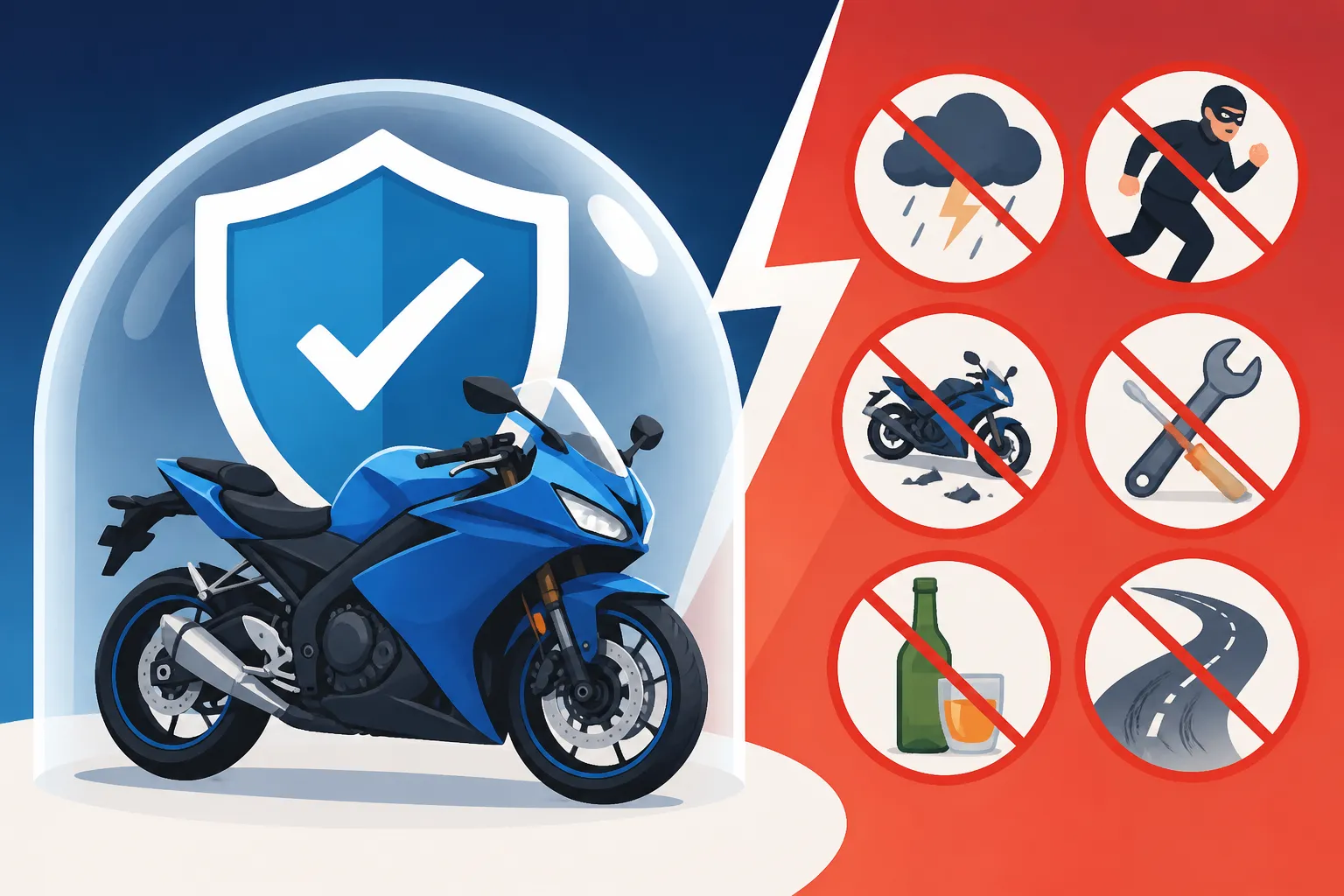
This one might seem obvious, but it bears repeating: insurance is designed to cover unforeseen accidents and losses, not purposeful harm or actions outside the law. If you intentionally damage your motorcycle, or if the damage occurs while you're engaged in an illegal activity, don't expect your policy to pick up the tab.
Let’s say you get into a heated argument with someone and, in a fit of rage, you kick in your own headlight. Your comprehensive or collision coverage won't come to your rescue there. Similarly, if you’re using your motorcycle to commit a crime, like fleeing from law enforcement, and you crash, any resulting damage to your bike or injuries to yourself will almost certainly be excluded. This extends to things like driving under the influence (DUI) or driving with a suspended license. While your liability coverage might still pay out for damages to other people or property if mandated by state law, you can bet your bottom dollar your own bike will be left unprotected, and your premiums will skyrocket, possibly even requiring an SR-22 for Motorcycles: When It's Required. It’s a harsh lesson, but one rooted in the fundamental principle of insurance: it’s there for accidents, not willful misconduct.
Racing and Off-Road Use
For many riders, the thrill of the track or the challenge of an off-road trail is a huge part of motorcycling. However, standard motorcycle insurance policies are typically designed for street-legal use on public roads. If you take your bike to a race track, participate in competitive events, or venture into off-road areas not designated for public vehicle use, you're likely entering a zone where your policy offers zero coverage.
Imagine you've got a fantastic sport bike and decide to hit a track day at a local speedway, pushing your limits. You misjudge a turn, lay the bike down, and now you’ve got a bent frame and a shattered fairing. Or perhaps you took your adventure bike deep into the wilderness, far off any marked trails, and had a nasty spill. In both scenarios, your insurer will likely deny the claim, citing the "racing" or "off-road use" exclusion. Some companies, like Markel or Dairyland, might offer specialized endorsements for limited track use or off-road policies, but these are almost always separate, add-on coverages with their own terms and conditions, not part of your everyday policy. It’s crucial to understand that even if it's a "non-competitive" track day, it can still fall under a racing exclusion because of the inherent increased risk. If you're passionate about these activities, you need to seek out specific coverage that explicitly protects you.
Wear and Tear, Mechanical Breakdown, and Neglect
Your motorcycle, like any machine, requires regular maintenance and care. Insurance policies are not extended warranties or maintenance plans. They do not cover routine wear and tear, mechanical failures, or damage resulting from neglect.
Think about it this way: your chain wears out over time, your tires eventually need replacing, and engine components can fail after years of use. These are expected costs of ownership and maintenance. If your engine seizes up due to lack of oil changes, or your brakes fail because you neglected routine servicing, your insurance policy isn't going to cover the repair costs. That's on you, the owner, to maintain your ride. Even a cracked frame that develops over time due to metal fatigue, rather than a sudden impact, would fall under this exclusion. These are the kinds of expenses you budget for as a responsible rider, not something your insurer absorbs. If you're worried about larger mechanical issues, you might look into an extended warranty from the manufacturer or a third-party provider, but don't confuse it with insurance.
Specific Situations Often Not Covered Without Add-Ons
Beyond the fundamental exclusions, there are several situations and types of property that many riders assume are covered under their comprehensive or collision policies, but frequently are not. These often require specific add-on coverages or endorsements to ensure protection.
Custom Parts and Aftermarket Accessories
One of the joys of owning a motorcycle is personalizing it, whether it's a custom paint job, a performance exhaust, upgraded suspension, or fancy chrome. You spend good money on these modifications, so naturally, you’d expect them to be covered if something happens, right? Unfortunately, standard policies usually only cover your bike’s factory-installed components up to a certain, often low, limit.
If your policy only includes $500 in accessories coverage and you’ve put $5,000 into custom parts and aftermarket exhaust, you're on the hook for the remaining $4,500 if those parts are damaged or stolen. This is a big deal for riders with customized Harleys, sport bikes loaded with carbon fiber, or touring bikes decked out with advanced navigation systems and premium sound. To protect these investments, you almost always need to purchase specific Accessories & Custom Parts Coverage Explained. This add-on allows you to declare the value of your modifications and ensure they are adequately insured, often on an "agreed value" basis rather than depreciated "actual cash value." Without it, your prized customizations might not be covered, leaving you with a significant financial loss.
Roadside Assistance and Towing
You’re cruising down a remote highway, and suddenly, your tire goes flat, or your battery dies. Your first thought might be to call your insurance company, expecting them to dispatch roadside assistance. While many auto policies include this, it’s not a given with motorcycle insurance.
Roadside assistance and towing are optional add-ons that come with an extra premium. If you haven't specifically purchased this coverage, your policy won't cover the cost of a tow truck to get your stranded bike to a repair shop. This can be especially frustrating if you're far from home or in an unfamiliar area. Companies like Progressive or Geico often offer this as a relatively inexpensive add-on, and for many riders, it's a no-brainer for the peace of mind it provides, especially given how difficult and expensive it can be to move a disabled motorcycle. Without it, you’ll be paying out of pocket, and those costs can quickly add up, especially for long-distance tows.
Medical Expenses for the Rider
This is a common misconception that can lead to devastating financial consequences. Many riders incorrectly assume that if they have "full coverage," their medical bills after an accident will be taken care of by their motorcycle policy. For the most part, this isn't true.
While your liability coverage will pay for injuries to other people if you're at fault, it generally does not cover your own medical expenses. Some states offer Personal Injury Protection (PIP) or Medical Payments (MedPay) for Riders? as an optional add-on, but it's not universally available or mandatory. In many cases, your health insurance is expected to cover your injuries. If you don't have adequate health insurance, or if your health insurance has high deductibles and co-pays, you could be facing crippling medical debt after a serious motorcycle accident. This is a critical gap in coverage that every rider needs to assess. If available in your state, adding MedPay or PIP is often highly recommended to bridge this gap and provide some level of protection for your own injuries, regardless of fault.
Coverage for Passengers
If you enjoy sharing the ride with a friend or loved one, you need to make sure your policy covers them. Standard liability coverage will protect your passenger if you cause an accident and they are injured, assuming your liability limits are sufficient. However, what if your passenger is injured in a single-vehicle accident where no other party is involved, or if they have their own medical expenses beyond what your liability might cover?
In some cases, specific "passenger liability" or "medical payments for passengers" coverage may be an add-on. If you regularly ride with a passenger, it’s worth reviewing your policy and speaking with your insurer to ensure they have adequate protection in case of an incident. While your primary health insurance might kick in, ensuring they have additional coverage through your motorcycle policy offers an extra layer of security, particularly for serious injuries. This is a nuance often missed, but incredibly important for the safety and well-being of anyone you carry on your bike.
Reading the Fine Print: Understanding Your Policy
The best way to avoid unwelcome surprises is to understand your policy inside and out. It’s not the most exciting reading material, but it’s critical. Don't just skim over the declarations page; dig into the policy booklet itself.
Deductibles and Coverage Limits
Even when an event is covered, your policy isn't going to pay for everything. You'll have deductibles and coverage limits that define the actual payout.
- Deductibles: This is the amount you pay out of pocket before your insurance company starts paying. For example, if you have a $500 deductible for collision coverage and you cause $2,000 in damage to your bike, you'll pay the first $500, and your insurer will cover the remaining $1,500. This is a direct cost you bear on most claims.
- Coverage Limits: These are the maximum amounts your insurer will pay for a specific type of coverage. For instance, your liability coverage might have a split limit of "25/50/25," meaning $25,000 for bodily injury per person, $50,000 for bodily injury per accident, and $25,000 for property damage. If the damages exceed these limits, you're personally responsible for the rest. This is why understanding Minimum Liability Insurance Explained (The Three Numbers) is so vital. If you only carry state minimums and cause a severe accident, you could be sued for the difference. This also applies to custom parts, as mentioned, where your policy might have a small inherent limit, and you'd need to explicitly add more.
Exclusions Section and Endorsements
Every policy has a dedicated "Exclusions" section. This is where the insurer lists everything they won't cover. It’s often dense, legalistic language, but it’s crucial to read. If you're unsure about anything, call your agent and ask for clarification.
Beyond the standard exclusions, remember that anything you want added to your coverage (like roadside assistance, custom parts, or gap insurance) will typically appear as an "endorsement" or "rider" on your policy. These are amendments that modify the standard contract. If it's not explicitly listed as an endorsement, it's probably not covered. When you get a quote, especially from a platform like The Zebra, make sure you're comparing apples to apples and that any specific coverages you need are included, not just the base price. Don't be afraid to ask for a sample policy document to review the full terms. The more you know about What Motorcycle Coverage Do You Actually Need?, the better equipped you'll be to avoid a nasty surprise.
Bridging the Coverage Gaps
While it might seem like there are a lot of things not covered, many of these gaps can be filled with additional coverages or smart planning. The goal isn't just to buy any insurance, but to buy the right insurance for your specific riding habits and motorcycle.
Reviewing and Customizing Your Policy
The absolute best way to ensure you're adequately covered is to regularly review your policy. Don't just set it and forget it. Your riding habits might change, you might add more modifications to your bike, or you might move to a new state with different requirements.
When you're shopping for insurance, or even if you're just looking to update your current policy, consider all the types of Motorcycle Insurance Coverage Explained. Think about what you truly need. If you ride an expensive, custom cruiser, ensuring proper Accessories & Custom Parts Coverage Explained is essential. If your bike is financed, you might need Do You Need Gap Insurance on a Motorcycle?. For riders concerned about potential medical bills after an accident, adding MedPay or PIP is a smart move. Don't hesitate to ask your agent for a thorough rundown of all available options and clarify any potential exclusions. Platforms like The Zebra can be great for comparing different insurers and seeing which ones offer the specific add-ons you need at a competitive price.
Considering Other Forms of Protection
Sometimes, insurance isn't the only answer. For certain risks, other forms of protection are more appropriate or can supplement your policy.
For instance, mechanical breakdowns are best handled by an extended warranty, either from the manufacturer or a reputable third-party provider. These plans specifically cover the failure of mechanical components beyond the factory warranty period. For extreme off-road riding or track use, you might need specialized policies from niche insurers that cater specifically to those activities, as standard providers typically shy away from that level of risk. Also, maintaining your motorcycle meticulously not only keeps you safer but also prevents issues that insurance wouldn't cover anyway. Keep a detailed maintenance log, follow the manufacturer's recommendations, and address any issues promptly. This due diligence not only prolongs the life of your bike but also minimizes the chances of uninsurable mechanical failures.
Summary of Common Exclusions and Solutions
To make things a bit clearer, here’s a quick overview of some common items not covered by standard motorcycle insurance and how you might get protection:
| Excluded Item/Situation | Why it's excluded by default | Potential Solution/Add-on Coverage |
|---|---|---|
| Intentional Damage | Not an "accident"; goes against insurance principles. | No insurance solution; personal responsibility. |
| Illegal Activities | Damage incurred while breaking the law. | No insurance solution; personal responsibility. |
| Racing/Track Use | High-risk activity, outside normal road use. | Specialized track day insurance, competitive riding policies. |
| Off-Road Use (Beyond Designated Areas) | High-risk activity, specific terrain. | Off-road/dirt bike specific policies or endorsements. |
| Wear & Tear / Mechanical Breakdown | Expected maintenance, not accidental damage. | Extended warranty (manufacturer or third-party); regular maintenance. |
| Neglect | Damage resulting from lack of proper care. | No insurance solution; regular maintenance. |
| Custom Parts/Accessories | Only factory parts covered, or minimal limits. | Accessories & Custom Parts Coverage Explained (endorsement). |
| Roadside Assistance | Not inherent to core insurance (liability/collision). | Roadside Assistance & Towing for Motorcycles (endorsement). |
| Rider's Own Medical Expenses | Generally relies on personal health insurance. | Medical Payments (MedPay) or Personal Injury Protection (PIP) (if available). |
| Passenger Medical/Injuries (beyond liability) | Requires specific rider protection. | Passenger liability coverage, enhanced MedPay/PIP. |
| Total Loss (Gap Coverage) | Bike's actual cash value might be less than loan amount. | Do You Need Gap Insurance on a Motorcycle? (endorsement). |
Taking the time to understand what's not covered by your motorcycle insurance can save you a world of stress and financial heartache. It empowers you to make informed decisions, customize your policy, and ride with genuine peace of mind, knowing you’re truly protected against the unexpected.
Disclaimer
The information provided in this article is for general informational purposes only and does not constitute professional insurance advice. Insurance policies vary widely by provider, state, and individual circumstances. You should always consult with a licensed insurance professional to discuss your specific needs and review your policy documents thoroughly.