What Is Underinsured Motorist Coverage on a Motorcycle?
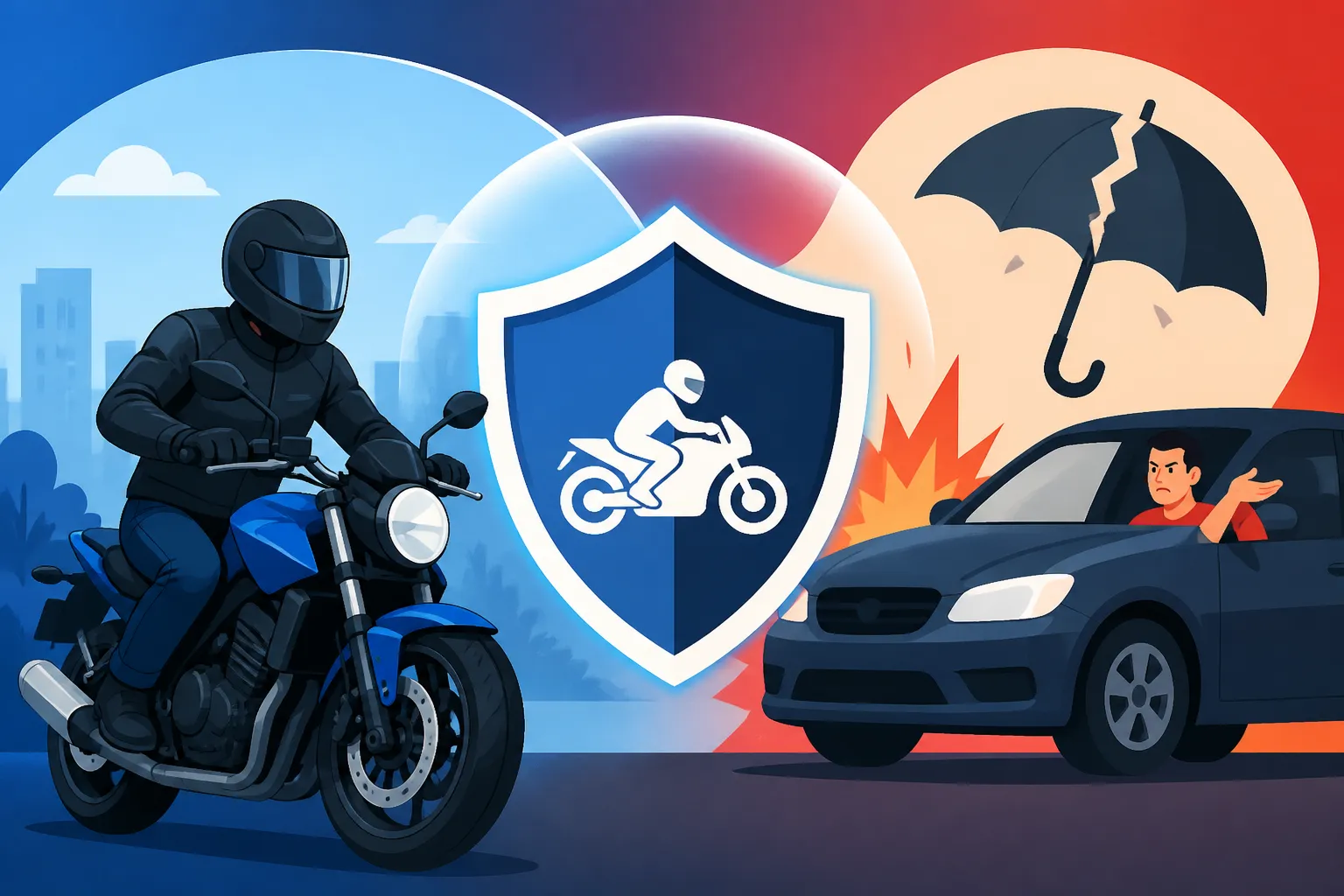
There’s a unique dread that washes over you as a motorcyclist when you hear about an accident where the other driver barely had any insurance. You do everything right – you ride responsibly, you invest in good gear, and you even carry robust insurance on your own bike – only to find out that if someone else’s negligence put you in the hospital, their piddly state minimum coverage isn't going to touch your medical bills or the damage to your cherished machine. This guide is all about tackling that exact frustration by explaining what Underinsured Motorist (UIM) coverage is for motorcyclists and why it's such a vital safety net.
The Harsh Reality of Underinsured Drivers on the Road
It's a scary thought, but the roads are teeming with drivers who carry only the bare minimum insurance required by law. While it might seem like "insurance is insurance," those minimums are often laughably inadequate to cover the true costs of an accident, especially when a motorcycle is involved. We riders are inherently more vulnerable, and our injuries can be far more severe and expensive to treat.
Why Minimum Liability Isn't Always Enough
Every state has its own Minimum Liability Insurance Explained (The Three Numbers) that drivers must carry, typically expressed in a format like 25/50/25. This means $25,000 for bodily injury per person, $50,000 for bodily injury per accident, and $25,000 for property damage. Sounds like a lot, right? Well, let's talk about the real world for a second. Imagine you're riding your beloved Harley-Davidson through the winding backroads of upstate New York, enjoying a perfect Saturday. Suddenly, a distracted driver swerves into your lane. You manage to lay the bike down, avoiding a direct hit, but you break an arm and suffer a nasty case of road rash. Your bike, while not totaled, needs a new fairing, controls, and some engine work.
A trip to the emergency room, surgery for your broken arm, a few nights in the hospital, and then months of physical therapy can easily rack up $50,000, $75,000, or even $100,000 in medical bills, sometimes more. And that's before considering lost wages from being unable to work, pain and suffering, or the significant cost to repair or replace your motorcycle. If the at-fault driver only has the state minimum of $25,000 for bodily injury, where does the remaining $50,000+ come from? If they have a beat-up old sedan and no assets, good luck trying to get it from them directly. This is precisely the kind of gaping hole that Underinsured Motorist coverage is designed to fill. Many riders often consult resources like Motorcycle Insurance Requirements by State (2026 Guide) to understand their legal obligations, but rarely consider the limitations of other drivers' compliance.
The Financial Nightmare After an Accident
Without adequate protection, being hit by an underinsured driver can swiftly turn a traumatic event into a financial catastrophe. You're already dealing with the physical pain and emotional recovery from the accident itself. The last thing you need is a mountain of medical bills landing on your doorstep, with no clear way to pay them. Your health insurance might cover some of it, but deductibles, co-pays, and limitations on what they'll pay for accident-related care can still leave you holding a hefty bag.
Beyond medical costs, there's the damage to your motorcycle. Modern bikes, even mid-range models, are expensive. A new Honda CBR600RR can cost over $12,000, and repairs on a high-performance machine can quickly eat through that $25,000 property damage limit. What about your helmet, your riding jacket, your custom leather gear? These aren't just accessories; they're vital safety equipment, and replacing them can be costly. If the at-fault driver's property damage limit is gone after just a few items, you're looking at significant out-of-pocket expenses to get your bike roadworthy again or to replace it. This kind of financial strain can lead to collection agencies, damage your credit, and in extreme cases, even push individuals into bankruptcy. The thought of What Happens If You Ride Without Insurance? is terrifying, but it's almost as bad to be hit by someone else who effectively has no real insurance.
Understanding Underinsured Motorist (UIM) Coverage for Riders
This is where Underinsured Motorist (UIM) coverage steps up as your champion. It’s an optional, but incredibly valuable, part of your overall Types of Motorcycle Insurance Coverage Explained that protects you when another driver is at fault but doesn't have enough insurance to cover your losses. Think of it as a safety net that catches you when the other guy's safety net is too small.
How UIM Coverage Kicks In
Let’s clarify how UIM works and how it differs from its cousin, Uninsured Motorist (UM) coverage. Uninsured & Underinsured Motorist Coverage (UM/UIM) are often bundled together, but they serve distinct purposes. UM coverage protects you if the at-fault driver has no insurance at all, or if you're a victim of a hit-and-run and the driver can't be identified. UIM, on the other hand, comes into play when the at-fault driver does have insurance, but their policy limits are insufficient to cover your total damages.
Here’s a common scenario: You're involved in a collision, and the other driver is 100% at fault. Your medical bills and lost wages amount to $70,000, and your bike damage is $15,000. The at-fault driver carries the state minimum liability of $25,000 for bodily injury per person and $25,000 for property damage. Their insurance company will pay you their maximum limit: $25,000 for your bodily injuries and $15,000 for your bike. That leaves you with $45,000 in bodily injury costs (70k – 25k) that are currently unpaid. If you have UIM coverage with limits equal to or greater than that remaining $45,000, your own UIM policy will step in to cover the difference, up to your UIM limits. It’s a remarkable peace of mind knowing that your policy is there to protect you from the financial irresponsibility of others.
What UIM Actually Covers for Motorcyclists
Generally, UIM coverage is split into two categories: Underinsured Motorist Bodily Injury (UIMBI) and Underinsured Motorist Property Damage (UIMPD). While UIMBI is almost universally available and often prioritized, UIMPD might be offered as a separate option or might be included in some policies depending on your state and insurer.
- UIM Bodily Injury (UIMBI): This is the core of UIM coverage. It pays for your medical expenses, rehabilitation costs, lost wages, and pain and suffering beyond what the at-fault driver's liability insurance covers. For motorcyclists, whose injuries are frequently more severe and long-lasting than those of car occupants, UIMBI is absolutely critical. Imagine a scenario where you're hit, and you sustain a serious leg injury requiring multiple surgeries and extensive physical therapy. The other driver's $25,000 limit might cover the initial ambulance ride and emergency room visit, but your UIMBI could be the difference between paying for months of expensive rehabilitation yourself or having it covered.
- UIM Property Damage (UIMPD): This part of the coverage helps pay for damage to your motorcycle and sometimes your riding gear (helmet, jacket, leathers, boots) if the at-fault driver's property damage liability limits are exhausted. For instance, if your custom-painted tank, fairings, and exhaust system on your Triumph Bonneville are mangled, and the repairs total $10,000, but the other driver only has $5,000 in property damage coverage, UIMPD would cover the remaining $5,000 (up to your policy limits). It’s worth noting that coverage for custom parts and accessories might fall under separate Accessories & Custom Parts Coverage Explained depending on your insurer, but UIMPD often works in conjunction with it to protect your investment in your bike.
Stacked vs. Non-Stacked UIM Coverage
This is a detail that many riders overlook but can make a huge difference in how much protection you truly have. When you purchase UIM coverage, you might have the option for "stacked" or "non-stacked" coverage, depending on your state's laws.
- Non-Stacked UIM: This means your UIM limits apply only once per accident, regardless of how many vehicles you insure on your policy or how many policies you have. For example, if you have two motorcycles on one policy, and each has $50,000 non-stacked UIM, you still only have $50,000 available per accident.
- Stacked UIM: This is often the superior option for riders. Stacked UIM allows you to multiply your coverage limits by the number of vehicles insured on your policy (intra-policy stacking) or even by the number of policies you have (inter-policy stacking). If you have two bikes on your policy, each with $50,000 stacked UIM, you could potentially have $100,000 in UIM coverage available for a single accident. Some states also allow you to stack UIM coverage from different policies, like your motorcycle policy and your auto policy, further increasing your protection. While stacked coverage usually comes with a slightly higher premium, the added financial security it offers, especially for potentially catastrophic motorcycle accident injuries, is often well worth the cost. It’s important to check with your insurance provider about what stacking options are available in your state.
Why UIM is Non-Negotiable for Motorcycle Riders
For car drivers, UIM is smart. For motorcyclists, it’s arguably essential. The physics of a motorcycle accident mean that riders are exposed to far greater risks of severe injury than occupants of enclosed vehicles. This vulnerability directly translates into higher potential medical costs, which makes UIM coverage an absolute cornerstone of responsible riding.
The High Stakes of Motorcycle Accidents
Let's be brutally honest: when a motorcycle is involved in a collision with another vehicle, the rider almost always comes out worse. There’s no steel cage, no airbags, no seatbelts to absorb impact. The human body takes the brunt. This means that even a relatively "minor" accident can result in devastating injuries. Common injuries include multiple fractures, severe road rash (which requires extensive treatment and skin grafts), internal injuries, and catastrophic head or spinal cord trauma. These aren't just bumps and bruises; they're life-altering injuries that can require long hospital stays, multiple surgeries, and years of physical rehabilitation.
Consider the cost of a severe injury. A single helicopter ride to a trauma center can run tens of thousands of dollars. Surgery for a complex fracture can be $20,000-$50,000. Weeks or months in a specialized rehab facility could easily top $100,000. These figures quickly dwarf the average state minimum liability coverage of $25,000 or even $50,000. Without UIM, you're looking at potentially losing your home, your savings, and facing a lifetime of debt simply because an underinsured driver made a mistake. This extreme vulnerability makes a compelling case for robust What Motorcycle Coverage Do You Actually Need?, with UIM being high on that list.
Protecting Your Financial Future
Think of your UIM coverage as an impenetrable shield for your financial well-being. It's not just about covering immediate medical bills; it's about safeguarding your entire future. If you're seriously injured, you might be out of work for an extended period, leading to significant lost income. UIM can help replace those lost wages, ensuring you can still pay your mortgage, feed your family, and maintain some semblance of stability during a challenging recovery.
Moreover, UIM helps you avoid the agonizing decision between proper medical care and financial ruin. You won't have to cut short your rehabilitation because you can't afford it, or skip necessary follow-up appointments. It allows you to focus on healing, rather than battling debt collectors or navigating complex legal battles against an uninsured or underinsured driver. While your own Liability Coverage for Motorcycles Explained protects others from you, UIM protects you from others. It’s an investment in your peace of mind and your long-term financial security.
How to Determine Adequate UIM Limits
So, how much UIM coverage do you really need? There's no one-size-fits-all answer, but a good rule of thumb is to carry UIM limits that match your own liability limits. If you're responsible enough to carry $100,000/$300,000 in bodily injury liability to protect others, you should extend that same level of protection to yourself with UIM.
When assessing your needs, consider the following:
- Your assets: How much do you stand to lose if you have massive medical bills and lost income? Your home, savings, retirement accounts – these are all at risk.
- Your income: How long could you realistically go without your primary income stream?
- Your health insurance: What are your deductibles, co-pays, and out-of-pocket maximums? Does it cover long-term rehabilitation? Remember, health insurance might not cover "pain and suffering" or lost wages – UIM can.
- The cost of your bike and gear: While UIMPD handles some of this, having sufficient limits is key.
Don't just pick a number out of thin air. Talk to a trusted insurance agent or use an online comparison tool like The Zebra to explore different coverage options and their associated costs. They can help you understand the nuances of your state's laws and recommend limits that truly align with your financial situation and risk tolerance. Comparing quotes on platforms like The Zebra can quickly show you how increasing your UIM limits impacts your premium, often for a surprisingly small additional cost compared to the immense protection it offers. They can help you find companies like Progressive or Dairyland that offer strong UIM options.
Integrating UIM with Your Existing Motorcycle Insurance
Adding or enhancing UIM coverage isn't as complicated as it might sound. It's a matter of reviewing your current policy, understanding your options, and making informed choices to build the most comprehensive safety net possible for your riding adventures.
Reviewing Your Current Policy
Before you do anything else, grab your current motorcycle insurance policy declaration page. Take a close look at the "Coverage Types" section. Do you see "Uninsured Motorist" (UM) and "Underinsured Motorist" (UIM) listed? What are their limits? Often, insurers will include UM/UIM bodily injury coverage automatically, but the limits might be low, matching your state's minimum liability requirements. You'll want to ensure these limits are much higher, ideally matching your own bodily injury liability limits.
Also, check for UIM Property Damage (UIMPD). As mentioned, this might be a separate add-on or not available in all states or from all insurers. Understand your deductibles for these coverages as well; a higher deductible can lower your premium but means more out-of-pocket expense if you need to file a claim. If you don't see UIM or UM on your policy, it's time to call your agent immediately. Sometimes, it's confusing to navigate all the terms, and articles like What Does Full Coverage Motorcycle Insurance Mean? can shed light on what typically goes into a robust policy.
Getting Quotes and Making Informed Decisions
Once you know what you currently have, it's time to explore your options for strengthening your UIM protection. The process is pretty straightforward:
- Gather Your Information: You'll need details about your motorcycle (make, model, year, VIN), your riding history, any safety courses you've completed (like a Motorcycle Safety Foundation course), and your desired coverage limits.
- Contact Your Current Insurer: Ask them to provide quotes for increasing your UIMBI and UIMPD limits, and inquire about "stacked" vs. "non-stacked" options if available in your state.
- Shop Around: Don't stop at just one quote! Different insurance companies have different pricing structures and coverage offerings. Use online comparison tools like The Zebra, which can provide multiple quotes from various providers (like Dairyland, Markel, or Progressive) quickly and efficiently. This allows you to compare not just the overall premium, but also the specific UIM options and limits available to you. This is where a guide on How to Compare Motorcycle Insurance Quotes really comes in handy.
- Ask Questions: Don't hesitate to ask your agent or the online platform's support staff any questions you have about UIM. Clarify what's covered, what isn't, and how the claims process works for How to File a Motorcycle Insurance Claim under UIM.
Common Misconceptions About UIM
Let's bust a few common myths that might lead riders to undervalue UIM coverage:
- "My health insurance will cover everything." While your health insurance is definitely important, it's not a substitute for UIM. Health insurance primarily covers medical treatment and often has high deductibles and co-pays. It won't cover lost wages, pain and suffering, or property damage to your bike. Furthermore, your health insurance company might seek reimbursement from any settlement you receive from the at-fault driver or your UIM policy (this is called subrogation). UIM covers the full spectrum of your losses.
- "Everyone has enough insurance, it's the law." This is a dangerous assumption. As we discussed, state minimums are often woefully inadequate. A $25,000 bodily injury limit might sound good on paper, but it's quickly exhausted in a serious motorcycle accident. Many drivers also illegally drive without any insurance, which is where How to File a Claim When Hit by an Uninsured Driver comes into play, but UIM steps in when they have some, but not enough.
- "UIM is too expensive." In most cases, increasing your UIM limits is surprisingly affordable, especially when you consider the immense financial protection it provides. It's often one of the most cost-effective additions you can make to your policy. Don't let a small increase in premium deter you from protecting your entire financial future. When considering how much motorcycle insurance costs overall, the UIM portion is usually a small but crucial fraction.
Being prepared for the unexpected is a hallmark of responsible riding. Underinsured Motorist coverage is a crucial piece of that preparedness, ensuring that even if another driver fails to carry adequate protection, your financial well-being won't be collateral damage in an accident.
Comparing Underinsured Motorist Scenarios
To really drive home the value of Underinsured Motorist coverage, let's look at a hypothetical accident scenario involving a rider and an at-fault driver with minimum liability coverage. This table illustrates how UIM fills the gap.
| Scenario Detail | At-Fault Driver's Liability Coverage | Rider's Total Damages | Rider's Own UIM Limits (BI/PD) | At-Fault Pays | UIM Pays (If Applicable) | Rider's Out-of-Pocket | Outcome |
|---|---|---|---|---|---|---|---|
| Scenario 1: No UIM | $25k BI / $25k PD | $70k BI / $15k PD | $0 BI / $0 PD | $25k BI / $15k PD | $0 | $45k BI / $0 PD | Rider pays $45,000 for medical. |
| Scenario 2: With UIM | $25k BI / $25k PD | $70k BI / $15k PD | $100k BI / $25k PD | $25k BI / $15k PD | $45k BI / $0 PD | $0 | Rider fully covered for BI & PD. |
| Scenario 3: Higher PD Damages with UIM | $25k BI / $25k PD | $70k BI / $35k PD | $100k BI / $25k PD | $25k BI / $25k PD | $45k BI / $10k PD | $0 | Rider fully covered for BI & PD. |
| Scenario 4: Stacked UIM (2 bikes) | $25k BI / $25k PD | $120k BI / $15k PD | $50k BI (stacked) / $25k PD | $25k BI / $15k PD | $75k BI / $0 PD | $20k BI / $0 PD | Rider's stacked UIM covers $75k, still $20k out of pocket for very high BI. |
Note: This table is a simplified illustration. Actual payouts depend on policy terms, deductibles, state laws, and the specifics of the claim. "BI" refers to Bodily Injury and "PD" refers to Property Damage.
This table clearly shows that in Scenarios 1 and 4, without adequate UIM or when damages exceed even generous stacked limits, the rider is left footing a substantial bill. In contrast, Scenario 2 and 3 demonstrate how UIM coverage directly and significantly reduces the rider's out-of-pocket expenses, providing a crucial safety net against the financial fallout of an accident caused by an underinsured driver. This is why when you're going through What to Do After a Motorcycle Accident (Insurance Steps), having UIM in place dramatically simplifies the financial recovery process.
Disclaimer
The information provided in this guide is for general educational purposes only and should not be considered as professional financial or legal advice. Motorcycle insurance laws and coverage options vary significantly by state and insurer. It is always recommended to consult with a qualified and licensed insurance agent or legal professional to discuss your specific needs and obtain personalized advice regarding your motorcycle insurance policy.