Motorcycle Insurance Cost With a DUI
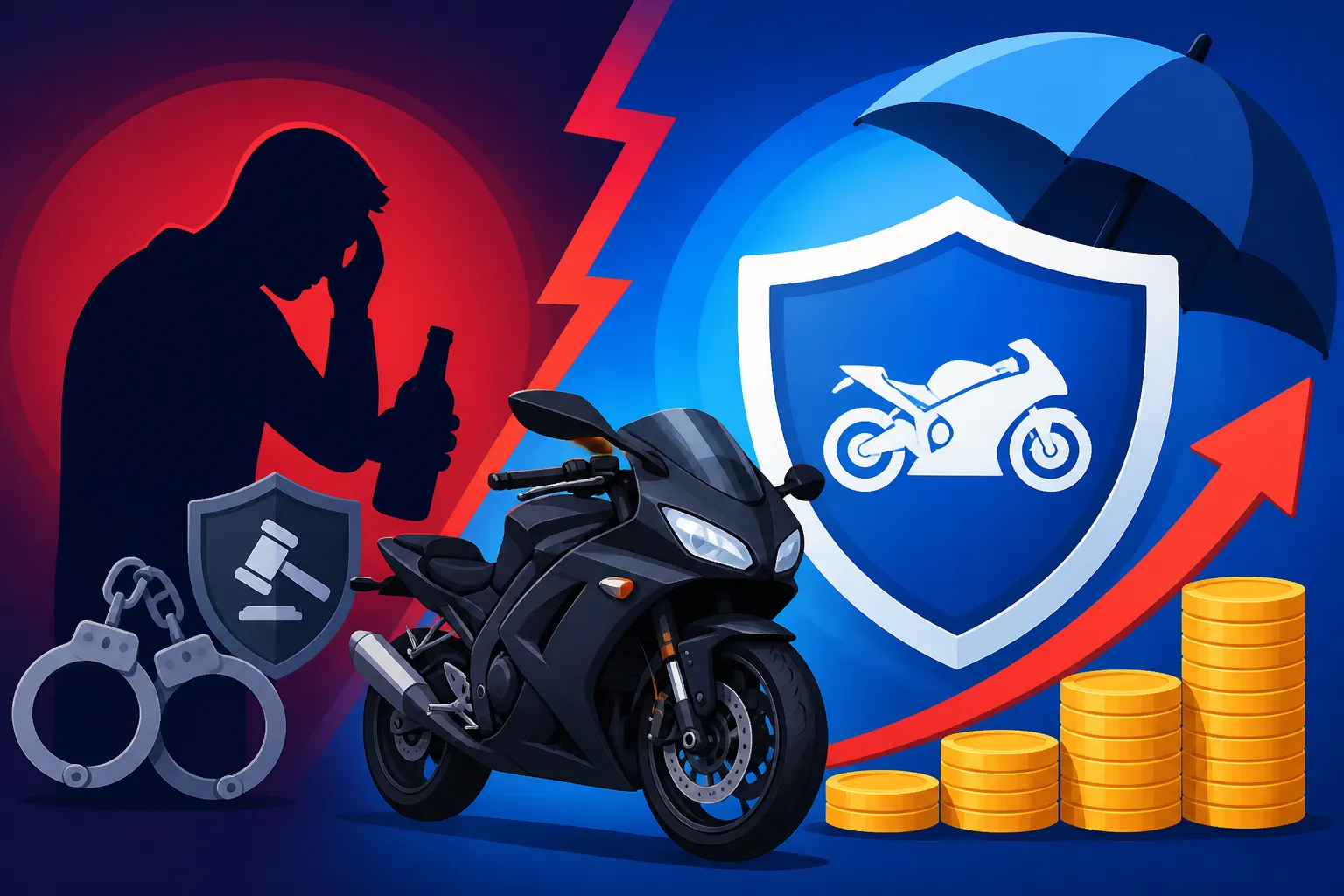
Getting a DUI is a gut-wrenching experience that extends far beyond the courtroom and the heavy fines. For riders, it often feels like the end of the road because the sudden spike in insurance premiums can make keeping your bike nearly impossible. This guide breaks down exactly how much your rates will climb, how to handle the mandatory filings, and the best ways to eventually get your costs back under control.
Why a DUI Is a Financial Earthquake for Riders
The moment a DUI hits your driving record, you are no longer viewed as a standard rider by the actuarial tables. To an insurance company, a DUI is the ultimate indicator of risk, suggesting that you are statistically more likely to be involved in a high-cost claim in the future. This shift in perception triggers an immediate reclassification of your profile, moving you from the "preferred" or "standard" tier into the "non-standard" or "high-risk" category.
The financial fallout isn't just a one-time fee; it is a recurring surcharge that can last for several years. I have talked to riders who saw their premiums double or even triple overnight. It is incredibly frustrating to feel like you are being punished every single month for a mistake you are already paying for through the legal system. Understanding this reclassification is the first step in managing the long-term impact on your wallet.
The Immediate Impact on Your Premium
When your insurance company runs your Motor Vehicle Record (MVR) at your next renewal, the DUI will trigger an automatic surcharge. This isn't a small "oops" increase like you might see after a minor speeding ticket. Instead, it is a fundamental reassessment of what it costs to insure you. In many cases, the surcharge itself can be 100% or more of your original premium. For example, if you were paying $500 a year to insure your cruiser, you might suddenly see a renewal notice for $1,200 or more.
This spike happens because the insurer is trying to offset the massive potential liability costs associated with alcohol-related accidents. If you are struggling to understand the math behind these hikes, resources like What Affects Your Motorcycle Insurance Rate? can provide some clarity on how insurers weigh different violations. It is a bitter pill to swallow, especially when you are already dealing with lawyer fees and court costs, but knowing the "why" helps you prepare for the "how much."
How Long Does a DUI Affect Your Rates
A DUI doesn't vanish from your insurance record as quickly as a minor mechanical violation might. In most states, insurance companies will look back at your driving history for three to five years, but for a major violation like a DUI, that window often extends to seven or even ten years. During this time, the "weight" of the violation will slowly decrease, but the initial three years are typically the most expensive.
I often tell people to view this as a marathon, not a sprint. You won't see your rates drop back to "normal" after just twelve months of clean riding. However, every year you go without another incident, you become slightly less of a risk in the eyes of the underwriters. Staying informed about Motorcycle Insurance Cost With a DUI across different stages of the look-back period can help you set realistic expectations for your budget over the next decade.
Understanding High-Risk Driver Classifications
Once you have a DUI, some of the most popular, household-name insurance companies might refuse to renew your policy altogether. They simply don't have the "appetite" for high-risk riders. This forces you into the non-standard market, where companies specialize in insuring people with "tarnished" records. While these companies provide a necessary service, their base rates are naturally higher because their entire pool of customers is considered high-risk.
Being labeled a high-risk driver is a stigma that feels unfair, especially if you have decades of safe riding behind you. However, it is a label you can eventually shed. In the meantime, you have to navigate this new landscape with your eyes wide open. You might find that looking into Best Motorcycle Insurance for SR-22/High-Risk is your best bet for finding a carrier that won't just flat-out deny you coverage.
Average Motorcycle Insurance Cost After a DUI
Trying to pin down a single average cost for motorcycle insurance after a DUI is tricky because so many factors are in play. However, data suggests that the national average increase for a motorcycle policy after a DUI is roughly 80% to 150%. If you live in a high-cost state or ride a high-performance machine, those numbers can go even higher. It is a staggering amount of money that takes a massive bite out of your recreational budget.
To give you a clearer picture of the landscape, let's look at how these costs break down across different scenarios. Remember, these are estimates, and your actual quote will depend on your specific zip code, age, and bike. Using a comparison tool like The Zebra can help you see these variations in real-time, allowing you to filter through different carriers that are willing to work with your specific record.
Comparing Rates by Age and Experience
Age plays a massive role in how a DUI affects your premium. If you are a rider under 25, a DUI can be catastrophic for your insurance eligibility. Young riders are already considered high-risk, so adding a major violation to the mix often results in premiums that cost more than the bike itself. On the flip side, if you are an older rider, you might have more "equity" with insurers, but the DUI will still cause a significant surge.
Consider a rider in their 50s who has had a clean record for thirty years. While they will still see a massive hike, they might find their final premium is still lower than a 22-year-old with a clean record. You can see more about how age influences these numbers in our guide on Motorcycle Insurance Cost for Riders Over 50. Regardless of your age, the DUI acts as a multiplier, magnifying whatever risk factors were already present in your profile.
Regional Variations in Post-DUI Pricing
Where you live matters just as much as what you did. Some states have much stricter insurance regulations and higher minimum liability requirements, which can drive up the base cost of a post-DUI policy. For instance, a rider in a "no-fault" state might face higher premiums than someone in a traditional tort state. Additionally, urban areas with high theft and accident rates will always be more expensive than rural settings.
If you are curious about how your specific state handles these costs, looking into the How Much Is Motorcycle Insurance? 2026 Guide can give you a baseline of what standard riders pay, which you can then mentally double to estimate your post-DUI reality. The Zebra is particularly useful here for seeing how local regional taxes and state-specific surcharges apply to your unique situation, as it aggregates data from various local and national providers.
Comparing Costs by Bike Type
The type of motorcycle you ride will heavily influence your post-DUI premium. Insurers look at the "loss history" of specific bike models. Sport bikes, which are statistically involved in more high-speed accidents, are already expensive to insure. Adding a DUI to a sport bike policy is a recipe for a four-figure premium. Cruisers and touring bikes generally fare better, but the increase will still be painful.
| Bike Type | Estimated Pre-DUI Annual Cost | Estimated Post-DUI Annual Cost |
|---|---|---|
| Cruiser (e.g., Honda Shadow) | $450 | $950 |
| Sport Bike (e.g., Kawasaki Ninja) | $900 | $2,100 |
| Touring Bike (e.g., Harley Electra Glide) | $600 | $1,250 |
| Dual-Sport (e.g., Suzuki DRZ-400) | $350 | $750 |
The SR-22 and FR-44 Requirement
If the higher premiums weren't enough, most states require riders with a DUI to file an SR-22 or, in Florida and Virginia, an FR-44. Many people mistakenly think these are insurance policies, but they aren't. They are simply certificates of financial responsibility that your insurance company files with the DMV to prove that you have the state-mandated amount of coverage.
The real headache with an SR-22 is that it acts as a permanent "flag" on your account. It notifies the state the second your insurance lapses, which can lead to an immediate license suspension. It is a high-stakes game of compliance that adds administrative layers to your life as a rider. Understanding the nuances of SR-22 for Motorcycles: When It's Required is essential if you want to avoid further legal trouble.
What Is an SR-22 Filing?
An SR-22 is essentially a bond or a certificate that guarantees you are maintaining at least the minimum liability insurance. When you ask an insurance company to file one for you, they are essentially telling the state, "We are watching this rider, and if they stop paying their premium, we will tell you immediately." Because of this added monitoring, many standard insurers will refuse to file an SR-22, which is another reason you end up in the high-risk market.
The cost of the filing itself is usually small—often just a $25 to $50 one-time fee—but the "hidden" cost is the higher premium tier you must enter to get the filing. You can't just buy a standard policy and "add" an SR-22; you must buy a policy that allows for it. If you need to dive deeper into the mechanics of this, check out How to Get SR-22 Filing for a Motorcycle for a step-by-step breakdown.
The FR-44: Florida and Virginia Requirements
If you live in Florida or Virginia, you might be required to file an FR-44 instead of an SR-22. The "FR" stands for Financial Responsibility, and the requirements are much stricter. Unlike the SR-22, which only requires you to carry the state's minimum liability limits, the FR-44 requires you to carry much higher limits—often double or triple the standard minimums.
In Florida, for example, an FR-44 requires significantly higher liability limits for bodily injury and property damage. This means you aren't just paying more because of the DUI; you are paying more because the state is forcing you to buy "more" insurance than the average rider. You can find a detailed comparison of these forms in our post on What Is FR-44 and Which States Use It?. This is a massive financial burden that often catches riders by surprise.
Filing Fees and Hidden Administrative Costs
Beyond the premium increase and the filing fee, there are often other administrative costs associated with a DUI. These can include license reinstatement fees, fees for mandatory alcohol education programs, and the cost of an Ignition Interlock Device (IID) if the court requires one for your motorcycle. While these aren't insurance costs per se, they all come out of the same bucket of money you use to keep your bike on the road.
I've seen riders who were so focused on the insurance premium that they forgot about the $200 reinstatement fee or the $100 monthly rental for an IID. It all adds up quickly. Being proactive and using a site like The Zebra to compare quotes early in the process can at least help you lock in the lowest possible insurance rate, leaving you more room in your budget for these other mandatory expenses.
How to Find the Cheapest Coverage Post-DUI
Even with a DUI, you don't have to settle for the first quote you receive. The "high-risk" market is actually quite competitive, and different companies have different ways of calculating risk. One company might penalize you heavily for a DUI but give you a break if you have a high credit score, while another might focus entirely on your driving record. This is where the legwork really pays off.
You shouldn't feel like you are at the mercy of the insurance industry. By being strategic and using the right tools, you can find a policy that is expensive but manageable. It takes patience and a lot of phone calls (or clicks), but it is possible to find a path forward.
Shopping Around and Comparing Quotes
The most important thing you can do is shop around. Don't assume that because your current insurer dropped you, every other company will charge the same high rate. I always recommend getting at least five to seven different quotes. This is where The Zebra becomes an invaluable ally. Instead of filling out seven different forms, you can enter your info once and see how different carriers respond to your DUI and SR-22 needs.
When you are shopping, be 100% honest about your record. If you try to hide a DUI, the company will find it anyway during the underwriting process, and they might cancel your policy for misrepresentation. It is much better to find a company that knows the truth and is willing to cover you from day one. Start by looking at How to Get Cheap Motorcycle Insurance for general tips that still apply even when you are in the high-risk pool.
Utilizing Usage-Based and Pay-Per-Mile Insurance
If you only ride your bike on weekends or for short commutes, usage-based insurance might be a lifesaver. These policies use a device or a smartphone app to track how much and how safely you ride. If you can prove that you are a low-mileage rider who doesn't speed or hard-brake, some companies might offer you a lower rate despite your DUI.
This is a relatively new frontier in motorcycle insurance, but it is growing. For a rider with a DUI, "pay-per-mile" can significantly lower the monthly cost of keeping the bike in the garage. If the bike is sitting most of the time, why pay for a full-time "high-risk" premium? Exploring these non-traditional options can sometimes yield surprising savings that standard policies just can't match.
Leveraging Non-Standard Carriers
While big names like Geico or State Farm might be out of reach for a while, companies like Dairyland, Foremost, or Progressive often have more flexibility when it comes to major violations. These "non-standard" carriers are built to handle the extra paperwork and the higher risk profiles. They are often much more efficient at filing SR-22s and getting you back on the road quickly.
Just because a company is "non-standard" doesn't mean they are bad. Many of them have excellent claims service and robust mobile apps. They simply have a different business model that allows them to take on riders that other companies won't touch. You can compare some of these specialists in our guide on Best Motorcycle Insurance for SR-22/High-Risk to see which one might be the best fit for your specific bike and budget.
Practical Steps to Lower Your Premium Over Time
Once you have secured a policy, the work isn't over. Your goal now is to "rehabilitate" your insurance profile so that you can eventually move back into the standard market. This requires a commitment to perfect riding and a proactive approach to managing your policy. It is a slow process, but the financial reward at the end—lower premiums—is well worth the effort.
Think of your insurance record as a garden. Right now, it's full of weeds because of the DUI. Every safe mile you ride and every safety course you take is like pulling a weed and planting something better. Over time, the garden will look healthy again, and the insurers will start competing for your business again.
Completing Safety Courses and Traffic School
One of the fastest ways to get a discount on your motorcycle insurance is to complete a recognized safety course, such as those offered by the Motorcycle Safety Foundation (MSF). Even if you have been riding for thirty years, taking a "Basic RiderCourse" or an "Advanced RiderCourse" can trigger a 5% to 15% discount on your premium.
In the eyes of an insurer, a safety course shows that you are taking your responsibilities seriously and are actively working to improve your skills. This is a great way to offset some of the post-DUI surcharge. You can read more about how this works in Does a Motorcycle Safety Course Lower Insurance?. It won't wipe out the DUI, but it's a positive mark on your record that insurers love to see.
Adjusting Coverage Limits and Deductibles
If your premium is simply too high to afford, you might need to take a hard look at your coverage levels. While you must maintain the state-mandated minimums and any requirements for an SR-22 or FR-44, you might be able to save money by increasing your deductible. Moving from a $250 deductible to a $1,000 deductible can significantly lower your annual premium.
However, be careful with this approach. If you have a high deductible and you get into an accident, you will have to pay that amount out of pocket before the insurance kicks in. It’s a trade-off between monthly cost and "out-of-pocket" risk. For more advice on finding this balance, see How to Lower Your Motorcycle Insurance Premium. Using The Zebra to "stress test" different deductible levels can help you see exactly how much you would save before you make any permanent changes to your policy.
Maintaining a Continuous Insurance Record
One of the biggest mistakes riders make after a DUI is letting their insurance lapse because they can't afford the new rate. A lapse in coverage is another major red flag for insurers and will drive your rates even higher when you try to get insurance again. Even if you aren't riding the bike, it is often cheaper in the long run to maintain a "storage" or "lay-up" policy than to have a total gap in coverage.
Continuous coverage proves to insurers that you are a stable, responsible customer. If you have a gap of even a few days, you might lose your "loyalty" discounts or be hit with a "prior insurance" surcharge. Keep your policy active, even if it's just the bare minimum required by your SR-22. This consistency is key to eventually getting back into the good graces of the top-tier insurance companies.
Legal and Administrative Penalties Beyond Insurance
It is important to remember that the insurance cost is just one piece of the puzzle. A DUI on a motorcycle carries the same legal weight as a DUI in a car, and in some states, the penalties are even more aggressive because of the inherent danger of riding. You are looking at a complex web of legal requirements that will demand your time, energy, and money for years to come.
Dealing with the DMV and the court system can be an absolute nightmare. I've seen riders lose their jobs because they couldn't get their license reinstated in time for their commute. Staying on top of the administrative side of things is just as important as finding cheap insurance if you want to keep your lifestyle intact.
License Suspension and Reinstatement
In almost every state, a DUI comes with an automatic license suspension. The length of this suspension varies, but it is typically between 90 days and one year for a first offense. During this time, you cannot legally operate any motorized vehicle, including your motorcycle. To get your license back, you'll usually have to pay a hefty reinstatement fee and provide proof of an SR-22 filing.
The logistics of this can be tricky. You often need the insurance before the DMV will give you your license back, but many insurance companies won't give you a policy until you have a valid license. It’s a "chicken and egg" scenario that requires a lot of patience. You can read more about the intersection of licensing and insurance in our guide on Motorcycle License, Endorsement & Insurance.
Ignition Interlock Devices on Motorcycles
While more common for cars, some jurisdictions are now requiring Ignition Interlock Devices (IIDs) for motorcycles as well. These devices require you to blow into a breathalyzer before the bike will start. Not all motorcycles can accommodate an IID due to their electrical systems, which can lead to a "de facto" ban on riding for some people during their probation period.
If you are required to have an IID, you'll need to find a specialized shop that can install it on a bike. This adds another monthly rental fee to your expenses. It is an intrusive and expensive requirement, but it is often the only way the court will allow you to have a restricted license so you can ride to work.
Impact on Your Permanent Driving Record
The final thing to keep in mind is that while the insurance surcharge might fade after three to five years, the DUI often stays on your permanent criminal record or driving history forever. This can affect your ability to get certain jobs, especially those that involve driving a company vehicle. It's a heavy burden that follows you long after you've paid your last insurance surcharge.
The best way to handle this is to be a model citizen on the road from here on out. No more speeding tickets, no more "rolling" stops, and obviously, absolutely no more drinking and riding. By showing a long-term commitment to safety, you can mitigate the "stain" of the DUI when it comes to future insurance applications or employment background checks. Use tools like The Zebra to keep monitoring your rates every six months; as the DUI gets older, more companies will be willing to offer you a better deal.
Motorcycle Insurance Disclaimer
This article provides general information regarding motorcycle insurance costs following a DUI and should not be construed as legal or financial advice. Insurance laws, state requirements for SR-22/FR-44 filings, and premium surcharges vary significantly by jurisdiction and individual circumstances. Always consult with a licensed insurance agent or a legal professional to understand the specific regulations and requirements in your state before making decisions about your coverage or legal status.