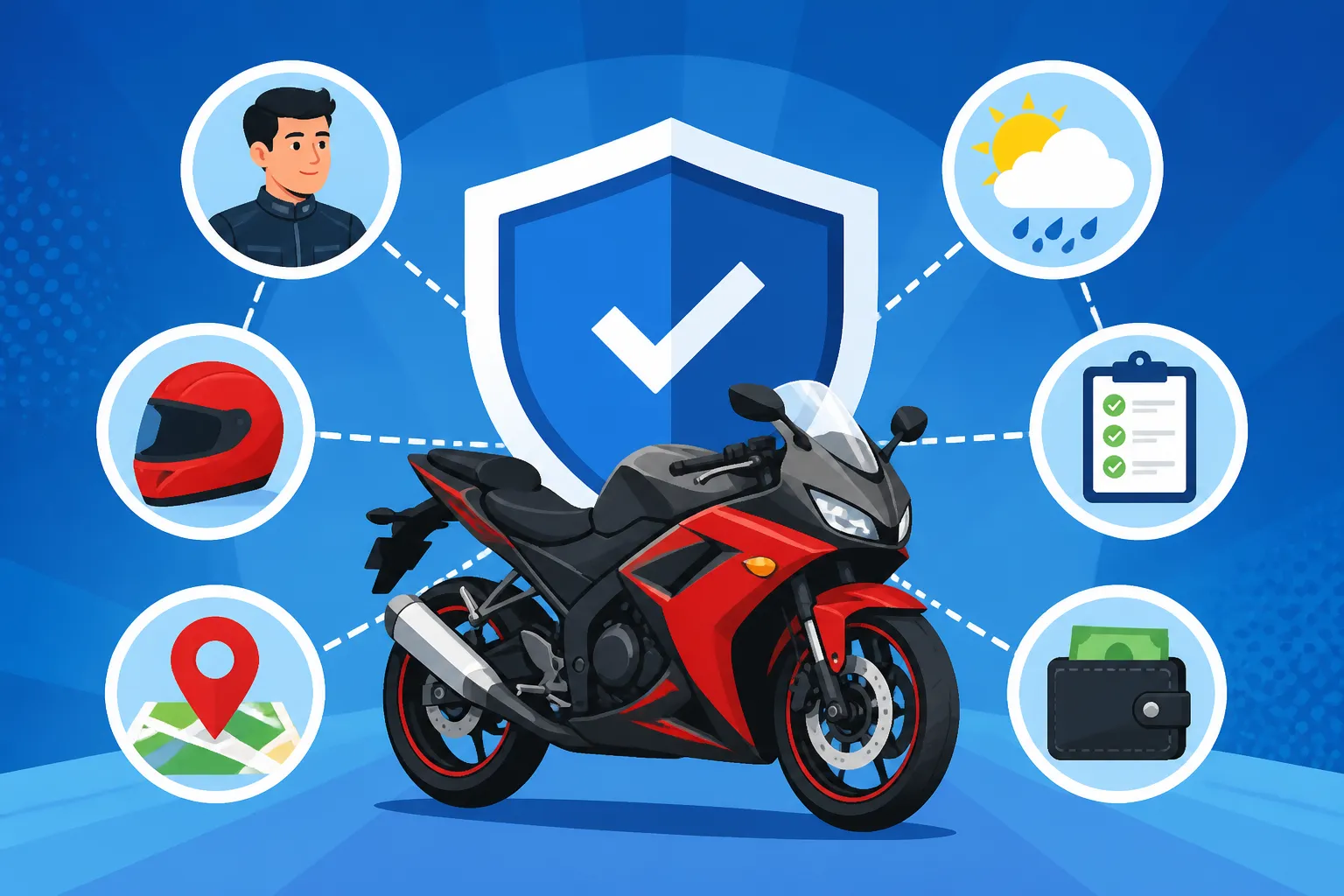
What Affects Your Motorcycle Insurance Rate?
You just spent months scrolling through listings, finally found that perfect 2026 Triumph Bonneville or a sleek Kawasaki Ninja, and negotiated a price that felt like a steal. Then you call for an insurance quote and your jaw hits the floor. We have all been there, staring at a premium that seems to make no sense compared to what your buddy pays for the same bike. This guide meticulously breaks down every hidden variable, from your zip code to your credit score, to solve the mystery of why your rates look the way they do.
Personal Factors and Demographics That Shift Your Rate
When an insurance company looks at you, they are not just seeing a rider; they are seeing a collection of data points that represent a certain level of risk. They use complex actuarial tables to predict how likely you are to file a claim based on millions of other people who share your characteristics. It can feel a bit dehumanizing, but understanding these personal metrics is the first step in mastering your How Much Is Motorcycle Insurance? 2026 Cost Guide journey.
Age and Maturity Levels
Age is perhaps the most significant demographic factor. Statistically, younger riders, particularly those under the age of 25, are involved in significantly more accidents than older, more experienced riders. This is not necessarily a reflection of your individual skill, but rather the collective data of your age group. For a 19-year-old on a high-powered sport bike, the rates can be astronomical because the insurer sees a high probability of a high-speed incident.
As you get older, your rates typically begin to stabilize. Once you hit 30, and again at 50, you might see significant drops in your premium as you move into brackets that insurers consider more "stable." However, there is a curve; very senior riders may eventually see rates tick back up if insurers perceive a decline in reaction times. Exploring Motorcycle Insurance Cost by Age can help you visualize how these brackets change over the decades.
Riding Experience and Licensure
There is a massive difference between having a learner’s permit and holding a full motorcycle endorsement for ten years. Insurers value time on the road. If you have been riding since you were 16 without a single incident, your rate will be drastically lower than someone who just decided to pick up riding at age 40. The "new rider" surcharge is a real thing, and it usually lasts for the first three years of licensure.
Ensuring you have a proper Motorcycle License, Endorsement & Insurance setup is critical. If you are riding on a permit, many insurers will either refuse to cover you or charge a massive premium because you haven't yet proven your proficiency through a state-administered skills test. Once you secure that endorsement, make sure your agent knows immediately so they can update your profile and potentially drop your rate.
Credit History and Financial Responsibility
It might seem strange that how you handle a credit card affects how much you pay to ride a motorcycle, but most states allow insurers to use a credit-based insurance score. The industry's logic is that individuals who manage their finances responsibly are also more likely to be responsible on the road and maintain their equipment properly.
If your credit score has taken a hit recently, you might find your premiums are 20% to 50% higher than someone with "Excellent" credit. This is one of those hidden frustrations that riders often overlook. If you are struggling with this, looking into Best Cheap Motorcycle Insurance for Bad Credit can offer some relief, as certain carriers weigh credit less heavily than others.
The Motorcycle Itself: Make, Model, and Specs
The machine you choose to put in your garage is the second biggest piece of the rating puzzle. Not all bikes are created equal in the eyes of an insurance adjuster. They look at the "crashability" of the bike, the cost of parts, and the likelihood of it being targeted by thieves.
Sport Bikes vs Cruisers
This is the classic insurance divide. A sport bike, like a Yamaha R6 or a Suzuki GSX-R, is built for speed and agility. Because these bikes are often associated with high-speed riding and are more expensive to repair due to their intricate plastic fairings, they are much more expensive to insure. Even a minor tip-over on a sport bike can result in thousands of dollars in cosmetic damage.
On the flip side, cruisers and touring bikes often enjoy much lower rates. A Harley-Davidson or an Indian Scout is generally ridden more conservatively over longer distances. The parts are often more accessible, and the lack of expensive fairings means a low-speed drop doesn't always result in a total loss. Understanding the Motorcycle Insurance Cost for a Sport Bike vs Cruiser is essential before you sign the papers at the dealership.
Engine Size and Displacement
The "CC" count of your engine is a direct indicator of power, and to an insurer, power equals risk. A 250cc starter bike is seen as a low-risk tool for learning. A 1300cc Hayabusa is seen as a rocket ship. The jump in premiums between a 600cc bike and a 1000cc bike can be hundreds of dollars per year, even if the rider remains the same.
When you ask Does Engine Size (CC) Affect Insurance Cost?, the answer is a resounding yes. Insurers categorize bikes into "classes" based on displacement. If your bike crosses into a "super-standard" or "liter-bike" category, you are automatically moved into a higher-risk premium tier. This is why many experienced riders choose "middleweight" bikes in the 650cc to 900cc range—they offer plenty of power without the "widowmaker" insurance premiums.
Customizations and Aftermarket Modifications
We all love to make our bikes our own. Whether it’s a custom Vance & Hines exhaust, upgraded Ohlins suspension, or a bespoke paint job, these changes add value to the bike. However, standard policies often only cover the bike as it came from the factory. If you don't declare your mods, you're not only risking a claim denial, but you're also missing out on the correct rating.
Adding Accessories & Custom Parts Coverage Explained to your policy will increase your rate, but it ensures that your $3,000 custom turbo kit is actually protected. Insurers view heavily modified bikes as higher risks because they are harder to value and often indicate a rider who is interested in performance testing.
Geographical Location and Regional Risks
Where you park your bike at night has a massive impact on your monthly bill. Insurance is all about the "pool" of risk in your immediate vicinity. If you live in a high-crime area or a city with congested traffic, you are simply more likely to have something go wrong.
Urban vs Rural Riding
If you live in the heart of Los Angeles or Chicago, you are dealing with stop-and-go traffic, distracted drivers, and a higher density of intersections—where the majority of motorcycle accidents occur. Consequently, California Motorcycle Insurance Requirements or rates in New York City are going to be significantly higher than those in rural Iowa.
In rural areas, while the risk of theft is lower, insurers might look at other factors like "deer strikes" or the distance to the nearest hospital. However, the sheer volume of claims in cities usually makes urban riding the more expensive option. If you move from a small town to a major metro, expect your motorcycle insurance to be one of the first bills that increases.
Crime Rates and Theft Statistics
Some bikes are "theft magnets." If you own a popular model like a Honda CBR or a high-end Ducati and live in a zip code with high vehicle theft rates, your comprehensive coverage will spike. Insurers track which models are most frequently stolen in specific neighborhoods.
If you keep your bike in a locked, alarmed garage, some insurers might offer a small discount, but the primary rating factor remains the zip code on your registration. Using a tool like The Zebra can help you see how much your rate might change if you were to move just a few miles away into a different zip code.
Climate and Seasonal Use
In states like Florida or Arizona, you can ride 365 days a year. In states like Michigan or Maine, the bike might sit in a garage for six months. You would think the northern states would be cheaper, but they often have higher rates for the months you do ride because the risk is concentrated, and there's a higher chance of hitting road salt or potholes.
However, many riders in the north utilize Seasonal Lay-Up & Winter Storage Insurance to save money. This allows you to drop collision and liability while the bike is on stands, keeping only comprehensive coverage in case of a fire or theft in the garage. Understanding how your local climate affects your Average Motorcycle Insurance Cost by State is a key part of budgeting for the year.
| Factor | Impact on Rate | Why it Matters |
|---|---|---|
| Age (Under 25) | High Increase | High statistical likelihood of accidents. |
| Clean Record | High Decrease | Proves responsible behavior and low risk. |
| Sport Bike Type | Moderate-High Increase | Expensive fairings and high performance. |
| MSF Course | Small Decrease | Shows commitment to safety and skill. |
| High Credit Score | Moderate Decrease | Correlates with overall financial and road responsibility. |
| Urban Zip Code | Moderate Increase | Higher traffic density and theft risk. |
Riding History and On-Road Behavior
This is the one area where you have the most direct control. Your "paper trail" as a driver and rider tells the insurance company exactly how much of a gamble you are.
The Clean Record Discount
Every speeding ticket, reckless driving charge, or at-fault accident stays on your insurance record for three to five years. For motorcyclists, a single "excessive speed" ticket can double your premium overnight. Insurers view a ticket not just as a one-time mistake, but as a pattern of behavior that will eventually lead to a costly claim.
If you have a checkered past, you may be required to file an SR-22 for Motorcycles: When It's Required. This is a certificate of financial responsibility that proves to the state you are carrying insurance, and it usually comes with a massive "high-risk" surcharge. Keeping your record clean is the single most effective way to lower your Average Monthly Cost of Motorcycle Insurance.
Training and Safety Certifications
One of the few ways to proactively lower your rate is by taking a Motorcycle Safety Foundation (MSF) course or a similar state-approved program. Most major insurers offer a 5% to 15% discount for riders who have completed a safety course within the last three years.
Beyond the discount, the skills you learn can literally save your life and prevent the accidents that cause rates to skyrocket in the first place. When you look at Does a Motorcycle Safety Course Lower Insurance?, you’ll find that the course often pays for itself in premium savings within the first year. It’s a win-win for your wallet and your safety.
Usage Frequency and Annual Mileage
Are you a "weekend warrior" who only puts 500 miles a year on the odometer, or are you a year-round commuter who racks up 15,000 miles? The more time you spend on the road, the higher the mathematical probability that someone will pull out in front of you.
When you get a quote, you’ll be asked for your estimated annual mileage. Be honest, but accurate. If you over-estimate, you’re paying for risk that doesn't exist. Some modern insurers even offer Pay-Per-Mile Motorcycle Insurance: Cost & Options, which can be a game-changer for people with multiple bikes or those who only ride on sunny Sundays.
Policy Structure and Coverage Selections
Sometimes, your rate is high simply because of the "ingredients" you’ve put into your policy. Choosing the right balance between protection and price is an art form.
Deductible Levels and Premium Balance
The deductible is the amount you pay out of pocket before insurance kicks in. If you have a $250 deductible, your premium will be high because the insurance company is taking on more of the financial burden for small mishaps. If you raise that deductible to $1,000, your monthly rate will drop significantly.
This is a great strategy for experienced riders who have an emergency fund. You are essentially betting on yourself. However, you have to be careful. If you’re asking What Is the Deductible on Motorcycle Insurance? and you realize you can't afford a $1,000 bill if you drop your bike, then a lower deductible might be worth the extra monthly cost.
Liability-Only vs Full Coverage
If you are riding an older bike that is worth less than $3,000, you might decide that Liability-Only vs Full Coverage Cost analysis leans toward liability-only. Liability covers the damage you do to others, but it won't pay a dime to fix your bike if you slide out on some gravel.
For a brand-new bike, especially a financed one, Motorcycle Insurance Requirements for Financed Bikes will almost always mandate full coverage (collision and comprehensive). This ensures the lender’s investment is protected. The jump from liability-only to full coverage is often the biggest price increase you will see when building a policy.
Multi-Policy and Multi-Bike Bundles
Insurers love loyalty. If you have your home, auto, and motorcycle insurance all with the same company, they will almost always give you a "bundling" discount. This can shave 10% to 25% off each individual policy.
Furthermore, if you have more than one bike, look for a Multi-Bike Discount: Insuring More Than One Motorcycle. Adding a second bike to an existing policy is usually much cheaper than taking out a brand-new policy elsewhere, as the insurer assumes you can only ride one bike at a time, which limits their total exposure.
External Influences and Industry Trends
Sometimes your rate goes up even when nothing about your life has changed. This is the part of insurance that feels the most unfair, but it’s rooted in the global economy and state law.
State Minimum Requirements and Legislative Shifts
Every state has its own laws regarding Minimum Liability Insurance Explained (The Three Numbers). If your state legislature decides to raise the minimum coverage from 15/30/5 to 25/50/25, every single rider in that state will see a rate hike. They are now required by law to purchase more "product" than they were before.
Similarly, states like Michigan have unique "No-Fault" laws. If you are looking into Michigan Motorcycle Insurance (No-Fault) Explained, you'll see that the rates are vastly different because the state requires unique personal injury protection. Always stay aware of local law changes that might be affecting your bottom line.
Rising Costs of Repair and Medical Care
Inflation hits insurance hard. As the cost of specialized motorcycle parts increases and the hourly rate for mechanics at dealerships goes up, the insurance company has to pay out more for every claim. They pass these costs on to you in the form of higher premiums.
Medical inflation is even more significant. If you are involved in a serious accident, the hospital bills can easily reach six figures. As healthcare becomes more expensive, the "Medical Payments" or "Personal Injury Protection" portion of your insurance rises to keep up with the potential payouts. This is why Why Is My Motorcycle Insurance So Expensive? is such a common question in high-inflation years.
How to Navigate Quotes and Comparisons
The worst thing you can do is just accept the first quote you get. The motorcycle insurance market is incredibly competitive, and different companies "appetite" for risk changes constantly.
One year, a company might want to grow their share of the sport bike market and offer aggressive rates. The next year, after a string of losses, they might jack those rates up to drive customers away. This is why tools like The Zebra are invaluable—they allow you to compare multiple companies at once to see who currently wants your business.
When you How to Compare Motorcycle Insurance Quotes, make sure you are comparing "apples to apples." Ensure the liability limits, deductibles, and add-ons like Roadside Assistance & Towing for Motorcycles are identical across all quotes. You might find that one company is $400 cheaper simply because they have a better algorithm for your specific age and bike combination.
Don't be afraid to switch. There is no reward for loyalty in the insurance world if a competitor is offering the same coverage for 30% less. Just make sure you understand How to Switch Motorcycle Insurance Without a Lapse so you don't end up with a penalty or a period of time where you are riding uninsured.
Motorcycle Insurance Disclaimer
This guide is provided for informational purposes only and does not constitute legal or financial advice. Insurance laws and rating factors vary significantly by state and individual provider. Always consult with a licensed insurance agent or professional to discuss your specific coverage needs and to ensure compliance with local regulations. Insurance premiums and availability are subject to change based on underwriting criteria.