How Does Gap Insurance Pay After a Total Loss?
It’s a gut-wrenching feeling: your beloved motorcycle is totaled, a mangled mess after an accident or theft, and the insurance company cuts you a check that barely covers a fraction of what you still owe on the loan. Many riders find themselves in this awful predicament, stuck paying off a loan for a bike they no longer have. This guide is here to walk you through exactly how gap insurance works to bridge that frustrating financial divide after a total loss, ensuring you don't get left holding the bag.
What is a Motorcycle Total Loss?
The term "total loss" can sound pretty definitive, but for insurance companies, it's a specific calculation that determines if repairing your damaged motorcycle is economically feasible. It's not always about how bad the bike looks, but rather the numbers behind the damage.
Defining "Totaled" for Motorcycles
When your motorcycle is involved in an incident – be it a crash, theft, or even severe weather damage – your insurance provider will assess the extent of the damage. A motorcycle is typically declared a "total loss" or "totaled" when the cost to repair the damage, plus the salvage value of the bike, exceeds a certain percentage of its actual cash value (ACV) before the incident. This percentage, known as the total loss threshold, varies by state and insurer, but it often hovers around 70-80%. So, even if your bike could be fixed, if the repair bill is too high relative to its market worth, it's likely headed for the salvage yard. For a deeper dive into this, check out our guide on What Happens When Your Motorcycle Is Totaled?.
For example, imagine your sport bike, a Yamaha R6, is involved in a collision. The fairings are smashed, the forks are bent, and there's suspected engine damage. An adjuster comes out, carefully documenting every scratch and broken part. They determine the bike’s actual cash value before the crash was $8,000. If the repair estimate comes in at $6,500, and your state's threshold is 75%, then $6,500 is more than 75% of $8,000 ($6,000). So, despite some parts potentially being salvageable, the insurer declares it a total loss because it's simply not cost-effective to repair.
Actual Cash Value (ACV) vs. Repair Costs
This is where the rubber meets the road. Your standard collision or comprehensive insurance coverage will pay out based on the motorcycle's actual cash value (ACV) at the time of the loss, minus your deductible. ACV isn't what you paid for the bike, nor is it necessarily what you owe. It's the market value of your motorcycle, considering factors like age, mileage, condition, and depreciation. Think of it as what you could have realistically sold your bike for just before the incident.
Let's say you bought a brand new Kawasaki Ninja 400 for $5,500 a year ago. You've put 5,000 miles on it, and it's been through a season of riding. If it's totaled today, its ACV might only be $4,500 due to depreciation. Your insurance payout (after your deductible) would be based on that $4,500, not the original $5,500 sticker price. This gap between what the bike is worth to the insurer and what it cost you can be significant, especially for newer models that depreciate quickly. Understanding your policy's payout structure, including whether it uses ACV, stated value, or agreed value, is crucial. You can learn more about these differences in our article on Agreed Value vs Stated Value vs Actual Cash Value.
Factors Influencing a Total Loss Decision
Several elements play into an insurer’s decision to declare a total loss. Beyond the sheer dollar amount of repairs versus ACV, the availability of parts, particularly for older or specialized bikes, can be a factor. If a crucial component is discontinued or incredibly hard to source, even a lower repair cost might lead to a total loss declaration simply because the repair isn't practical.
Location also matters. Labor rates for mechanics can vary widely, impacting the overall repair cost. A repair that might be just under the total loss threshold in a rural area with lower labor costs could easily push it over the edge in a major metropolitan hub like Los Angeles or New York. The condition of your motorcycle before the damage is also considered; a well-maintained bike might have a slightly higher ACV than one showing signs of neglect, influencing the calculation.
The Problem: Owing More Than Your Bike is Worth
This is the harsh reality that catches many riders off guard. You secured a great loan, you're making your payments, and then disaster strikes. Suddenly, you're faced with a financial deficit because your insurance payout doesn't zero out your loan. This is often referred to as being "upside down" or having "negative equity."
Depreciation: The Silent Killer
Motorcycles, much like cars, begin to depreciate the moment you ride them off the dealership lot. This isn't a slow, steady decline either; the steepest drop in value often occurs in the first year or two of ownership. Factors like mileage, wear and tear, and the introduction of newer models all contribute to this decline. You might have bought a shiny new Harley-Davidson Street Glide for $25,000, financed it over five years, and after just 18 months, its market value has dropped to $19,000.
If your bike is totaled at that 18-month mark, your primary insurance company will pay you that $19,000 (minus your deductible). But what if you still owe $21,000 on the loan? That's a $2,000 shortfall you're suddenly responsible for, even though you no longer have the motorcycle. It's a frustrating scenario that can leave you feeling financially devastated and without a ride. This rapid depreciation is why many lenders strongly recommend, and sometimes even require, additional protection.
Financing and Lease Agreements
Most new motorcycles are purchased with financing, and some riders even opt for leases. These agreements often stretch over several years, meaning you're paying off the principal balance slowly. When you factor in interest, taxes, and fees rolled into the loan, it's easy to owe more than the bike's current market value, especially early in the loan term. Many loan agreements, particularly for expensive bikes, are structured in a way that the depreciation outpaces the rate at which you pay down the principal.
Lenders are acutely aware of this risk. If your motorcycle is totaled and the insurance payout is less than your outstanding loan balance, the lender is the one who stands to lose money. To protect their investment, many financing institutions will either require you to carry gap insurance or offer it directly at the time of purchase. This is especially true for those with Motorcycle Insurance Requirements for Financed Bikes. It’s not just about covering your ride; it’s about covering the bank’s asset.
The Dreaded "Negative Equity"
Negative equity is simply the difference between what you owe on your loan and what your motorcycle is actually worth. It’s a common problem for riders, particularly those who:
- Made a small down payment: The less money you put down upfront, the more you finance, and the longer it takes for your loan balance to drop below the bike's depreciating value.
- Opted for a long loan term: Spreading payments over 60 or 72 months might make monthly payments lower, but it also means you’re paying interest for longer, and the principal decreases more slowly, increasing the likelihood of negative equity.
- Have a high interest rate: A higher interest rate means more of your early payments go towards interest rather than reducing the principal, keeping your loan balance high.
- Rolled over negative equity from a previous loan: If you traded in a bike that you were upside down on and rolled that balance into your new motorcycle loan, you're starting with negative equity right from the start.
In these situations, the risk of a total loss leaving you in a deep financial hole is significantly higher. Without gap insurance, that negative equity becomes your personal debt to the lender, even if you’re no longer riding.
How Gap Insurance Steps In After a Total Loss
This is where gap insurance truly shines. It’s designed specifically to protect you from the financial sting of negative equity following a total loss. It literally covers the "gap" in your finances.
Bridging the Financial Divide
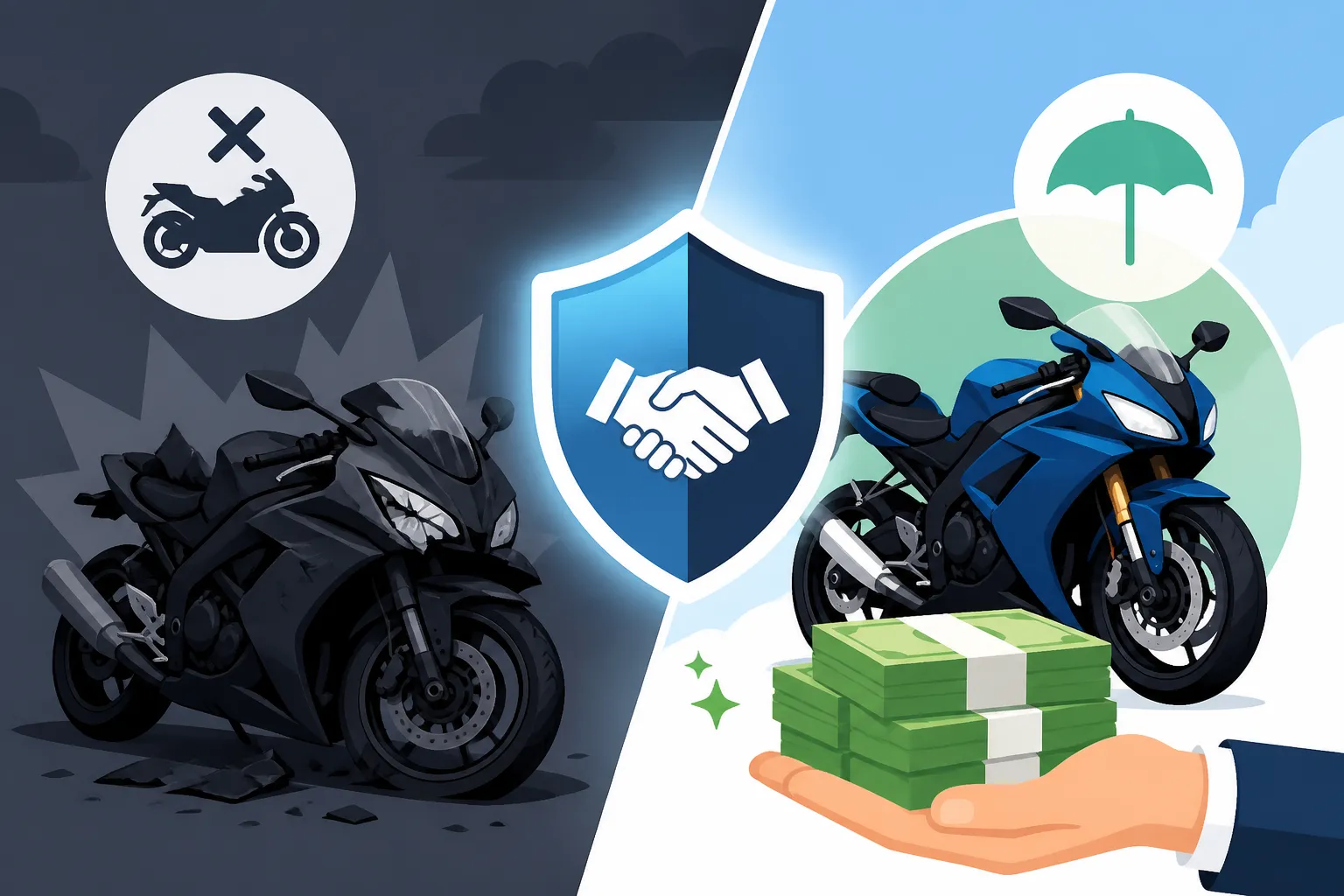
When your motorcycle is declared a total loss, your primary insurance policy (collision or comprehensive) pays out its actual cash value (ACV), minus your deductible. If that ACV is less than what you still owe on your loan or lease, that difference is your responsibility. This is the gap. Gap insurance steps in to pay that remaining balance directly to your lender, essentially wiping out your loan so you don't have to make payments on a bike you no longer possess.
Let's revisit our Kawasaki Ninja 400 example. You bought it for $5,500, financed the whole thing, and a year later you still owe $5,000. Due to depreciation, its ACV is now $4,000. Your collision coverage will pay out $4,000 (assuming a $0 deductible for simplicity). Without gap insurance, you’d still owe the lender $1,000. With gap insurance, it would pay that $1,000 difference, settling your loan completely. It truly provides peace of mind that you won't be trapped in a cycle of debt after an unforeseen incident.
Who Pays What: Your Primary Insurer vs. Gap Provider
It's important to understand the sequence of events and which insurer is responsible for what portion of the payout.
- Primary Insurer (Collision/Comprehensive): After your motorcycle is totaled and you file a claim, your primary insurer (like Progressive or State Farm) will first determine the actual cash value (ACV) of your bike. They will then pay that ACV, minus your deductible, to either you or your lender. This is usually the first check issued.
- Gap Insurer: Once the primary insurer has made their payment, if there's still an outstanding balance on your loan that exceeds that payout, your gap insurance provider steps in. They will calculate the remaining difference between the primary payout and your loan balance, and then send a check directly to your lender to pay off the rest of the loan.
This two-step process ensures that the lender is fully compensated, and you are free from the financial obligation of a lost motorcycle. It’s a seamless process once the total loss is declared, removing a huge burden from your shoulders.
Example Scenarios
To make it concrete, let's look at a couple of scenarios:
Scenario 1: New Bike, Large Loan
- Bike: Brand new Honda Rebel 1100, financed for $10,000.
- Loan Balance at time of total loss: $9,500 (after 6 months of payments).
- Actual Cash Value (ACV) from primary insurer: $8,000 (due to rapid depreciation).
- Primary Insurance Payout: $8,000 (assuming $0 deductible for simplicity).
- Gap: $9,500 (loan balance) – $8,000 (ACV payout) = $1,500.
- With Gap Insurance: The gap insurer pays the $1,500 to the lender. Your loan is fully paid off.
- Without Gap Insurance: You owe the lender $1,500 out of your own pocket.
Scenario 2: Older Bike, Smaller Loan
- Bike: 5-year-old Kawasaki Vulcan S, financed for $6,000.
- Loan Balance at time of total loss: $2,000.
- Actual Cash Value (ACV) from primary insurer: $4,500.
- Primary Insurance Payout: $4,500.
- Gap: In this case, there's no gap. The ACV ($4,500) is more than the loan balance ($2,000).
- With/Without Gap Insurance: Your primary insurer pays $4,500. The lender takes their $2,000, and you receive the remaining $2,500. Gap insurance would not have paid anything here because there was no "gap" to cover.
This clearly illustrates that gap insurance is most valuable when your loan balance significantly exceeds your bike's market value. If you're wondering what kind of coverage you should even have, take a look at our What Does Full Coverage Motorcycle Insurance Mean? article to understand the components of a robust policy.
Here's a quick comparison table:
| Scenario Description | Loan Balance | Actual Cash Value (ACV) | Primary Insurer Payout (after deductible) | Your Out-of-Pocket (No Gap) | Gap Insurance Payout | Your Out-of-Pocket (With Gap) |
|---|---|---|---|---|---|---|
| New Bike, Quick Total Loss | $25,000 | $20,000 | $20,000 | $5,000 | $5,000 | $0 |
| Modestly Depreciated Bike | $12,000 | $10,500 | $10,500 | $1,500 | $1,500 | $0 |
| Bike's Value Exceeds Loan | $5,000 | $7,000 | $7,000 | $0 | $0 | $0 |
| High Loan, Extreme Depreciation | $18,000 | $12,000 | $12,000 | $6,000 | $6,000 | $0 |
When is Gap Insurance Truly Necessary for Riders?
While gap insurance sounds like a must-have for every financed motorcycle, it's not always strictly necessary. Its value depends heavily on your specific financial situation and the type of motorcycle you own. Understanding these factors can save you money while still providing crucial protection.
New Bikes with High Depreciation
If you just rode a brand new motorcycle off the lot, especially a high-performance sport bike or an expensive touring model, you’re in the prime zone for needing gap insurance. As mentioned, new vehicles depreciate rapidly in their first year or two. The moment you take possession, its value typically drops by a significant percentage. This immediate depreciation, coupled with the slow reduction of your loan principal, creates a wide "gap" that could leave you vulnerable if a total loss occurs early in your ownership.
Consider a rider in Florida who buys a new Triumph Bonneville. Even with a decent down payment, the initial depreciation can be substantial. If that bike is stolen or involved in an accident within the first year, the ACV payout from their primary insurer, perhaps GEICO or Progressive, might leave them thousands of dollars short of their loan balance. Gap insurance in this scenario would be a financial lifesaver, ensuring they don't have to pay for a bike they no longer ride.
Long-Term Loans or High Interest Rates
The length and terms of your loan are critical indicators of whether gap insurance is a good idea. If you’ve secured a loan with a long repayment period (e.g., 60 or 72 months), your monthly payments will be lower, but the principal balance decreases at a much slower pace. This extends the period during which your loan balance is likely to exceed your motorcycle's depreciated value.
Similarly, a high interest rate means more of your early payments go towards interest rather than reducing the actual amount you borrowed. This keeps your loan balance higher for longer, increasing your exposure to negative equity in case of a total loss. Riders who might have a less-than-perfect credit score and consequently higher interest rates will find gap insurance particularly beneficial, as their loan balance drops slower relative to the bike's depreciation.
Putting Less Money Down
Making a substantial down payment on your motorcycle immediately reduces the amount you need to finance. This puts you in a better position from day one, as your loan balance starts lower and is more likely to remain below the bike's actual cash value as it depreciates. Conversely, if you put down little to no money – perhaps only covering taxes and fees – you're starting your loan with a very high principal, often exceeding the bike's value right away.
This "zero down" approach is common, especially for riders excited to get on the road without a large upfront investment. While it makes getting a new bike more accessible, it significantly increases your risk of negative equity if a total loss occurs. In such cases, gap insurance is almost essential to protect your financial interests. Without it, you could easily be on the hook for thousands of dollars after an accident, despite having comprehensive motorcycle coverage.
Understanding the Payout Process: Step by Step
Navigating an insurance claim after a total loss can be stressful, especially when multiple parties are involved. Knowing the steps to take can make the process smoother and ensure you receive the appropriate payouts from both your primary insurer and your gap insurance provider. For a full guide on the initial steps, you might find our article on How to File a Motorcycle Insurance Claim helpful.
Filing Your Primary Claim
The very first step after a total loss event – be it an accident, theft, or other covered peril – is to immediately contact your primary motorcycle insurance company. This is the insurer that provides your collision and comprehensive coverage.
You'll need to provide them with all the details of the incident, including the date, time, location, and a description of what happened. If it was an accident, provide any police reports and contact information for other parties involved. If it was theft, supply the police report confirming the theft. Your insurer will assign a claims adjuster who will investigate the incident, determine if your policy covers the loss, and assess the damage to your motorcycle. This adjuster will ultimately declare the bike a total loss if the repair costs exceed the total loss threshold. They will then calculate the actual cash value (ACV) of your motorcycle at the time of the loss. This ACV is the basis for your primary insurance payout, minus your deductible. This initial payout will usually be sent directly to your lender, or to you if the bike is fully paid off.
Notifying Your Gap Insurer
Once your primary insurer has declared your motorcycle a total loss and determined its actual cash value, you should then notify your gap insurance provider. This could be a separate company if you bought standalone gap coverage, or it might be an add-on from your primary insurer or the dealership/lender. You'll need to provide them with documentation from your primary insurer, including:
- The total loss declaration.
- The actual cash value (ACV) payout amount.
- Proof of your outstanding loan balance from your lender.
The gap insurer will then review these documents. They will confirm that the ACV payout from your primary insurer is indeed less than your outstanding loan balance. It's crucial to have all your paperwork in order to avoid delays. Make sure you keep copies of your original loan agreement, your insurance policy documents, and all correspondence related to the total loss claim. Companies like The Zebra can often help you streamline this process if you purchased your gap policy through a broker that they partner with, guiding you on what documents are needed.
Receiving the Payouts and Closing the Loan
After the gap insurer has verified all the necessary information, they will calculate the exact difference between the primary insurance payout (ACV minus deductible) and your remaining loan balance. They will then issue a payment directly to your lender for that specific "gap" amount.
This combined payment from your primary insurer and your gap insurance provider should fully satisfy your outstanding motorcycle loan. You should receive confirmation from your lender that the loan has been paid in full and that your account is closed. This means you will no longer be responsible for any payments on the motorcycle that was totaled. It's a huge relief, freeing you from the financial burden and allowing you to move forward without a lingering debt for a bike you no longer possess. Without gap insurance, you might find yourself navigating how to negotiate a motorcycle total loss settlement with your lender while still owing money.
Important Considerations and Limitations of Gap Coverage
While gap insurance is an incredibly valuable tool, it's not a magic bullet. There are important aspects to understand, including eligibility requirements, exclusions, and scenarios where it might no longer be necessary.
Eligibility and Exclusions
Not all motorcycles or loan scenarios qualify for gap insurance, and even when they do, there might be specific exclusions. Typically, gap insurance is offered for new or relatively new motorcycles that are financed or leased. Older bikes, those purchased outright, or those with very low outstanding loan balances usually won't qualify, or the coverage won't be beneficial.
Common exclusions for gap insurance include:
- Excessive Mileage: If your motorcycle has accumulated a very high amount of mileage, which drastically reduces its market value, you might not be eligible.
- Late Payments or Loan Default: Gap insurance is designed to cover a total loss, not to pay off your loan if you default or consistently make late payments.
- Fraud: Any fraudulent claims or misrepresentations will naturally void your gap coverage.
- Rolled-Over Debt: If you rolled negative equity from a previous vehicle into your current motorcycle loan, some gap policies may not cover the portion of the debt that isn't directly related to the current bike.
- Penalties and Fees: Gap insurance typically covers the outstanding loan principal and interest, but not late fees, extended warranty costs, or other administrative charges rolled into the loan.
- Long-Term Lease Agreements: While often available for leases, policies may have limits on the lease term length.
Always read your gap insurance policy carefully to understand its specific terms and conditions. What might be covered by one provider, such as Progressive, might have a subtle exclusion with another.
Cost of Gap Insurance
The cost of gap insurance is generally quite affordable, especially when you consider the potential financial disaster it can prevent. It's often added as a small premium to your regular motorcycle insurance policy, or it can be a one-time fee bundled into your loan from a dealership or lender.
- As an Add-On to Your Policy: Many major insurers offer gap coverage as an endorsement or rider to your comprehensive and collision policy. This is often the most cost-effective way to get it, usually adding a nominal amount, perhaps $20-$40 per year, to your premium. This makes it a great value for the protection it offers.
- Dealership/Lender Provided: When you finance your motorcycle, the dealership or lender might offer gap insurance directly. While convenient, these options can sometimes be more expensive, potentially costing several hundred dollars as a one-time fee that's rolled into your loan. This means you're paying interest on the gap insurance itself. It's crucial to compare this option with what your primary insurer can offer.
Always shop around. When getting motorcycle insurance quotes, ask about gap coverage options from different providers. Services like The Zebra allow you to compare various quotes, including add-on coverages, so you can find the best value.
When You Might Not Need It Anymore
Gap insurance isn't a permanent necessity. There will come a point in your motorcycle's life, or your loan term, when it simply no longer provides significant value. This typically occurs when your loan balance drops below the actual cash value of your bike.
- Paid Down Your Loan: As you make regular payments, your loan principal decreases. Once you've paid down a significant portion of your loan, it's very likely that your outstanding balance will be less than what your motorcycle is worth on the open market.
- Significant Down Payment: If you made a large down payment upfront, you might reach this break-even point much faster, or even avoid the "gap" entirely from the start.
- Older Motorcycle: For older bikes, especially those that are fully paid off or have very low loan balances, the need for gap insurance disappears. Your primary collision and comprehensive coverage will be sufficient to cover the bike's ACV, which will likely exceed any remaining loan.
It’s a good idea to periodically review your loan balance against your motorcycle's estimated market value. You can usually find rough estimates of your bike's value online through various appraisal tools. Once your loan balance is consistently lower than your bike's ACV, you can consider canceling your gap insurance. You might even find that your overall How Much Is Motorcycle Insurance? 2026 Cost Guide decreases slightly. Just ensure you don't cancel it prematurely and leave yourself exposed.
Disclaimer
Please remember that this article provides general information about motorcycle gap insurance. Insurance laws and policy specifics can vary significantly by state and individual insurance providers. It's essential to consult with a licensed insurance professional to discuss your specific needs and obtain personalized advice. Always read your policy documents thoroughly to understand your coverage, terms, conditions, and exclusions.