Does a Motorcycle Safety Course Lower Insurance?
Buying your first bike or upgrading to a more powerful machine is an absolute rush, but that excitement often hits a brick wall when you see your first insurance quote. Between the high risks associated with two-wheeled travel and the rising costs of medical care, riders frequently find themselves staring at premiums that feel like a second bike payment. This guide breaks down exactly how a motorcycle safety course can slash those costs and help you keep more of your hard-earned cash.
Why Insurance Companies Love Safety-Conscious Riders
If you have spent any time looking at How Much Is Motorcycle Insurance? 2026 Cost Guide, you know that insurers are in the business of predicting the future. They use complex algorithms to determine how likely you are to file a claim. To an insurance company, an untrained rider is a ticking time bomb of liability, whereas a trained rider represents a calculated, lower risk. This section explores why that plastic card you get at the end of a safety course is worth its weight in gold to your provider.
The Statistics Behind the Discount
The primary reason a safety course lowers your rate is rooted in cold, hard data. Statistical studies consistently show that riders who have completed a formal training program, such as those offered by the Motorcycle Safety Foundation (MSF), are involved in significantly fewer accidents than those who are self-taught or "learned from a friend." Most motorcycle accidents happen within the first five months of riding, and many of those are single-vehicle incidents where the rider simply failed to negotiate a curve or over-braked.
When you show an insurer that you have mastered low-speed maneuvers, emergency braking, and swerving techniques, you are telling them that you are less likely to cost them money. Companies like The Zebra often point out that proving your competency is one of the most direct ways to influence your premium because it addresses the "human element" of risk. While they can't change your age or your location, they can reward you for changing your skill level.
Risk Mitigation and Carrier Perspectives
From a carrier’s perspective, a safety course is a form of proactive risk mitigation. Insurance companies are essentially gambling on your safety; when you take a course, you are stacking the deck in their favor. This is why many major providers will offer a discount that lasts for three to five years before requiring a "refresher" course to maintain the lower rate. They recognize that skills can degrade over time, but the foundational habits learned in a Basic RiderCourse tend to stick.
Validation of these frustrations is important—it feels unfair to pay more just because you’re new, even if you’ve been riding dirt bikes your whole life. However, insurers don’t see your off-road history; they see a blank slate on the street. By taking a certified course, you provide the "paper trail" of safety that they require to justify a lower premium. It’s one of the few variables in your Motorcycle Insurance Cost by Age profile that you actually have total control over.
How Insurance Companies Categorize Training
Not all training is viewed equally by every insurance company. Most providers have a specific list of "approved" courses that trigger an automatic discount in their system. The MSF Basic RiderCourse is the gold standard, but many states have their own programs, like California’s CMSP or Oregon’s Team Oregon. If you take a "track day" school or a private advanced riding clinic, you might need to speak with an agent directly to see if they will honor it.
Often, the discount is categorized under "Safety Features" or "Driver Training" within the policy structure. Using a comparison tool like The Zebra can help you identify which specific carriers in your area offer the deepest discounts for these certificates. Some companies might offer a flat 5% off, while others might go as high as 15% if the course is paired with other safety features like anti-lock brakes (ABS).
How Much Can You Actually Save with a Safety Course?
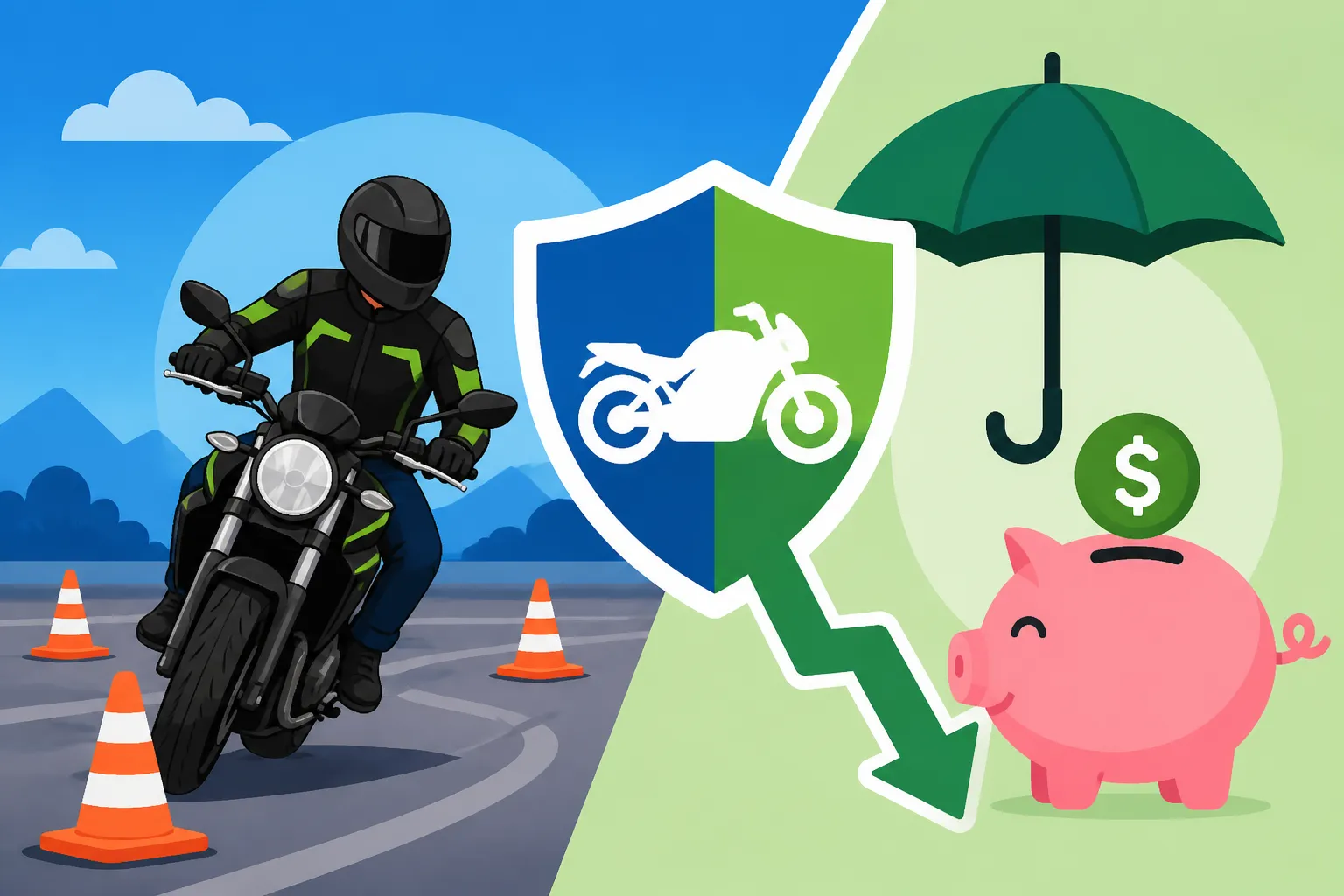
The big question every rider asks while sweating on a hot asphalt parking lot during their MSF weekend is: "Is this actually going to pay for itself?" The answer is almost always a resounding yes. While the initial cost of the course might range from $150 to $350 depending on your state, the long-term savings on your insurance policy usually eclipse that investment within the first year or two.
The Standard Percentage Range for Discounts
On average, completing a recognized motorcycle safety course will net you a discount between 5% and 15% on your annual premium. If you are a young rider in a high-cost area, this can translate to hundreds of dollars in savings. For instance, if you’re looking at California Motorcycle Insurance Requirements and find your premium is $1,200 a year, a 10% discount saves you $120 every single year. Over a three-year period, that’s $360—more than the cost of the course itself.
It is also worth noting that this discount usually applies to the "Liability" and "Collision" portions of your policy, which are often the most expensive components. While it might not reduce your "Comprehensive" coverage (which covers theft), the bulk of your bill will see a noticeable dip. Riders who use The Zebra to compare quotes often find that the "safety course" checkbox is one of the most impactful toggles for lowering the bottom-line number.
Cumulative Savings Over Your Riding Career
The financial benefit of a safety course isn't just a one-time event. It sets a lower baseline for your insurance history. As you gain years of experience without accidents—aided by the skills you learned—your rates will naturally trend downward. By starting with a training discount, you ensure that you are always paying the lowest possible "tier" for your age and bike type.
Consider the scenario of a rider who takes an advanced course every three years. Not only do they keep their skills sharp, but they also keep that "active" training discount on their policy indefinitely. This is especially helpful if you decide to buy a bike that is traditionally expensive to insure, such as those discussed in the Sport Bike Insurance Cost (Why So High) analysis. Training can make a "uninsurable" bike suddenly much more affordable.
Factors That Influence Your Specific Discount Amount
Your specific savings will depend heavily on your insurer and your state's regulations. Some states actually mandate that insurance companies provide a discount for safety course graduates, while in others, it is left up to the company’s discretion. Furthermore, the type of bike you ride matters. A 10% discount on a cruiser policy might be $50, but a 10% discount on a high-performance bike could be $200.
| Factor | Potential Discount Impact | Why it Matters |
|---|---|---|
| Rider Age | High | Younger riders have higher base rates, so percentage discounts save more dollars. |
| Bike Type | Moderate | Sport bikes have higher premiums; cruisers often have lower base costs. |
| State Laws | High | Some states like Florida or Texas have specific mandates for insurance discounts. |
| Course Level | Moderate | Advanced courses may offer additional tiers of savings with some niche insurers. |
| Insurance Carrier | Very High | Some companies prioritize safety training more than others in their pricing models. |
Types of Courses That Qualify for Discounts
Not every "riding lesson" will satisfy your insurance company's requirements for a discount. It is crucial to choose a program that is recognized by the state and the industry to ensure your time and money aren't wasted. Most riders start with the basic requirements, but advanced training can offer even deeper benefits both for your safety and your wallet.
Basic RiderCourse (BRC) and Beginner Training
The MSF Basic RiderCourse is the most common path for new riders. It typically involves a mix of classroom learning and on-motorcycle instruction over two or three days. The best part for beginners is that most states allow you to waive the DMV riding test if you pass the BRC. This means the course provides three major benefits: it teaches you to ride, it gets you your license, and it lowers your insurance.
When you're researching How to Buy Your First Motorcycle Insurance Policy, the first thing an agent will ask is if you have your endorsement and if you've taken a course. Having that certificate ready to email over can sometimes be the difference between getting a policy issued on the spot or facing a long "underwriting" delay. It proves you’ve had at least 15 hours of professional eyes on your riding habits.
Experienced RiderCourses and Advanced Skills
Many riders don't realize that the "Experienced RiderCourse" (BRC2) or advanced skills clinics can also trigger discounts. These courses are designed for people who already have their license but want to master their own specific motorcycle. You usually bring your own bike to these sessions, which allows you to learn its specific braking limits and cornering clearance.
Insurers appreciate this because a rider who is comfortable on their specific machine is much less likely to panic in a real-world emergency. If you have recently upgraded from a small starter bike to something like a heavy touring rig, taking an advanced course is a great way to show your insurer that you are taking the transition seriously. Using The Zebra to check if your current insurer offers an "Advanced Training" stackable discount is a smart move before you sign up for a weekend class.
State-Specific and Military-Approved Programs
For those in the armed forces, there are often military-specific riding courses (like the Sportbike RiderCourse or the Military Sportbike RiderCourse) that are mandatory for riding on base. These courses are incredibly rigorous and are highly respected by insurance companies. Most insurers will treat these as equivalent to or better than the standard MSF BRC.
Additionally, some states have unique programs that might offer higher local incentives. For example, if you are looking into Texas Motorcycle Insurance Requirements, you might find local programs that are tailored to the specific riding conditions of the Southwest. Always check with your local DMV or your insurance agent to see if there is a "preferred" state program that offers a bigger discount than the national standard.
Beyond the Discount: Other Financial Benefits of Training
While the direct insurance discount is the most obvious perk, the secondary financial benefits of taking a safety course are often much larger. Riding a motorcycle is a high-stakes activity, and the cost of a single "minor" mistake can be astronomical. Training acts as a financial buffer against the hidden costs of motorcycling.
Avoiding Costly Beginner Accidents
The most expensive thing you can do on a motorcycle is crash. Even a "low-speed tip-over" can cause thousands of dollars in damage to fairings, handlebars, and engine cases. If you haven't mastered the "friction zone" or slow-speed balance, these drops are almost inevitable. By learning these skills in a controlled environment on a "loaner" bike provided by the course, you save your own bike from unnecessary wear and tear.
Furthermore, avoiding an accident means you don't have to pay your deductible. If you have a $500 or $1,000 deductible, preventing just one accident pays for the safety course several times over. You also avoid the "rate hike" that follows a claim. As discussed in What Happens to My Rate After a Motorcycle Claim?, even a non-fault accident can sometimes lead to a loss of "vanishing deductibles" or other loyalty perks.
Impact on Your Permanent Driving Record
In many states, passing a safety course can be used to dismiss a moving violation or add "safe driving points" to your license. While this varies by jurisdiction, keeping your driving record clean is the single most important factor in keeping your insurance rates low. A single speeding ticket or "failure to maintain lane" can spike your premiums for three years or more.
If you already have a couple of points on your license, taking a safety course is a proactive way to show the insurance company that you are rehabilitating your riding habits. When you use The Zebra to shop for new coverage, having a recent safety course completion date can sometimes offset the negative impact of an older minor violation, making you appear as a "moving toward low-risk" rider rather than a "high-risk" one.
Equipment and Gear Protection Savings
Many safety courses emphasize the "All The Gear, All The Time" (ATGATT) philosophy. Learning which gear actually protects you and how to maintain it can save you money in the long run. Some insurers offer specialized coverage for riding gear, and they are more likely to offer better terms to riders who have been formally educated on the importance of helmets, jackets, and boots.
If you are curious about Does Motorcycle Insurance Cover Riding Gear?, you'll find that having a safety course certificate sometimes helps you qualify for higher limits on accessory coverage. Insurers assume that a trained rider is more likely to be wearing their gear, which reduces the severity of medical claims—and medical claims are the most expensive part of any insurance payout.
How to Apply the Safety Course Discount to Your Policy
Once you have that certificate in your hand, you need to make sure the insurance company actually applies the discount. It doesn't always happen automatically, and being proactive can ensure you don't leave money on the table for months.
Proof of Completion and Documentation
As soon as you finish your course, you will receive a completion card or certificate. Make a digital copy immediately. Most modern insurers allow you to upload this directly through their mobile app or website. If you are working with a local agent, simply emailing a photo of the card is usually enough.
Make sure the name on the certificate matches the name on your insurance policy exactly. If you took the course under a nickname but your policy is under your legal name, it could cause a delay in the "verification" process. If you're using a tool like The Zebra to compare rates, you can usually check a box indicating you have "Driver Training" to see the discounted rate in real-time before you even upload the document.
Timing Your Training for Maximum Savings
If you are planning on buying a new bike, try to time your safety course so that you finish it before you sign the insurance paperwork. This allows the discount to be baked into the initial policy. If you take the course mid-policy, don't worry—most companies will pro-rate the discount and give you a small refund or a credit toward your next monthly payment.
For riders looking at Motorcycle Insurance Grace Period When Buying, remember that while you might have a few days to get the bike insured, the "safety course" discount will only apply from the date you provide the certificate. Don't wait until your renewal period to send it in; every month you wait is money you're giving away for free.
Switching Insurers to Find Better Training Incentives
Not all companies reward safety training equally. If your current insurer only offers a measly 2% discount, it might be time to look elsewhere. Some niche insurers that specialize in motorcycles, like those reviewed in Dairyland Motorcycle Insurance Review, often have more aggressive discounts for MSF graduates because they understand the rider community better than "general" auto insurers.
Using The Zebra is particularly helpful here because you can see side-by-side how different companies value your training. You might find that while Company A has a lower "base" price, Company B has a much larger "safety course" discount that ultimately makes them the cheaper option. Always shop around every time you complete a new level of training.
Maximizing Your Overall Savings Beyond Training
While a safety course is a fantastic start, it shouldn't be your only strategy for lowering insurance costs. Combining your training discount with other "stackable" incentives can lead to truly massive savings.
Bundling and Multi-Vehicle Discounts
The "holy grail" of insurance savings is often bundling. If you have your car, home, and motorcycle all with the same company, you can see discounts that far exceed the 10% from a safety course. When you combine a bundle discount with a safety course discount and a "clean record" discount, you can sometimes cut your premium in half compared to a standalone policy.
If you're wondering Is It Cheaper to Add a Motorcycle to Auto Insurance?, the answer is almost always yes. However, even if you keep the policies separate, make sure both companies know about your safety training. Even your auto insurer might give you a small "safe driver" credit for completing a motorcycle course, as the skills (like situational awareness and defensive driving) carry over to the car.
The Role of Credit Scores and Geography
It feels unfair, but your credit score and your zip code often have a bigger impact on your rate than your riding skill. If you live in a high-theft area or a city with heavy traffic, your rates will be higher regardless of your MSF certificate. However, the safety course discount is a percentage—meaning it's actually more valuable in expensive areas. 10% of a $2,000 urban policy is much more helpful than 10% of a $400 rural policy.
Improving your credit score can also drastically lower your premiums. Insurers use "insurance scores" (which are based on credit) to predict how likely you are to file a claim. If you're working on your credit, platforms like The Zebra can help you track how your insurance rates drop as your score climbs. Combine that with a fresh safety certificate, and you'll see a significant difference.
Choosing the Right Bike to Keep Costs Down
Finally, the bike you choose to put in your garage dictates your "starting" price. If you’re a new rider, buying a Honda Rebel Insurance Cost is going to be significantly cheaper than trying to insure a high-performance sport bike. No amount of safety training will make a 1000cc superbike "cheap" for a 19-year-old.
Use your safety course as a tool to graduate through bike types. Start with a sensible bike, get your training, build a few years of clean riding history, and then move up to your dream machine. By the time you're ready for that high-performance bike, your insurance history will be so solid that the premiums won't be a barrier to entry.
Motorcycle Insurance Disclaimer
This guide is intended for informational purposes only and does not constitute legal, financial, or professional insurance advice. Insurance laws, discounts, and requirements vary significantly by state and individual provider. Always consult with a licensed insurance agent or your state's Department of Motor Vehicles to verify specific coverage needs and discount eligibility. Rates and savings mentioned are estimates based on national averages and may not reflect your actual costs.