What Is Accessories Coverage on a Motorcycle?
You’ve poured your heart, soul, and hard-earned cash into making your motorcycle truly yours. From that custom paint job and aftermarket exhaust to the comfortable touring seat and tricked-out electronics, every modification reflects your personal style and enhances your riding experience. But what happens to all that investment if your bike is stolen, damaged in an accident, or suffers an unfortunate tip-over? Many riders are surprised to find that their standard motorcycle insurance policy might not cover these cherished additions, leaving them out of pocket and frustrated. This guide will meticulously break down what accessories coverage is, how it works, and why it's so critical for protecting your unique ride.
The Heart of the Matter: Why Standard Policies Miss Your Custom Ride
It's a common misconception among riders that "full coverage" automatically means all parts of their bike are covered, including the custom bits. Unfortunately, that's often not the case. Standard comprehensive and collision policies are designed to cover the motorcycle as it came from the factory, or its "stock" value. Anything added on afterward, especially if it significantly increases the bike's value or changes its performance or appearance, often falls into a grey area if you don't have specific accessories coverage. This oversight can lead to a really painful surprise if you ever need to file a claim.
What Constitutes a Motorcycle Accessory?
When we talk about motorcycle accessories, we're not just referring to a fancy keychain. We're talking about components that are installed after the bike leaves the factory floor. These can range from purely aesthetic enhancements to performance upgrades and practical additions. The key is that they aren't considered part of the motorcycle's original manufacturer specifications.
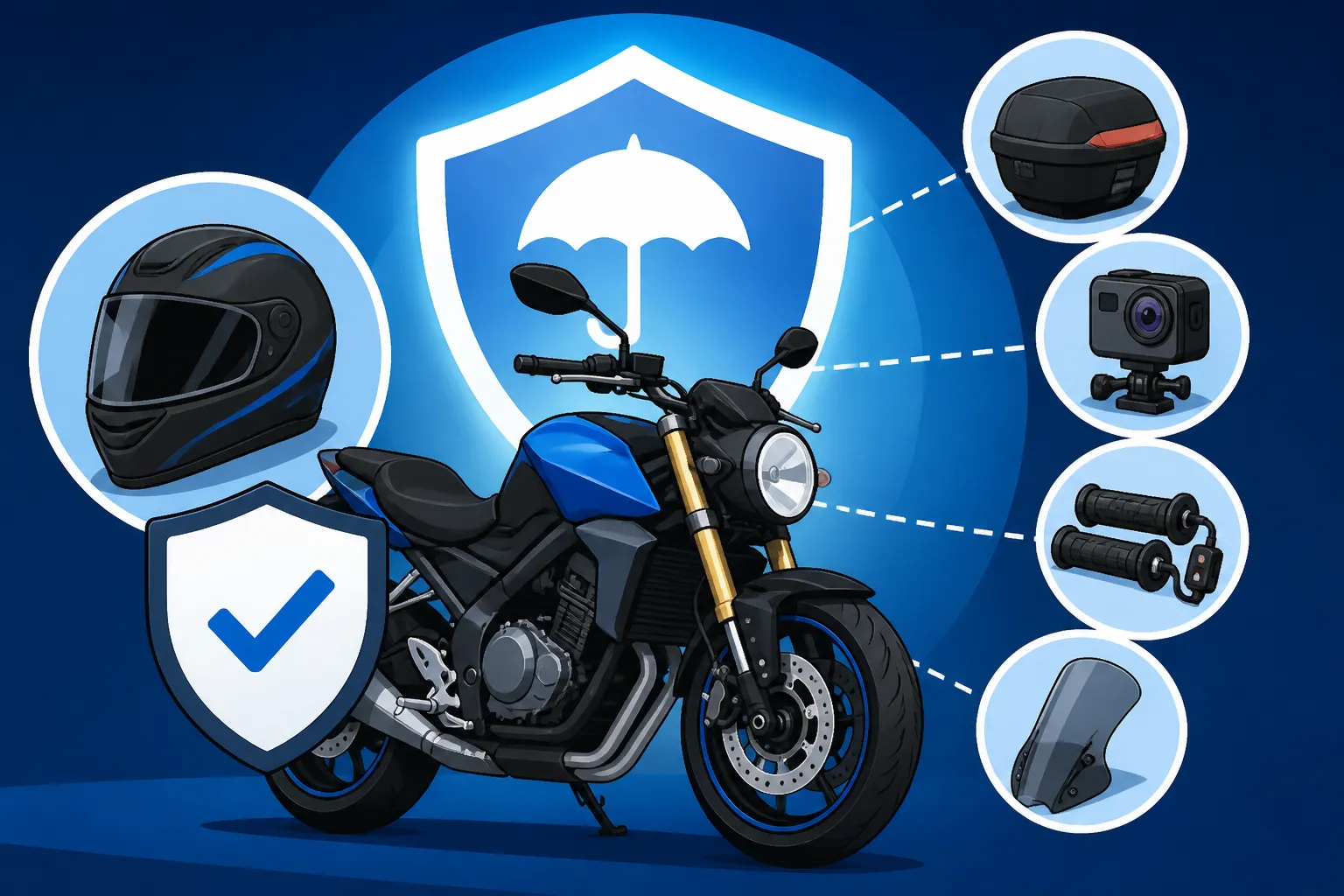
Think about it: that screaming exhaust system you swapped in for the stock pipes, the custom leather saddlebags that perfectly match your cruiser, or even the advanced GPS and communication system integrated into your touring rig. These items are distinct from the factory components. Other common examples include custom paint and airbrushing, chrome upgrades, specialized lighting, custom wheels, performance chips, upgraded seats, backrests, fairings, and even security systems. Each of these adds value, functionality, and personality to your motorcycle, but they also represent an additional financial investment that needs proper protection. Without dedicated coverage, filing a claim for these items might result in little to no reimbursement, leaving you to bear the full cost of replacement or repair.
The Gap in Basic Coverage
The fundamental issue is that standard motorcycle insurance policies, while essential for legal riding and protecting against major financial losses, primarily assess your bike based on its market value as a stock model. For many insurance companies, the baseline value of your motorcycle is what it would cost to replace a similar model, year, and make without any aftermarket additions. This means if you've invested thousands in upgrades, your basic policy might only cover a small, predetermined amount for "custom parts and equipment," or sometimes nothing at all beyond the factory standard.
Imagine you have a beautifully customized Harley-Davidson Softail, complete with a high-performance engine kit, bespoke handlebars, a premium sound system, and a unique paint job. If you only carry standard comprehensive and collision coverage, and your bike is totaled, the insurer would likely assess the value of a stock Softail of the same year. All your custom investments? They might only be covered up to a very low limit, perhaps $1,000 or $3,000, which barely scratches the surface of what you've spent. This gap in coverage is precisely why understanding and opting for specific accessories coverage is so crucial for any rider who has personalized their machine. It’s about ensuring that the true value of your motorcycle, as you define it, is protected. If you're wondering about the various types of coverage, you might find our guide on Types of Motorcycle Insurance Coverage Explained helpful.
Diving Deep into Motorcycle Accessories Coverage
So, how do you bridge that gap and ensure your custom investments are truly protected? That's where dedicated accessories coverage comes into play. It’s an optional add-on that specifically extends your policy's protection to those aftermarket parts, modifications, and enhancements that aren't part of the original factory build. Without it, you could be left with a huge bill after an incident, especially considering how quickly costs for specialty parts and labor can add up.
How This Specific Coverage Works
Accessories coverage typically works by allowing you to declare a specific dollar amount for the total value of your custom parts and accessories. This amount is added to your policy, increasing your overall coverage limits for your motorcycle. When you file a claim, and the damage or loss includes these custom parts, the insurer will then factor in this declared value, up to the limit you've chosen. This means if your custom exhaust, valued at $1,500, is destroyed, and you have $5,000 in accessories coverage, that exhaust is much more likely to be covered for its full value than if you only had a standard policy with a $1,000 custom parts limit.
It’s important to note that this coverage usually works in conjunction with your comprehensive and collision policies. If your bike is stolen (a comprehensive claim) or involved in an accident (a collision claim), the accessories coverage kicks in to protect the custom parts affected by that event. This isn't a standalone policy; it's an enhancement designed to ensure that the unique elements of your ride are considered in any payout. It essentially upgrades your "full coverage" to truly full coverage for your specific bike. If you're curious about what full coverage entails generally, check out What Does Full Coverage Motorcycle Insurance Mean?.
Understanding Valuation Methods: Actual Cash Value vs. Stated Value
This is perhaps one of the most critical distinctions to understand when insuring custom motorcycles and their accessories. The way your insurance company values your custom parts can drastically impact your payout after a loss.
-
Actual Cash Value (ACV): This is the standard for most insurance policies. ACV pays out the replacement cost of an item minus depreciation. For custom parts, this can be a real problem. That custom paint job from five years ago, no matter how pristine, will have depreciated in the eyes of an insurer. The bespoke exhaust you added last year? Its value is already going down from the moment you bought it. This means the payout you receive might be significantly less than what it would cost to actually replace those custom parts today. It’s a bitter pill to swallow for many riders who feel their custom work holds its value.
-
Stated Value/Agreed Value: This is often the preferred option for riders with significant customizations. With a stated value policy, you and the insurance company agree on a specific value for your motorcycle and its accessories before the policy is issued. This value is typically determined by an appraisal, receipts for custom work, or other documentation. If a total loss occurs, the insurer will pay out this agreed-upon amount, regardless of depreciation. This provides peace of mind, knowing that your investment is fully recognized. Many insurers, like Progressive and Dairyland, offer robust options for stated value coverage specifically because they understand the unique needs of riders who customize their bikes. For a deeper dive into these valuation methods, our article Agreed Value vs Stated Value vs Actual Cash Value offers a comprehensive breakdown.
Choosing between ACV and stated value for your accessories coverage depends heavily on the extent and cost of your customizations. For a heavily modified machine, stated value offers unparalleled protection.
Practical Steps to Add Accessories Coverage
Adding accessories coverage to your motorcycle insurance policy isn't a complicated process, but it does require some proactive steps on your part to ensure everything is documented correctly.
- Inventory Your Modifications: Start by making a detailed list of every custom part, accessory, and modification you've made to your motorcycle. Include the make, model, and cost of each item, along with the date of purchase or installation. Don't forget custom paint, engraving, or specialty finishes that might not have a specific part number but certainly add value.
- Gather Receipts and Documentation: This is perhaps the most crucial step. Keep every single receipt, invoice, and work order related to your customizations. If you had professional work done, get detailed invoices. For custom paint, consider getting an appraisal or photographs that clearly show the quality and extent of the work. These documents serve as proof of your investment and will be invaluable if you ever need to file a claim.
- Contact Your Insurance Provider: Once you have your inventory and documentation ready, reach out to your current motorcycle insurance provider or shop around for new quotes. Be explicit that you want to add or increase your "Custom Parts and Equipment" or "Accessories Coverage." Many riders find that using comparison tools like The Zebra can help them quickly see which insurers offer the best rates and most comprehensive options for custom bikes.
- Determine Coverage Limits: Work with your insurer or agent to determine an appropriate coverage limit for your accessories. This is where your detailed inventory and receipts come in handy. You'll want to choose a limit that closely reflects the total replacement cost of all your custom items. Don't underestimate this amount; it's better to be slightly over-insured than under-insured when it comes to custom parts.
- Understand Your Policy's Terms: Before finalizing, ensure you understand how your specific policy defines "accessories," what valuation method will be used (ACV or stated value), and any deductibles that apply specifically to your custom parts claims. Don't hesitate to ask questions until you're completely clear.
By following these steps, you can ensure that the custom elements of your motorcycle are as protected as the bike itself, giving you greater peace of mind on every ride.
The Financial Side: Cost Factors and Making a Claim
Adding specific coverage for your motorcycle's accessories will naturally increase your insurance premium. However, the peace of mind and financial protection it offers often far outweigh the additional cost, especially for riders who have significant investments in their custom bikes. Understanding what influences this cost and how claims work can help you make informed decisions.
What Drives the Price of Protection
Several factors come into play when determining the premium for your accessories coverage:
- The Declared Value of Your Accessories: This is the most direct factor. The higher the total value of your custom parts and modifications, the more expensive the coverage will be. Insurance companies view higher values as increased risk, as they would have to pay out more in the event of a total loss or significant damage.
- Type of Accessories: While most accessories are treated similarly, extremely high-performance parts or exotic materials might be viewed with a slightly higher risk factor. For instance, a turbocharger installation might carry a different risk profile than custom chrome footpegs, though typically, the total declared value is the primary driver.
- Your Overall Riding Profile: Just like your base motorcycle insurance, the cost of accessories coverage is influenced by factors such as your age, riding experience, driving record, where you live, the type of motorcycle you ride, and even your credit score. A younger rider with a sport bike in an urban area will likely pay more than an experienced rider with a cruiser in a rural setting, even for the same amount of accessories coverage. To get a better grasp on these variables, check out our guide on What Affects Your Motorcycle Insurance Rate?.
- Insurer Specifics: Different insurance companies have different pricing models and risk assessments for custom parts. Some, like Progressive or Dairyland, are well-known for being rider-friendly and offering comprehensive custom parts options, while others might have stricter limits or higher premiums. Shopping around, perhaps using a tool like The Zebra, is always a smart move to find competitive rates.
- Deductibles: Your chosen deductible for comprehensive and collision coverage will also impact the cost. A higher deductible typically means a lower premium, but it also means you'll pay more out-of-pocket if you file a claim.
Navigating an Accessories Claim and Deductibles
Filing a claim involving custom parts is similar to a standard comprehensive or collision claim, but with the added layer of proving the value of your modifications.
- Report the Incident: As soon as possible after an accident, theft, or damage, report it to your insurance company. Provide all details of the incident.
- Document Everything: Take detailed photos of all damage, paying close attention to any custom parts. If your bike was stolen, provide a list of all accessories on it.
- Provide Proof of Ownership/Value: This is where those receipts, invoices, appraisals, and photos of your customizations become invaluable. Provide them to your claims adjuster to substantiate the declared value of your accessories. The more documentation you have, the smoother the process will likely be.
- Adjuster Assessment: An adjuster will assess the damage to your motorcycle, including the custom parts, based on your policy's terms (ACV or stated value) and the documentation you've provided.
- Deductibles: Remember, your comprehensive or collision deductible will apply to the entire claim, including the custom parts. So, if you have a $500 deductible and your custom exhaust (covered under accessories coverage) is damaged to the tune of $1,500, you'd receive $1,000 after your deductible is applied. It's crucial to understand how your deductibles work. For more information on navigating a claim, our guide How to File a Motorcycle Insurance Claim can be quite helpful.
Is Accessories Coverage Right for Your Motorcycle?
Deciding whether to invest in accessories coverage really comes down to a careful assessment of your motorcycle, your personal financial situation, and your comfort level with risk. It's not a one-size-fits-all answer, but for many riders, especially those who see their bikes as extensions of themselves, it's an almost indispensable layer of protection.
When It's Absolutely Essential
For certain riders and bikes, accessories coverage isn't just a nice-to-have; it's a financial necessity that can prevent devastating losses.
- Significant Investment in Customizations: If you’ve spent thousands of dollars on aftermarket parts, performance upgrades, or custom aesthetic work (paint, chrome, etc.), this coverage is critical. Imagine a $5,000 custom paint job being damaged in a parking lot tip-over; without accessories coverage, your standard policy might offer only a few hundred dollars, if anything, leaving you to shoulder the vast majority of the repair cost.
- High-Value Aftermarket Parts: Performance exhausts, advanced navigation systems, custom wheels, engine upgrades – these aren't cheap. If you've invested in top-tier components from brands like Vance & Hines, Öhlins, or Akrapovič, you'll want to ensure they're protected against theft or damage.
- Financed Motorcycles with Customizations: If your motorcycle is financed, lenders often require comprehensive and collision coverage. While this protects their asset (the stock bike), it doesn't necessarily protect your custom additions. If your heavily modified financed bike is totaled, and you only receive ACV for the stock value, you could be left owing money on a loan for a bike that's worth less than your financial obligation, plus losing all your custom investment. This is also where understanding topics like Motorcycle Insurance Requirements for Financed Bikes becomes crucial.
- Peace of Mind: Beyond the pure financial aspect, knowing that your unique machine is fully protected provides significant peace of mind. You've created something special; you want to ensure it stays special, or that you can recreate it if the worst happens.
Assessing Your Personal Need
Before you jump into adding this coverage, take a moment to honestly evaluate your situation.
- How much have you truly invested? Add up all the costs of your custom parts, labor, and specialized finishes. If this number is substantial (e.g., over $1,000-$2,000), then dedicated accessories coverage becomes much more compelling.
- What's your risk tolerance? Are you comfortable potentially losing the investment in your customizations if an incident occurs? Or would you prefer to pay a bit more in premiums to safeguard that investment?
- How easily replaceable are your customs? Some parts are off-the-shelf and might be less critical to cover specifically, but bespoke items like custom seats or hand-painted fairings would be extremely difficult and costly to replace without proper insurance.
- Consider the age of your bike. While accessories coverage is beneficial for any custom bike, for older, lower-value motorcycles with minimal, inexpensive customizations, the added premium might not always justify the cost. However, even on older bikes, a truly unique custom paint job could still warrant this protection.
Ultimately, for any rider who has poured their personality and resources into customizing their motorcycle, accessories coverage is a smart and often necessary investment. It ensures that the machine you love is protected in its entirety, allowing you to ride with confidence, knowing your unique style is safeguarded.
Here’s a quick overview of how accessories coverage enhances typical insurance:
| Feature | Standard Comprehensive/Collision | With Accessories Coverage |
|---|---|---|
| Bike Valuation Basis | Actual Cash Value (stock bike) | Can be Stated Value (custom bike) |
| Custom Parts Coverage | Very limited ($1k-$3k typical) | Specific, declared amount (e.g., $10k+) |
| Paint/Finish Coverage | Often only stock colors | Custom paint/artwork specifically included |
| Aftermarket Electronics | Not usually included | GPS, sound systems, comms covered |
| Performance Mods | Not usually included | Engine, exhaust, suspension upgrades covered |
| Deductible | Applies to claim payout | Applies to claim payout |
| Premium Impact | Lower | Higher, reflects increased value |
Disclaimer
Please remember that insurance policies can vary significantly between providers and depend on your specific circumstances. This article provides general information and should not be considered legal or financial advice. Always consult with a qualified insurance professional to discuss your individual needs and to obtain personalized quotes and policy details. Review your policy documents carefully to understand your coverage.