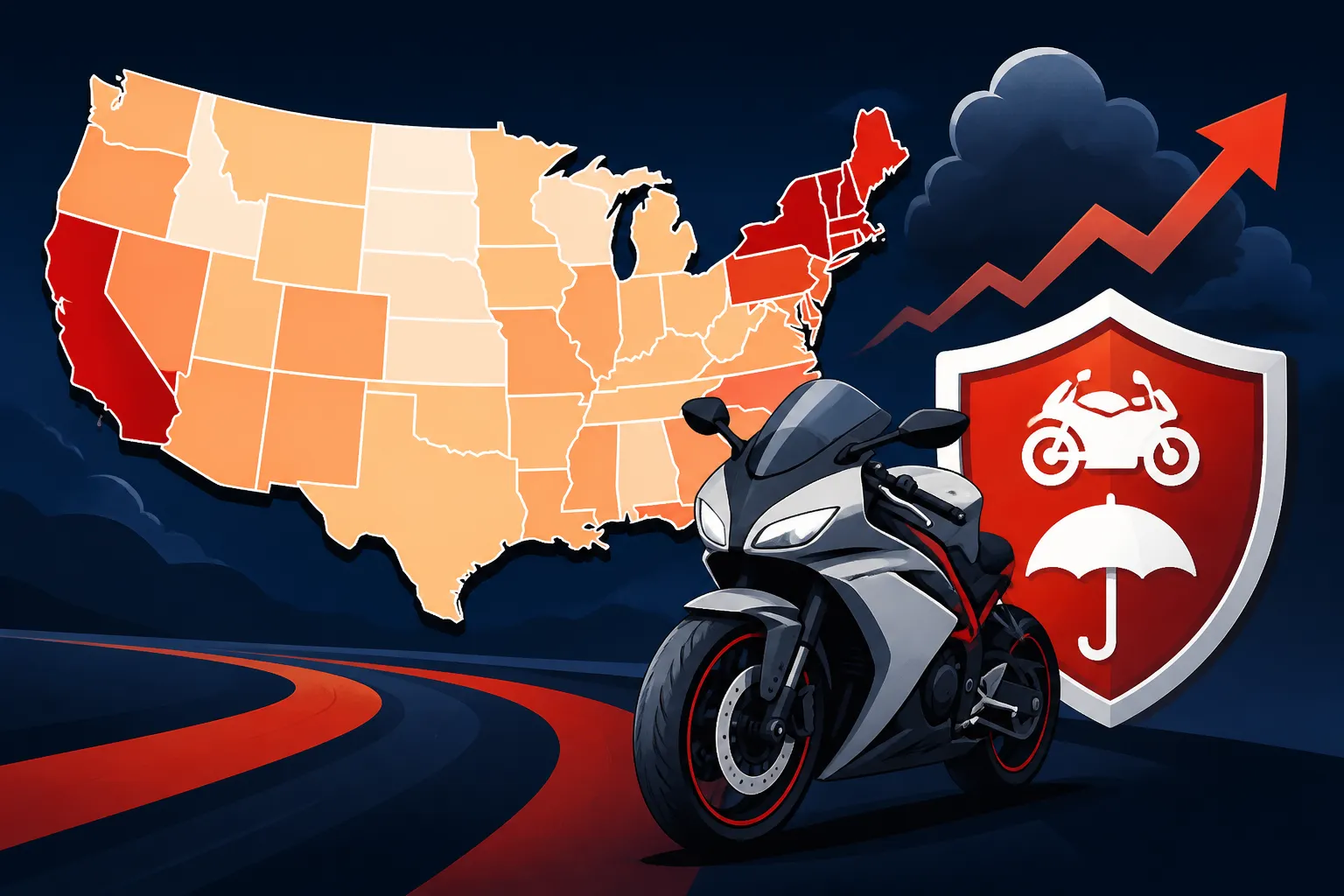
Most Expensive States for Motorcycle Insurance
Riders often assume their clean record and humble bike will keep costs low, but they get a shock when the quote arrives. Where you live is often the biggest factor in your monthly bill. This guide explores the most expensive states for motorcycle insurance and why living in certain zip codes feels like a financial penalty for loving two wheels.
Why Location Dictates Your Premium
When you look at your insurance bill, it is easy to feel like the insurance company is just picking a number out of a hat. However, location-based rating is a complex science that insurers use to predict the likelihood of you filing a claim. It is not just about your driving skills; it is about the environment in which you are riding. If you live in a place where the roads are crumbling, the traffic is legendary, and the weather is unpredictable, you are going to pay more.
Insurance companies use massive datasets to determine which regions are "hot spots" for accidents and theft. A veteran rider in a rural part of Montana might pay a fraction of what a beginner in downtown Miami pays, even if they have the same bike. This is because the "risk pool" in a city is much more volatile. Understanding these geographical nuances is the first step in realizing that your premium is less about you as a person and more about the statistical probability of something going wrong in your specific neighborhood.
The Impact of Climate and Seasonality
Weather plays a double-edged role in motorcycle insurance pricing. You might think that states with long, snowy winters would be cheaper because people aren't riding for half the year. In reality, it can be the opposite. In states like Michigan or New York, the riding season is short but intense. When the weather breaks, everyone hits the road at once, often leading to a spike in accidents during those few months. Furthermore, riders in these states often keep "comprehensive" coverage year-round to protect against theft or garage fires during the winter, meaning the Average Motorcycle Insurance Cost by State stays higher than you might expect.
Conversely, in "sunbelt" states like Florida and Arizona, the riding season never truly ends. While this sounds like a dream for the rider, it is a nightmare for the actuary. More days on the road statistically equals more opportunities for a collision. Year-round riding means more wear and tear on the bike, more exposure to distracted tourists, and more miles logged. This constant exposure is a primary reason why these states frequently appear on the list of most expensive places to insure a bike.
Population Density and Urban Risks
If you have ever tried to navigate a heavy cruiser through the gridlock of Los Angeles or the narrow streets of Brooklyn, you know that urban riding is a different beast entirely. High population density is a major driver of insurance costs. More cars on the road mean more "SMIDSY" (Sorry Mate, I Didn't See You) incidents. In crowded cities, the proximity of vehicles to one another increases the chance of low-speed tips, lane-splitting mishaps, and multi-vehicle pileups.
Theft is also a massive factor in urban areas. A bike parked on a street in a high-crime zip code is a much more tempting target than one tucked away in a locked garage in a sleepy suburb. Insurers track theft rates by zip code with surgical precision. If you are in an area where sport bikes are frequently stolen for parts, your comprehensive premium will skyrocket. This is where tools like The Zebra can be incredibly helpful for riders moving to a new city, as they allow you to see how a change in zip code might impact your monthly budget before you sign a lease.
State Regulations and Minimum Coverage Requirements
Every state has its own set of rules regarding how much insurance you must carry. These Motorcycle Insurance Requirements by State (2026 Guide) vary wildly and have a direct impact on the base price of your policy. Some states require very low limits, which keeps the entry-level price down, while others mandate much higher levels of protection. For instance, states with "no-fault" insurance systems or those that require high levels of Personal Injury Protection (PIP) are almost always more expensive.
Beyond the legal minimums, state-specific legal environments also matter. Some states have "tort" systems that make it easier for people to sue after an accident, which forces insurance companies to raise rates to cover potential legal defense costs and high settlements. When the state government mandates that insurers provide certain benefits, the cost of those benefits is passed directly to the rider. This regulatory landscape is often the silent killer of affordable premiums, turning a simple policy into a significant financial burden.
Deep Dive into the Top Most Expensive States
When we look at the data, a few states consistently rise to the top of the "most expensive" list. It is rarely a coincidence. These states usually have a combination of high population density, complex insurance laws, and high rates of uninsured motorists. If you find yourself living in one of these areas, you are likely already aware of the "premium pain" that comes with every renewal notice. It is important to look at Why Is My Motorcycle Insurance So Expensive? to understand the specific mechanics of these high-cost regions.
Navigating these states requires a bit more savvy. You cannot just take the first quote you get and hope for the best. You need to understand the local market. Using a comparison engine like The Zebra can help you navigate these high-cost waters by showing you which carriers are actually trying to compete in those difficult markets. Some companies shy away from high-risk states, while others specialize in them, and the price difference between the two can be hundreds of dollars.
Michigan’s Unique No-Fault System
Michigan is notorious in the insurance world for having some of the highest rates in the nation, and not just for motorcycles. The reason is the state's unique no-fault system and the Michigan Catastrophic Claims Association (MCCA) fee. For a long time, Michigan required unlimited medical benefits for auto and motorcycle accidents. While recent reforms have allowed riders to choose lower limit levels, the legacy of this system still weighs heavily on premiums.
In Michigan, if you are injured in an accident involving a motor vehicle, your medical claims are often handled through a complex hierarchy of coverage. This Michigan Motorcycle Insurance (No-Fault) Explained guide dives into the nitty-gritty, but the takeaway for the rider is simple: your insurance is providing a level of medical protection that is far superior to what you get in other states, and you are paying for that privilege. Even with the recent reforms, Michigan remains a "high-water mark" for insurance costs in the Midwest.
California’s Congested Roads and Lane Splitting
California is a paradise for riders, with the Pacific Coast Highway and the twisties of the Sierras, but the insurance costs can be a real buzzkill. The state's high premiums are driven largely by the sheer volume of traffic in major hubs like the Bay Area and Greater Los Angeles. When you have millions of cars sharing the road with a high concentration of motorcycles, accidents are inevitable.
Furthermore, California is the only state where lane splitting is explicitly legal and regulated. While many riders argue that lane splitting is safer because it prevents them from being rear-ended in stop-and-go traffic, insurance companies often view it as an added risk factor. The potential for side-swipe accidents or "doorings" in heavy traffic adds a layer of complexity to claims. When you combine this with the high cost of living and expensive vehicle repair rates in the state, it is easy to see why California Motorcycle Insurance Requirements often result in some of the highest quotes in the country.
Florida’s High Accident Frequency and Uninsured Rates
Florida is a bit of an anomaly in the motorcycle world. Technically, Florida does not require most riders to carry insurance to register a bike. However, if you are in an accident and don't have insurance, you can face severe financial penalties and the loss of your license. This creates a "wild west" environment where a significant number of riders are completely uninsured.
For the responsible rider who does buy a policy, this is bad news. To protect yourself from the sea of uninsured motorists, you must buy high limits of Uninsured/Underinsured Motorist coverage. Because the risk of hitting someone without insurance is so high, the cost of this coverage is astronomical in the Sunshine State. You can learn more about this strange situation in Do You Need Insurance for a Motorcycle in Florida? To get a realistic sense of what you'll actually pay, many riders turn to The Zebra to compare quotes that include the necessary UM/UIM protections that are practically mandatory for survival on Florida's roads.
Estimated Annual Premiums by State
To give you a clearer picture of the landscape, we have compiled an estimate of the annual premiums in some of the most expensive states compared to the national average. Please note that these are estimates for a standard cruiser with a clean driving record; your actual price will vary based on your personal profile.
| State | Estimated Annual Premium | Primary Cost Driver |
|---|---|---|
| Michigan | $1,200 – $1,500 | No-Fault Medical / MCCA Fees |
| California | $900 – $1,200 | Density / Lane Splitting / Theft |
| Florida | $850 – $1,100 | Uninsured Motorist Risk / Year-Round Riding |
| New York | $800 – $1,050 | Urban Congestion / High Liability Costs |
| Louisiana | $750 – $950 | Litigation Environment / Road Conditions |
| National Average | $500 – $700 | Baseline Risk |
Factors Beyond Geography That Spike Your Rate
While this guide focuses on the "where," it is important to remember that the "what" and "who" still matter immensely. Even in an expensive state like Michigan, you can mitigate some of the damage by making smart choices about your bike and your riding habits. Insurance is a puzzle, and geography is just one piece. If you are wondering How Much Is Motorcycle Insurance? 2026 Cost Guide, you have to look at the total package.
We often see riders move from a cheap state to an expensive one and keep the same bike, only to find their premium triples. This is a great time to audit your policy. Sometimes, the bike that was cheap to insure in rural Ohio becomes a massive liability in downtown Chicago. If you are struggling with high rates, it might be time to look at Motorcycle Insurance Cost by Bike Type to see if a different style of machine might save you enough money to justify the trade-in.
How Your Bike Choice Influences the Bill
The machine you choose to ride is a massive indicator of risk to an insurer. A high-performance supersport bike is designed for speed and agility, which insurers translate to "high probability of a high-speed claim." In expensive states, the Sport Bike Insurance Cost (Why So High) becomes even more exaggerated. If the state base rate is already high, the "sport bike surcharge" can make the policy nearly unaffordable for younger riders.
On the flip side, cruisers and touring bikes generally enjoy lower rates. These bikes are seen as being owned by more mature riders who take fewer risks. If you are living in a high-cost state, choosing a bike with a smaller engine or a more conservative style can be a strategic way to keep your costs down. The difference between insuring a 600cc sport bike and a 600cc standard motorcycle can be hundreds of dollars annually, even if they have similar market values.
The Hidden Influence of Credit Scores
In many of the most expensive states, insurance companies are allowed to use your credit-based insurance score to help determine your rate. They have found a statistical correlation between how a person manages their finances and how they manage risk on the road. If you have a lower credit score, you might be hit with a "double whammy": the high base rate of your state plus a surcharge for your credit history.
This is a point of major frustration for many riders, as it feels unrelated to their ability to handle a motorcycle. However, it is a reality of the modern insurance market. If you are looking for How to Lower Your Motorcycle Insurance Premium, improving your credit score is actually one of the most effective long-term strategies, right alongside keeping a clean driving record.
Rider Demographics and Experience Levels
Age and experience are universal factors, but they are magnified in high-cost states. If you are wondering How Much Is Motorcycle Insurance for an 18 Year Old?, the answer in a state like New York or Florida can be staggering. Young riders lack the "seat time" that insurers look for to prove they can handle emergency situations. In a high-traffic environment, that lack of experience is viewed as a ticking time bomb.
For older or "returning" riders, the news is usually better. If you have years of riding experience and a clean automobile driving record, insurers will cut you some slack, even in a crowded state. This is why it is so vital to accurately report your years of licensed experience when getting a quote. Small details like whether you have a garage or if you have completed a safety course can also tip the scales in your favor when the base rates are high.
Strategies to Lower Costs in High-Premium States
Just because you live in an expensive state doesn't mean you are powerless. There are several levers you can pull to bring that premium down to a manageable level. It requires a bit of homework and a willingness to shop around, but the effort usually pays off. Many riders have found that by spending an hour or two comparing options on The Zebra, they can find "hidden gems" in the insurance market that their local agent might not have access to.
The key is to be proactive. Don't wait for your renewal notice to see if your rates have gone up. Check the market every year. Insurance companies change their "appetite" for certain states and bike types all the time. A company that was expensive last year might be trying to grow its footprint in your state this year and offering aggressive new rates to attract customers.
Maximizing Every Possible Discount
Discounts are the easiest way to shave money off your bill. Most insurers offer a variety of them, but they won't always apply them automatically. You have to ask. One of the most common is the "safety course" discount. By completing a certified course, you prove to the insurer that you are invested in your own safety. Check out Does a Motorcycle Safety Course Lower Insurance? to see just how much you can save.
Other common discounts include:
- Multi-Policy Discount: Often called "bundling," this is one of the biggest savers. Check Bundling Motorcycle and Auto Insurance: Worth It? to see if moving your car and bike to the same carrier makes sense.
- Organization Member: Are you a member of the AMA, Harley Owners Group (HOG), or even AAA? Many insurers offer 5-10% off for members of recognized groups.
- Homeownership: Statistically, homeowners are seen as more stable and lower risk, leading to a small but helpful discount.
Adjusting Your Coverage Without Risking Everything
If your premium is still too high, you might need to look at your actual coverage limits and deductibles. Many riders carry a $250 deductible, but switching to a $500 or $1,000 deductible can significantly lower your comprehensive and collision premiums. You are essentially taking on a bit more of the small-scale risk in exchange for a lower monthly cost.
However, be careful not to cut your liability limits too low. In expensive states with high litigation rates, the "minimum" coverage is often not enough to protect your assets if you are at fault in a serious accident. Instead of cutting liability, look at whether you really need "Full Coverage" on an older bike. If your bike is only worth $2,000, paying $500 a year for collision coverage might not make financial sense.
Using Comparison Tools Effectively
The old way of getting insurance involved calling three different agents and spending all afternoon on the phone. Today, you can use technology to do the heavy lifting. Platforms like The Zebra allow you to put in your information once and see quotes from dozens of different carriers. This is especially useful in expensive states because it highlights the outliers—those companies that are offering significantly lower rates for your specific profile.
When using these tools, make sure you are comparing apples to apples. Ensure the liability limits, deductibles, and "add-ons" like roadside assistance are the same across all quotes. It is easy to think you found a "deal" only to realize the new policy has much lower protection. Take your time, read the fine print, and use the data to your advantage.
Comparing States Across the US (Regional Breakdown)
Insurance costs tend to follow regional trends. The Northeast and the South generally dominate the "most expensive" categories, while the Midwest and the Mountain West offer some of the most affordable rates. Understanding these regional patterns can help you set realistic expectations for your insurance budget if you are planning a move or a long-distance tour across state lines.
If you are curious about how your current state stacks up against the rest of the country, the Motorcycle Insurance Cost by State guide provides a comprehensive breakdown. It is fascinating to see how moving just across a state line—say, from New York to Pennsylvania—can result in a 30% drop in your insurance premium.
The High Cost of the Northeast Corridor
The stretch from Washington D.C. up to Boston is one of the most expensive places in the world to insure any vehicle. The combination of ancient, narrow roads, extreme traffic congestion, and a high cost of living creates a perfect storm for high premiums. In these states, "fender benders" are a daily occurrence, and the cost to repair even a minor scrape on a modern motorcycle can be thousands of dollars.
Furthermore, these states often have robust legal systems that lead to higher-than-average settlements for bodily injury. If you are riding in the Northeast, you are paying for the density and the high probability that any accident you are involved in will be expensive to resolve. This is why New York Motorcycle Insurance Requirements are often more stringent and costly than those in more rural states.
The Southern Heat and Year-Round Riding Risks
In the South, the "expensive" label is driven by a different set of factors. States like Louisiana, Florida, and Georgia have high rates because of weather-related risks (like hurricanes and flooding) and a high percentage of uninsured drivers. The year-round riding season means bikes are on the road more often, increasing the cumulative risk for the insurer.
Louisiana, in particular, often rivals Michigan for the top spot because of its unique legal environment. The state has a very high rate of personal injury lawsuits, which drives up the "Liability" portion of every motorcycle policy. If you are riding in the South, you have to be vigilant not just about the traffic, but about the specific legal and environmental risks that your insurer is pricing into your policy every month.
Motorcycle Insurance Disclaimer
This guide is for informational purposes only and does not constitute legal or financial advice. Insurance laws, state requirements, and premium rates are subject to change by state regulators and individual insurance companies. Always verify your state’s current minimum requirements and consult with a licensed insurance professional before purchasing or changing a policy. We do not guarantee the accuracy of estimated premiums, as individual rates vary based on a wide range of personal factors.