Average Motorcycle Insurance Cost by State
Many riders experience a sudden sense of sticker shock when they relocate across state lines or upgrade to a more powerful machine, only to find their insurance premiums have doubled or tripled overnight. This guide breaks down the complex landscape of state-by-state pricing, explaining why your neighbor in a different zip code might pay half as much as you and how you can navigate these costs to find the best possible rate for your lifestyle.
Understanding the Wild World of State Insurance Rates
The cost of insuring a motorcycle is never a flat fee; it is a complex calculation based on a massive pool of data that changes the moment you cross a state border. Insurance companies look at state-specific loss ratios, which essentially means how much they pay out in claims versus how much they collect in premiums within that specific geography. If you live in a state with high rates of motorcycle theft or a long riding season that leads to more frequent accidents, your base rate will naturally be higher than someone living in a rural area with a four-month riding window.
State laws also play a massive role in setting the floor for these prices. Every state has its own set of "minimums" for liability, which dictates the least amount of coverage you can legally carry to remain on the road. Some states require very low limits, while others mandate much higher protection for bodily injury and property damage. Furthermore, states with "no-fault" insurance systems often see higher premiums because the insurance company is responsible for certain costs regardless of who caused the accident. This variability is why using tools like The Zebra can be so helpful; they allow you to see how these different state mandates translate into real-world dollar amounts for your specific bike and history.
Beyond just the legal requirements, the local environment dictates risk. For example, a rider in a coastal state might face higher comprehensive costs due to the risk of flood or storm damage, while a rider in a densely populated metropolitan area faces a much higher statistical likelihood of a "fender bender" or a bike being swiped from a parking garage. When you start looking at the Average Motorcycle Insurance Cost by State, you begin to see a pattern where weather, population density, and state legislation converge to create the final price on your policy declaration page.
Why Your Zip Code Matters More Than Your Riding Gear
It is a common frustration among veteran riders: you have twenty years of clean riding, you wear ATGATT (All The Gear, All The Time), and yet your premium remains stubbornly high. The reality is that insurance is a game of statistics, and your zip code is one of the most powerful numbers in that equation. Insurance companies analyze claim frequencies down to the neighborhood level. If your particular area is a "hot spot" for bike thefts or has a notorious intersection with high accident rates, you are essentially paying a "territory load" to offset that communal risk.
In suburban or rural environments, the risks are fundamentally different. You might deal with more deer strikes or road debris issues, but the frequency of multi-vehicle accidents is typically lower. Because of this, insurance companies can afford to offer lower base rates to riders in these areas. It is not uncommon for a rider to move fifteen miles away into a different county and see their premium drop by 20% or more. This is where a service like The Zebra excels, helping you identify if your current carrier is penalizing you too heavily for your specific location compared to other providers who might view that same territory as lower risk.
We also have to consider the "litigation climate" of your specific area. In some states or even specific counties, personal injury lawsuits are more common and settlements are higher. Insurance companies track these legal trends meticulously. If a state is known for high jury awards in motorcycle accident cases, every rider in that state will see a reflection of that risk in their premium. It feels unfair to the safe rider, but it is the reality of how risk is pooled across a geographic population.
Legal Requirements and How They Dictate Price
Every state's Department of Insurance sets the rules for what a "legal" policy looks like, and this is the primary reason for the vast price gaps between states like Florida and North Carolina. In some jurisdictions, the minimum liability requirements are as low as 15/30/5, meaning $15,000 for bodily injury per person, $30,000 per accident, and $5,000 for property damage. While this keeps the "entry-level" cost of insurance low, it often leaves riders dangerously underinsured.
Contrast this with states that have higher mandatory minimums or those that require Personal Injury Protection (PIP). Michigan, for instance, has a unique no-fault system that has historically led to some of the highest insurance costs in the nation, though recent reforms have aimed to provide more choice. When a state mandates that an insurance company must provide lifetime medical benefits for certain injuries, the premium must rise to cover that massive potential liability. Understanding Minimum Liability Insurance Explained (The Three Numbers) is crucial for any rider trying to make sense of why their quote looks the way it does.
Additionally, some states have specific laws regarding uninsured motorist coverage. In states where a large percentage of drivers are uninsured, the state may require riders to carry Uninsured Motorist (UM) coverage. This is a classic "hidden" cost—you are essentially paying extra to protect yourself from the negligence of others who refuse to follow the law. While it adds to your monthly bill, in a high-risk state, it is often the most valuable part of your policy.
Breaking Down the Average Costs Across the Country
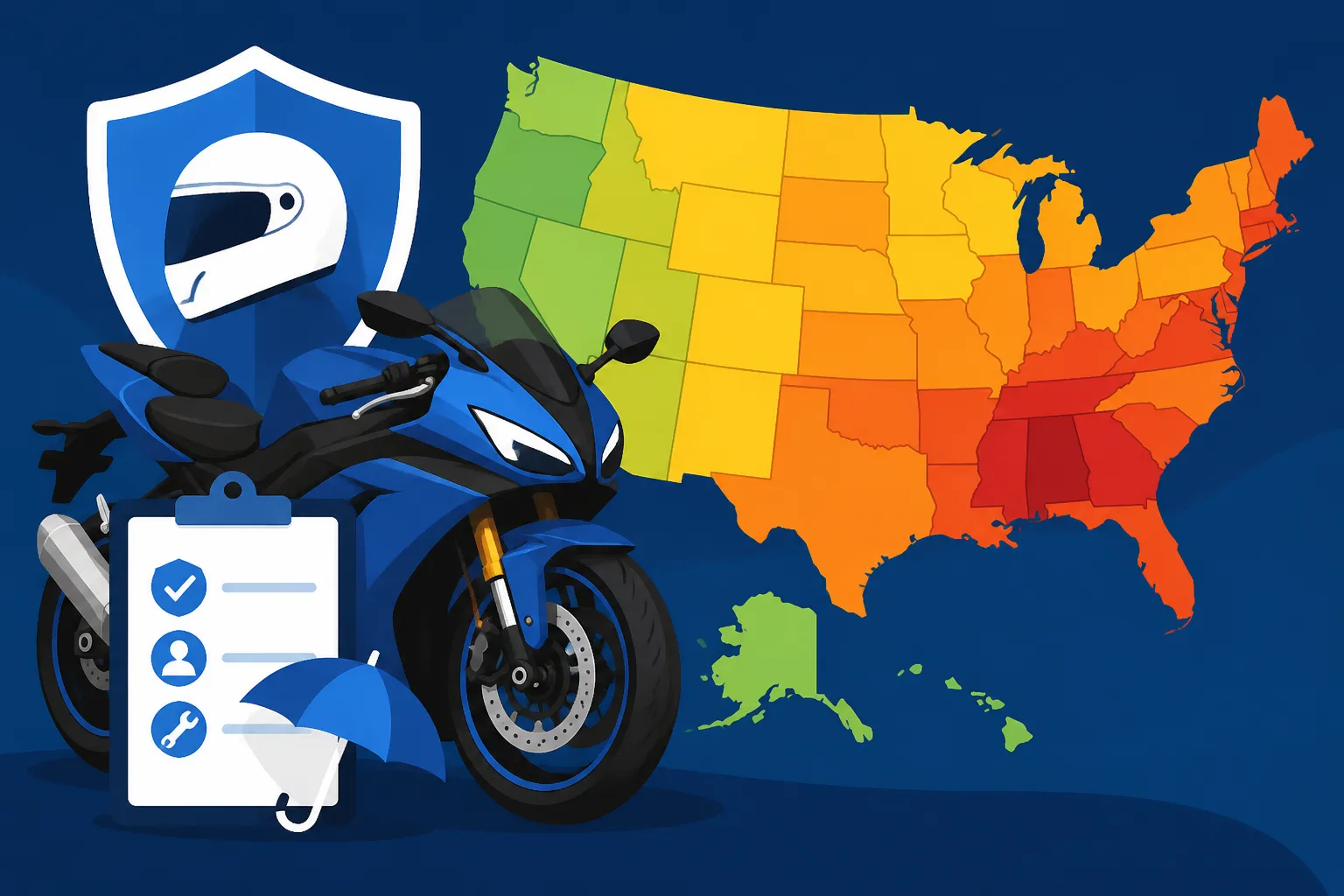
When we look at the national landscape, the average cost for motorcycle insurance hovers around $700 to $800 per year, but that "average" is a bit of a myth. In reality, you have a massive spectrum where some riders in low-risk states like North Dakota might pay $300 a year for a cruiser, while a young rider in California on a liter-bike could easily see quotes exceeding $3,000. It is a game of extremes.
The geographic "smile" across the southern United States—from California through Texas and over to Florida—typically represents the most expensive territory for riders. The reasons are simple: the weather is riding-friendly for 12 months of the year, which means more miles on the road and more opportunities for incidents. Conversely, the "Snow Belt" states often have lower annual averages, not because the risk is lower per mile, but because the bikes spend half the year under a cover in a garage. If you are trying to budget for a new bike, checking the Cheapest States for Motorcycle Insurance can give you a baseline for what to expect in your region.
| State Type | Average Annual Cost | Primary Cost Drivers |
|---|---|---|
| High-Cost States (e.g., CA, FL, TX) | $900 – $1,500+ | Year-round riding, high density, high theft rates. |
| Mid-Range States (e.g., NY, IL, GA) | $600 – $900 | High urban risk balanced by seasonal riding breaks. |
| Low-Cost States (e.g., ND, MT, IA) | $300 – $500 | Rural roads, lower theft rates, very short seasons. |
The Most Expensive States for Riders
California consistently ranks as one of the most expensive states for motorcycle insurance, and it is a "perfect storm" of factors. You have massive population centers like Los Angeles and San Francisco where traffic is legendary and lane-splitting is legal. While lane-splitting can be safer when done correctly, it introduces a unique set of risks that insurers must account for. Combine that with high vehicle values and a litigation-heavy environment, and it is easy to see why prices soar.
Florida is another heavyweight in the expensive category, but for different reasons. Florida’s unique insurance laws mean that many riders are not actually required to carry insurance to register a bike, provided they meet certain criteria (like being over 21 and having adequate health insurance). However, this creates a market where those who do choose to buy insurance are often in a pool of higher-risk individuals or are buying high levels of Uninsured Motorist coverage to protect themselves from the high number of uninsured riders on Florida roads.
Texas rounds out the top tier of expensive states. The sheer size of the state means riders often put significantly more miles on their bikes than riders in New England. Texas also experiences extreme weather events, from hailstorms to flooding, which drives up the cost of "Comprehensive" coverage. If you are a Texan rider, you are likely feeling the pinch of these environmental and high-mileage factors every time your policy renews.
The Cheapest States for a Policy
On the other end of the spectrum, we find states like North Dakota, Iowa, and New Hampshire. These states generally offer the lowest average premiums in the country. The primary factor here is the "exposure window." In North Dakota, you might only have five months of truly safe riding weather. Since the bike is stationary for the other seven months, the statistical likelihood of an at-fault accident drops precipitously. Insurers realize that a bike in a shed isn't going to hit a minivan.
Population density is the second major factor in these affordable states. When you have more cows than cars per square mile, the risk of a multi-vehicle collision is drastically reduced. Rural riders also tend to have lower theft rates. A motorcycle is much harder to "disappear" in a small town in Wyoming than it is in the middle of Chicago or Miami.
Finally, the regulatory environment in these states often favors lower premiums. Many of the lower-cost states have straightforward liability requirements without the complex "no-fault" or high-limit mandates seen in more expensive jurisdictions. For a budget-conscious rider, living in the Midwest or the Great Plains is arguably the best way to keep your "cost per mile" as low as possible.
The Core Factors That Influence Your Premium
While your state sets the baseline, your personal profile and your choice of machine are what finally move the needle. You could have two riders living in the exact same apartment complex in Austin, Texas, and one might pay $40 a month while the other pays $240. This discrepancy is usually tied to the "spec" of the motorcycle and the experience level of the person in the saddle.
The insurance company is essentially trying to predict the future. They look at your past—your riding record, your credit history, and your claims—and combine that with the known history of your specific bike model. If you are riding a bike that is statistically linked to high-speed accidents and expensive fairing repairs, you are going to pay a premium for that "fun factor." This is why it is so important to understand What Affects Your Motorcycle Insurance Rate? before you sign the papers at the dealership.
Bike Type and Engine Displacement
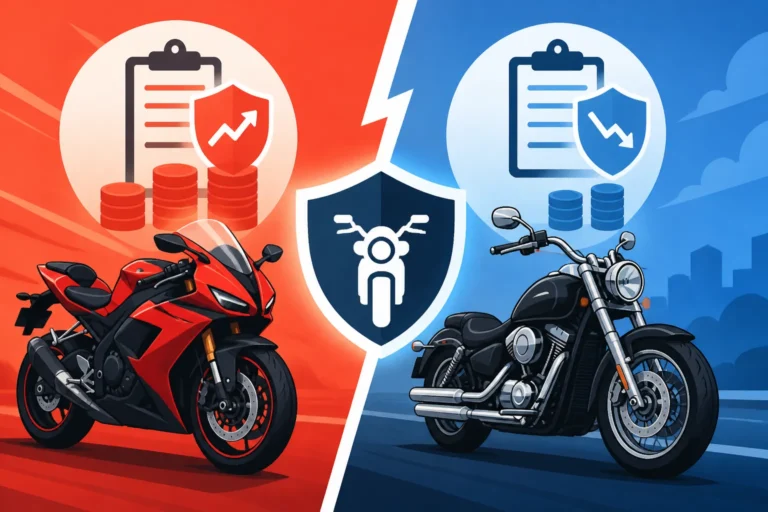
The type of motorcycle you choose is perhaps the single biggest variable under your control. Sport bikes, particularly "supersports" in the 600cc to 1000cc range, are notorious for high insurance rates. These bikes are designed for the track; they are fast, lightweight, and often made of expensive carbon fiber and plastic fairings that shatter in even a low-speed tip-over. To an insurer, a sport bike represents a high probability of a high-speed claim and a high cost to repair the bike itself.
Cruisers and touring bikes, on the other hand, tend to be much more affordable to insure. A Harley-Davidson or a Honda Gold Wing is typically ridden by an older, more experienced demographic. These bikes are heavy, stable, and generally not associated with reckless riding. Even though a top-of-the-line touring bike might cost $30,000, it might be cheaper to insure than a $10,000 sport bike because the "risk of incident" is so much lower. You can dive deeper into these nuances in our guide on Motorcycle Insurance Cost by Bike Type.
Engine size, or displacement (measured in cc), also matters, but it is not the only factor. A 1200cc cruiser might be cheaper to insure than a 600cc sport bike because the cruiser's engine is tuned for torque and relaxed riding, whereas the sport bike is tuned for peak horsepower and speed. However, within the same category, a larger engine almost always means a higher premium. A 1000cc bike is simply capable of more damage—to itself and others—than a 250cc beginner bike.
Rider Demographics and Experience
Age is a brutal factor in the insurance world. If you are under 25, you are statistically part of the highest-risk group on the road. Young riders are more likely to take risks, have less experience handling emergency situations, and are statistically involved in more single-vehicle accidents. Because of this, premiums for teenagers and young adults can be astronomical. For a detailed look at how age impacts your wallet, check out our breakdown of Motorcycle Insurance Cost by Age.
Experience is the antidote to age-related high costs. Many insurers offer significant discounts once you have held your motorcycle endorsement for three or more years without an accident. This "time in the saddle" proves to the insurer that you have survived the learning curve. If you are a new rider, even if you are 40 years old, you might still see higher rates for the first year or two until you prove your competency on the road. This is why Motorcycle Insurance Cost for a Beginner is a common concern for those entering the hobby later in life.
Marital status and even your occupation can also play a role. Statistically, married individuals are viewed as more "stable" and less likely to engage in high-risk riding behavior. Some insurers even offer discounts for members of specific organizations or professions, such as first responders, military members, or engineers, based on data suggesting these groups have lower claim frequencies.
Riding History and Credit Score
Your "MVR" or Motor Vehicle Record is the first thing an insurer pulls. Every speeding ticket, every "failure to yield," and certainly every DUI stays on your record for years and acts as a red flag for insurance companies. Even a ticket received in your car can affect your motorcycle insurance rates because it speaks to your overall "risk profile" as a driver. If you have a clean record, you are eligible for the best "tier" of pricing.
Surprisingly to many, your credit score is often as important as your riding record in many states. Insurers use "insurance-based credit scores" to predict how likely a customer is to file a claim or let their policy lapse. Data shows a strong correlation between high credit scores and lower insurance risk. If your credit is in the "poor" to "fair" range, you could be paying 50% more for the exact same coverage than someone with "excellent" credit.
This is another area where a service like The Zebra can be eye-opening. By comparing multiple carriers, you might find one that weights credit score less heavily than another. Some "non-standard" insurance companies specialize in riders with less-than-perfect records or credit, offering a lifeline to those who might otherwise be priced out of the market. Keeping an eye on your Average Motorcycle Insurance Cost by State helps you understand the baseline so you know if you are being "penalized" for your history.
Navigating Coverage Types and Their Price Impact
One of the biggest mistakes riders make is only looking at the "bottom line" price without understanding what they are actually buying. "Full coverage" is a term that gets thrown around a lot, but it doesn't have a legal definition. Usually, it refers to a policy that includes Liability, Collision, and Comprehensive coverage. Choosing between "Liability-only" and "Full Coverage" is the biggest decision you will make regarding your annual cost.
If you are riding an older bike that you bought for $2,000, it might not make financial sense to pay $400 a year for collision coverage with a $500 deductible. In that scenario, you're essentially "self-insuring" the bike. However, if you have a loan on your motorcycle, the lender will mandate that you carry full coverage to protect their investment. For a detailed analysis, read through Liability-Only vs Full Coverage Cost.
Liability-Only vs Full Coverage Cost
Liability insurance is the "legal minimum." it covers the damage you do to other people and their property. It does not pay a cent for your own bike or your own medical bills. Because the insurance company isn't on the hook for your expensive Ducati fairings, this coverage is relatively cheap. In many states, a liability-only policy can be as little as $10 to $20 a month for an experienced rider.
Full coverage, which adds Collision (accidents with other vehicles or objects) and Comprehensive (theft, fire, vandalism, weather), can easily quadruple that price. Collision is typically the most expensive component because, let's face it, motorcycles are easy to drop and expensive to fix. Comprehensive is often more affordable but varies wildly based on your local theft rates. If you live in an area with high motorcycle crime, your comprehensive premium will reflect that reality.
When deciding which path to take, you need to ask yourself: "If I woke up tomorrow and my bike was gone or wrecked, could I afford to replace it out of pocket?" If the answer is no, then full coverage is likely worth the extra cost. If you are riding a "beater" bike that you can afford to lose, liability-only is the way to go. You can find more advice on this in What Coverage Do You Actually Need?.
The Cost of Add-Ons (Roadside, Accessories)
Modern motorcycle policies offer a buffet of add-on coverages that can provide peace of mind but will also creep up your total cost. Roadside assistance is a common one. Unlike a car, you can't just call any tow truck for a motorcycle; you need a flatbed with proper tie-downs. Many riders find that paying $10 or $20 a year for specialized motorcycle roadside assistance is a bargain compared to a $200 tow bill.
Accessory coverage is another big one, especially for the Harley-Davidson and custom bike crowd. Standard policies usually only cover the bike as it came from the factory. If you've added $5,000 in chrome, custom paint, or high-end luggage, you need to "schedule" those items or increase your accessory limit. This will raise your premium, but without it, those expensive mods are effectively uninsured. Check out Accessories & Custom Parts Coverage Explained for more on this.
Finally, consider "Medical Payments" (MedPay) or "Personal Injury Protection" (PIP). If you don't have great health insurance, or if your health insurance has a high deductible for "high-risk activities" like motorcycling, MedPay can cover your initial hospital bills regardless of who was at fault. It is an added cost, but in a world where a single night in the ER can cost $10,000, it is a safety net many riders refuse to skip.
Strategic Ways to Lower Your Annual Bill
The good news is that you don't have to just accept whatever quote the insurance company throws at you. There are several levers you can pull to lower your rate without sacrificing the coverage you need. From taking a weekend class to simply changing how you pay, these small moves can add up to hundreds of dollars in savings over the course of a year.
Insurance companies love "low-risk" behavior. Anything you can do to prove you are a responsible, safety-conscious rider will generally result in a discount. It is also worth using comparison tools like The Zebra once a year just to make sure your current company hasn't "drifted" away from being competitive. Loyalty rarely pays in the insurance world; often, the best rates are reserved for "new business."
Discounts You Might Be Missing
The most popular discount is the "Safety Course Discount." Completing an MSF (Motorcycle Safety Foundation) course or a similar state-certified program not only makes you a better rider but usually nets you a 5% to 15% discount for three years. It is a win-win: you gain life-saving skills and the class essentially pays for itself through insurance savings. For more details, see Motorcycle Insurance Discounts You're Missing.
Anti-theft discounts are also common. If you keep your bike in a locked garage, use a disc lock with an alarm, or have a GPS tracking system installed, many insurers will shave a percentage off your Comprehensive premium. Just being able to tell your agent that the bike is "garaged" rather than "parked on the street" can make a significant difference in your quote.
Other "hidden" discounts include the "Experienced Rider" discount (for those who have been riding for years), the "Homeowner" discount (even if you don't bundle your home insurance), and the "Paid in Full" discount. If you can afford to pay for the whole year upfront rather than in monthly installments, most companies will waive the "convenience fees" and offer a small percentage off the total.
Bundling and Multi-Policy Savings
One of the most effective ways to lower your rate is the "multi-policy" discount. If you already have car insurance or renters/homeowners insurance, adding your motorcycle to that same company can save you 10% to 25% across all of your policies. The insurance company wants as much of your business as possible, and they will "buy" your loyalty with these deep discounts.
However, a word of caution: sometimes a company that is great for car insurance is terrible for motorcycles. They might give you a 20% discount for bundling, but their "base rate" for the bike might be 50% higher than a specialist company like Dairyland or Markel. This is why it is essential to check Bundling Motorcycle and Auto Insurance: Worth It? before making the switch.
Multi-bike discounts are also a factor for those of us who can't stop at just one motorcycle. Most insurers will offer a significant discount on the second and third bikes because they know you can only ride one at a time. The liability risk is lower because you're only one person on the road, regardless of how many bikes are in your garage.
How Seasonal Changes and Geography Affect Rates
The calendar is just as important as the map when it comes to insurance costs. If you live in a state where snow is a reality for four months of the year, you have a unique opportunity to save money that southern riders do not. Conversely, if you live in a "sunshine state," you have to account for the fact that you are "exposed" to risk every single day of the year.
Geography also dictates the "type" of accidents you are likely to have. Urban riders deal with intersections, left-turning cars, and theft. Rural riders deal with high-speed corners, gravel on the road, and wildlife. Insurance companies adjust their rates based on these regional flavors of risk. If you are curious about how your specific location stacks up, Does Where You Live Affect Motorcycle Insurance? provides a deeper dive.
The Lay-Up Policy Strategy for Northern Riders
For riders in states like Wisconsin or Maine, "Lay-Up" or "Winter Storage" policies are a lifesaver for the wallet. A lay-up period is a pre-defined set of months (usually November through March) where all "road" coverages (Liability and Collision) are suspended, but "storage" coverage (Comprehensive) remains active. This protects your bike from theft or a garage fire during the winter while removing the cost of accident coverage you aren't using.
The savings can be dramatic—often 30% to 50% off the annual premium. The catch is that you cannot ride the bike during those months. If you get a surprise 60-degree day in January and take the bike out for a spin, you are essentially riding uninsured. If you have an accident, the company will deny the claim. It requires discipline, but for many, it is the most logical way to handle Seasonal Lay-Up & Winter Storage Insurance.
Some modern companies have moved away from manual lay-up periods and instead just bake the "seasonality" into the annual price. They know you won't be riding in February in Minnesota, so they spread that reduced risk over the twelve monthly payments. It is always worth asking your agent how they handle the off-season to ensure you aren't overpaying for "ghost" miles.
Urban vs Rural Pricing Dynamics
As we touched on earlier, density is the enemy of low insurance rates. In a city like Chicago, the sheer volume of traffic means the "incidents per mile" is much higher than in the suburbs. Urban riders are also more likely to be victims of hit-and-runs or "parking lot tips," where someone knocks your bike over and leaves without a note. These small "nuisance claims" add up and drive up the premiums for everyone in the city.
Rural riders, however, face "severity risk" rather than "frequency risk." An accident in the country often happens at higher speeds and might involve a delay in emergency response times. While claims are less frequent, they tend to be more expensive when they do happen. However, because frequency is the main driver of insurance pricing, rural riders still usually come out ahead in the price game.
If you live in a city but store your bike in a secure, monitored facility, make sure to tell your insurer. Some companies will give you credit for the extra security, effectively lowering your "urban" penalty. Being proactive about describing your storage situation can move you from a high-risk pool to a more favorable one.
Shopping for the Best Rates Effectively
The key to getting the best price is to stop being a "passive" consumer. Most people get a quote when they buy a bike and then never look at it again. But your life changes—your credit improves, you get older, you move to a better neighborhood, or you get married. All of these are "rating factors" that could lower your price, but your insurance company isn't going to call you to offer a discount. You have to go get it.
Using a comparison engine like The Zebra is the modern way to "audit" your insurance. Instead of calling five different agents and giving your social security number five times, you can see a broad snapshot of the market in minutes. This keeps your current carrier honest and ensures you are always riding with the most competitive rate available.
Comparing Quotes Without Losing Your Mind
When you start comparing, the most important thing is to make sure you are comparing "apples to apples." If one quote has a $500 deductible and another has a $1,000 deductible, the prices aren't comparable. Always use the same limits for Bodily Injury, Property Damage, and Uninsured Motorist coverage across all quotes.
Pay attention to the "Actual Cash Value" (ACV) versus "Agreed Value." Most standard policies pay ACV, which means if your bike is totaled, they pay you what the bike was worth the second before the crash (minus depreciation). For custom or vintage bikes, you might want an "Agreed Value" policy, which pays a set amount you and the insurer decided on beforehand. This is more expensive but prevents a lowball payout on a cherished machine. Our guide on How to Compare Motorcycle Insurance Quotes walks you through this step-by-step.
Don't ignore the reputation of the company. A company might be $50 cheaper per year, but if they have a reputation for fighting every claim or having terrible customer service, that $50 "saving" will feel like a nightmare if you ever actually have an accident. Look for companies with high "A.M. Best" ratings, which measure financial stability and their ability to pay claims.
Using Comparison Platforms
The traditional way of buying insurance through a "local agent" is still great for complex needs, but for the average rider, online comparison platforms are much more efficient. These platforms use advanced algorithms to pull real-time data from dozens of carriers. This is where The Zebra shines, providing a transparent look at the market without the high-pressure sales tactics.
One benefit of using a platform is the ability to "tweak" your coverage in real-time to see how it affects the price. You can see exactly how much you would save by increasing your deductible from $250 to $500, or how much it would cost to add that roadside assistance package. This level of transparency puts the power back in the rider's hands.
Finally, remember that the "cheapest" insurance isn't always the "best." The goal is to find the best value—the most protection for the lowest possible cost. By understanding the Average Motorcycle Insurance Cost by State and knowing which factors you can control, you can hit the road with the confidence that you are protected without overpaying for the privilege.
Disclaimer
This guide is intended for informational purposes only and does not constitute legal, financial, or professional insurance advice. Insurance laws and average rates are subject to change and vary significantly by individual circumstances, carrier, and state regulations. Always consult with a licensed insurance professional or your state's Department of Insurance to confirm specific requirements and coverage options before purchasing a policy.