How to Handle a Motorcycle Insurance Claim in Indiana
Riding your motorcycle across the stunning landscapes of Indiana is an incredible feeling, but an accident can turn that joy into a stressful nightmare, leaving you wondering how to even begin picking up the pieces. Dealing with the aftermath, especially the labyrinthine world of insurance claims, can feel overwhelming. This guide is here to walk you through the specifics of handling a motorcycle insurance claim right here in the Hoosier State, giving you the clear, step-by-step information you need.
Understanding Indiana's Fault System and Insurance Requirements
Before we dive into the nitty-gritty of filing a claim, it's really important to grasp how insurance and liability work in Indiana. Knowing this foundational information can significantly impact your claim process and your financial recovery. It's not just about having a policy; it's about understanding what that policy truly means in your state.
At-Fault vs. No-Fault in Indiana
First off, let's clear up a common misconception: Indiana is not a no-fault state for auto insurance, and that extends to motorcycles too. This means that after an accident, the person who is determined to be at fault is generally responsible for the damages and injuries of all parties involved. This "at-fault" or "tort" system is a crucial piece of information for any rider.
When you're involved in a collision, your insurance company, or the other driver's insurer, will investigate to determine who caused the accident. This investigation can involve reviewing police reports, witness statements, photographs, and even accident reconstruction. If you're found to be at fault, your liability coverage will kick in to pay for the other party's damages up to your policy limits. If the other driver is at fault, their liability insurance should cover your expenses. This determination of fault is often where the real battle begins in the claims process, especially when both parties have differing accounts.
Indiana also operates under a "modified comparative fault" rule, sometimes called the "51% rule." This means that if you are found to be more than 50% at fault for an accident, you cannot recover any damages from the other party. If you are 50% or less at fault, your recoverable damages will be reduced by your percentage of fault. For example, if you sustained $10,000 in damages but were found 20% at fault, you would only be able to recover $8,000 from the other driver's insurance. This can be a huge factor, especially in complex motorcycle accidents where the fault isn't immediately obvious.
Minimum Motorcycle Insurance in the Hoosier State
Every state has its own specific rules, and Indiana is no different when it comes to what you absolutely must carry to legally ride. You can find a comprehensive breakdown in our guide on Motorcycle Insurance Requirements by State (2026 Guide).
In Indiana, the minimum liability coverage requirements for motorcycles are the same as for other motor vehicles. These are often expressed as a series of three numbers, like 25/50/25, which can be a bit confusing if you're not used to insurance jargon. Our article on Minimum Liability Insurance Explained The Three Numbers dives deeper into what these figures mean.
Essentially, Indiana requires the following minimum liability coverage:
- $25,000 for bodily injury per person: This is the maximum amount your insurance will pay for injuries to one person in an accident where you are at fault.
- $50,000 for total bodily injury per accident: This is the maximum amount your insurance will pay for all injuries in an accident where you are at fault, regardless of how many people were injured.
- $25,000 for property damage per accident: This is the maximum your insurance will pay for damage to other people's property (like their vehicle, fences, or other structures) in an accident where you are at fault.
These are just the minimums. While it might seem tempting to only carry the minimum to save a few bucks on your premium, it's often a really risky gamble. A serious accident, especially involving a motorcycle, can easily exceed these limits, leaving you personally responsible for the remainder of the costs. This is why many riders choose to carry higher liability limits, or add additional coverages like Uninsured/Underinsured Motorist (UM/UIM) coverage, which we'll discuss a bit later. Always consider your assets and risk tolerance when deciding on coverage amounts, as the peace of mind of having adequate protection is invaluable.
It's also worth noting that if you finance your motorcycle, your lender will almost certainly require you to carry full coverage insurance, which typically includes collision and comprehensive coverage in addition to liability. This protects their investment in your bike. Even if your bike is paid off, considering comprehensive and collision is wise if you want to protect your own motorcycle from damage, theft, or other non-collision incidents.
| Coverage Type | Indiana Minimum Requirement | What it Covers |
|---|---|---|
| Bodily Injury Liability (per person) | $25,000 | Injuries to one person in an at-fault accident (other party) |
| Bodily Injury Liability (per accident) | $50,000 | Total injuries to all people in an at-fault accident (other party) |
| Property Damage Liability (per accident) | $25,000 | Damage to another party's property in an at-fault accident |
Immediate Steps After a Motorcycle Accident in Indiana
The moments right after a motorcycle accident are often chaotic, scary, and confusing. It's easy to feel overwhelmed, but what you do in these immediate moments can significantly impact the outcome of your insurance claim. Staying as calm as possible and following a few key steps can make a world of difference.
Prioritizing Safety and Calling for Help
Your safety, and the safety of others, is the absolute top priority after any accident. Even if you feel okay, the adrenaline can mask injuries, so it's crucial to assess the situation cautiously. If you can move your motorcycle safely out of the flow of traffic, do so, but only if it doesn't put you or others at further risk. If you can't, activate your hazard lights and set up any warning triangles or flares if you have them.
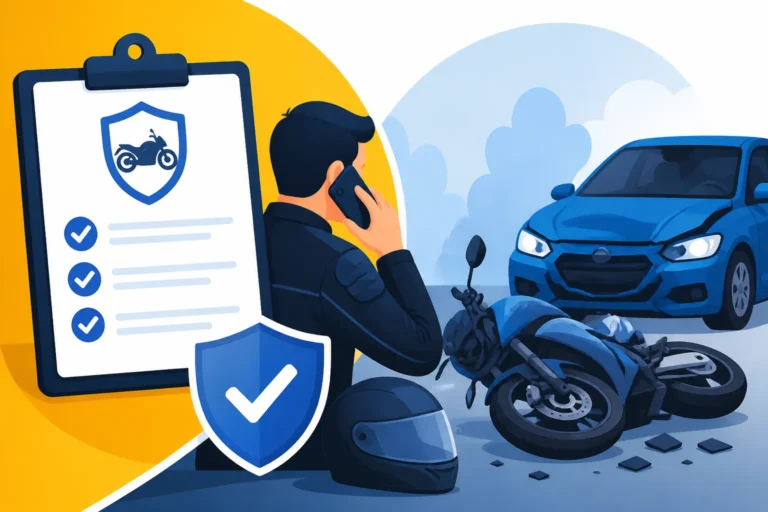
Next, and this is non-negotiable, you need to call 911 immediately. Even for minor fender benders, a police report is an invaluable piece of documentation for your insurance claim. The responding officers will investigate the scene, gather witness statements, and document any damage. This official report often carries significant weight with insurance companies. Don't let anyone talk you out of calling the police, especially if there are injuries or significant damage. For a more detailed guide on this crucial first step, check out What to Do After a Motorcycle Accident Insurance Steps.
Beyond the police, seek medical attention. Even if you feel fine, injuries like whiplash, internal bleeding, or concussions might not be immediately apparent. Paramamedics can assess you at the scene, and it's always recommended to follow up with a doctor as soon as possible. Delaying medical treatment can not only jeopardize your health but also make it harder to link your injuries directly to the accident when filing a claim. Insurance companies are notorious for scrutinizing gaps in medical care.
Documenting the Scene and Gathering Information
While waiting for emergency services, if your condition allows, start gathering as much information and evidence as possible. Think of yourself as a detective – every detail counts. Use your smartphone to take pictures and videos from multiple angles. Get shots of your motorcycle's damage, the other vehicle's damage, road conditions, traffic signs, skid marks, and anything else that seems relevant to the scene. Don't forget to photograph the license plates of all vehicles involved.
Exchange information with all other drivers involved. This includes their name, contact number, driver's license number, vehicle make and model, and, critically, their insurance company and policy number. If there are passengers, get their names and contact information too. Don't engage in arguments or admit fault, even if you think you might be partially to blame; let the professionals determine that later. Just stick to factual information exchange.
Look for witnesses. Independent witnesses can be incredibly helpful in corroborating your account of the accident, especially if there's a dispute over fault. Ask for their names and contact information. Many people hesitate to get involved, but often a friendly request and an explanation of how important their input is can secure their cooperation. Remember to document the date, time, and exact location of the accident. These seemingly small details can be surprisingly difficult to recall accurately later when you're under stress.
Navigating the Claims Process with Your Insurer
Once the immediate aftermath is handled and you're safe, the next big hurdle is reporting the claim and dealing with the insurance companies. This is where many riders feel lost, but being prepared can make the process much smoother, even if it's still frustrating at times.
Reporting the Claim and Initial Contact
As soon as you can, and ideally within 24-48 hours, you need to report the accident to your own insurance company. Even if you believe the other driver is entirely at fault, notifying your insurer promptly is usually a requirement of your policy. Delaying this step can sometimes complicate your claim, or even, in rare cases, lead to issues with coverage. Most major insurance providers like Progressive have 24/7 claim hotlines or online portals where you can initiate the process quickly.
When you call, be ready to provide all the information you collected at the scene: names, contact details, insurance information of other parties, police report numbers, and a factual account of what happened. Again, stick to the facts and avoid speculating or admitting fault. Simply state what you observed. Your insurance company will assign a claims adjuster to your case, who will be your primary point of contact moving forward. This adjuster will guide you through the next steps, which typically involve assessing the damage to your motorcycle and any injuries you sustained.
If you're unsure about the process or simply want to explore your options, comparing insurance services can be really helpful. Websites like The Zebra allow you to compare various motorcycle insurance quotes, which can be useful even after an accident if you're thinking about future coverage or want to understand market rates. Remember that the claims process isn't always linear, and patience, coupled with persistent follow-up, will be your best allies.
Working with Adjusters and Damage Assessment
The claims adjuster's job is to investigate your claim and determine the appropriate payout based on your policy and the circumstances of the accident. They will review all the documentation, including the police report, photos, witness statements, and medical records. If your motorcycle was damaged, they'll arrange for an inspection. This might involve sending you to an approved repair shop for an estimate, or sending an appraiser directly to your bike's location.
It's crucial to be cooperative but also diligent when dealing with adjusters. Provide them with requested information promptly, but also keep detailed records of all your communications, including dates, times, names of people you spoke with, and a summary of the conversation. Don't be afraid to ask questions if something isn't clear. If your motorcycle is deemed a total loss, the adjuster will calculate its actual cash value (ACV) and offer you a settlement. This can be a point of contention, as the ACV might be lower than what you believe your bike is worth. Our article on What Happens When Your Motorcycle Is Totaled provides excellent insights into this process.
For any injuries, your adjuster will need access to your medical records. Make sure all your medical treatments and expenses are well-documented. If you have medical payments (MedPay) coverage, that can help cover your immediate medical costs regardless of fault. The adjuster will also evaluate your pain and suffering, lost wages, and other non-economic damages if applicable. This is where having thorough medical documentation and clear communication with your doctors becomes paramount. Don't rush through treatment or sign off on anything until you are completely satisfied with the proposed settlement.
What Happens If You're Hit by an Uninsured Driver in Indiana?
It's a scary thought, but unfortunately, it's a real possibility on the roads: getting into an accident with someone who doesn't have insurance, or enough insurance, to cover your damages. This is where certain proactive coverage choices really shine.
Uninsured/Underinsured Motorist Coverage Explained
Imagine you're cruising down I-70 near Indianapolis, minding your own business, and suddenly a driver cuts you off, causing an accident. Only, when the dust settles, you find out they don't have any insurance. Or maybe they only have the bare minimum liability coverage, which quickly gets exhausted by your medical bills and motorcycle repair costs. This is precisely the nightmare scenario that Uninsured & Underinsured Motorist Coverage UM/UIM is designed to protect you from.
In Indiana, insurance companies are required to offer you Uninsured Motorist (UM) and Underinsured Motorist (UIM) coverage, though you have the right to reject it in writing. UM coverage steps in when the at-fault driver has no insurance at all, or in the case of a hit-and-run where the other driver isn't identified. It typically covers your medical expenses, lost wages, and pain and suffering. UIM coverage, on the other hand, comes into play when the at-fault driver has some insurance, but their policy limits aren't enough to cover all your damages. Your UIM coverage would then make up the difference, up to your policy's limits.
Choosing to carry UM/UIM coverage is genuinely one of the smartest decisions you can make as a motorcycle rider. Given the number of uninsured drivers out there, and the often-severe injuries that can result from a motorcycle accident, this coverage acts as a vital safety net. It ensures that even if you're the victim of a financially irresponsible driver, you won't be left to bear the full burden of your expenses alone. Always check your policy declarations page to see if you have this crucial protection, and if not, seriously consider adding it.
Navigating Claims Without Adequate Coverage
What if you don't have UM/UIM coverage, and you're hit by an uninsured or underinsured driver? This is where things get significantly more complicated and stressful. Without that vital safety net, recovering your damages becomes a much steeper uphill battle.
Your first option would be to try and pursue a claim against the at-fault driver directly. This means filing a personal lawsuit against them to recover your medical bills, property damage, and other losses. However, this path is often fraught with difficulties. Many uninsured drivers are uninsured precisely because they lack significant assets or financial means, which means even if you win a judgment against them, actually collecting that money can be incredibly challenging, if not impossible. It can be a long, expensive, and ultimately fruitless endeavor.
Another possibility, if you have certain coverages on your own policy, is to utilize those. If you have collision coverage, it would pay for the damage to your motorcycle, though you'd still be responsible for your deductible. If you have medical payments (MedPay) or personal injury protection (PIP) coverage (though Indiana is not a PIP state, some policies might include similar medical benefits), those could help with your immediate medical bills. However, these coverages typically don't cover lost wages or pain and suffering, leaving significant gaps in your financial recovery. This is why having comprehensive What Motorcycle Coverage Do You Actually Need? is so important. It highlights the critical difference between being "legally covered" and "adequately protected."
Potential Challenges and How to Overcome Them
Dealing with an insurance claim, especially after a traumatic event like a motorcycle accident, is rarely straightforward. You might encounter various roadblocks, from lowball settlement offers to disputes over fault. Being aware of these potential challenges can help you navigate them more effectively.
Dealing with Lowball Offers
It's an unfortunate reality that insurance companies, whether your own or the other party's, are businesses looking to minimize their payouts. After you've submitted all your documentation and the adjuster has completed their assessment, they'll come back with a settlement offer. It's not uncommon for this initial offer to be lower than what you believe you deserve, especially for property damage or injury claims. This is often referred to as a "lowball offer."
When faced with a low offer, do not accept it immediately. Take a deep breath and remember that this is a negotiation. You have the right to counter-offer and present additional evidence to support your claim for higher compensation. This might include providing multiple repair estimates for your motorcycle, demonstrating the market value of your bike with listings for comparable models, or submitting detailed medical bills and records that clearly show the extent and cost of your injuries, including future treatment projections if applicable. Keep all your receipts for out-of-pocket expenses, like rental vehicles or transportation to medical appointments. Our guide on How to Negotiate a Motorcycle Total Loss Settlement offers specific strategies for getting a fair value for your bike.
Documenting your pain and suffering, and the impact the accident has had on your daily life, can also be crucial. Keep a journal of your recovery, noting limitations, discomfort, and any activities you've had to miss. This personal account can provide powerful context beyond just medical bills. Be firm, but professional, in your negotiations. If you feel strongly that the offer is still inadequate after presenting your evidence, it might be time to consider the next step.
When to Seek Legal Counsel
While it's always an option to consult with an attorney at any point in the claims process, there are specific situations where it becomes highly advisable, if not essential. If you're dealing with serious injuries that require extensive medical treatment, long-term care, or result in permanent disability, a personal injury attorney specializing in motorcycle accidents can be invaluable. They can accurately assess the full value of your claim, including future medical expenses, lost earning capacity, and significant pain and suffering, which are complex calculations to make on your own.
Another strong indicator to seek legal help is when there's a dispute over fault, especially if the other party or their insurance company is trying to place a significant portion of the blame on you. Given Indiana's modified comparative fault rule, being found even 51% at fault can mean you recover nothing. An attorney can gather additional evidence, interview witnesses, and present a compelling argument on your behalf to protect your right to compensation.
Finally, if the insurance company is delaying your claim, denying it outright without clear justification, or refusing to negotiate fairly, a lawyer can step in. They can push the process forward, negotiate on your behalf, and if necessary, file a lawsuit to protect your rights. Many personal injury attorneys work on a contingency fee basis, meaning they only get paid if you win your case, which can ease the financial burden of seeking legal representation during a challenging time. Don't hesitate to get a consultation; many offer free initial assessments to help you understand your options.
Staying Prepared for the Unexpected
While no one ever wants to be in an accident, being prepared can significantly reduce the stress and financial burden if one occurs. Understanding Indiana's insurance landscape and having a clear plan for filing a claim is crucial for every rider. Make sure your insurance coverage is robust enough to protect you, not just meet the minimum legal requirements. Regularly review your policy and ensure it aligns with your riding habits and financial situation. Knowing the steps, documenting everything, and not being afraid to advocate for yourself or seek professional help are your best defenses against the unexpected twists and turns of a motorcycle insurance claim.
Disclaimer
Please remember, this article provides general information and is not intended as legal advice. Motorcycle insurance laws and regulations can change, and individual situations vary greatly. Always consult with a qualified insurance professional or attorney regarding your specific circumstances and for the most current information.