Why Is My Motorcycle Insurance So Expensive?
You just spent weeks scouring online marketplaces, finally found the perfect bike, and negotiated a price that felt like a steal. Then, you call for a quote and your jaw hits the floor. It is incredibly frustrating when your insurance premium costs a significant chunk of the bike's actual value. This guide breaks down exactly why those rates are sky-high and how you can fight back.
The Human Element: Why Your Profile Dictates the Price
When an insurance underwriter looks at your application, they aren't seeing a person; they are seeing a collection of risk variables. The most significant variable is usually you. Your age, your experience level, and even your financial history play a massive role in why that monthly bill looks more like a mortgage payment than a utility bill.
The Youth and Inexperience Tax
It is a statistical reality that younger riders are more likely to be involved in high-speed accidents. If you are under the age of 25, you are essentially paying for the mistakes of every other rider in your demographic. Insurance companies rely heavily on actuarial tables that show a sharp spike in claims for riders between the ages of 16 and 24. For a deeper look at these specific numbers, you might want to check out Motorcycle Insurance Cost by Age to see how these brackets shift as you get older.
Even if you are older but new to the two-wheeled world, you aren't off the hook. A 40-year-old with a brand-new endorsement is still viewed as a high-risk entity because they lack the "muscle memory" and defensive riding skills that come with years on the road. This is often a shock to people who have had a clean car driving record for decades, but the skills don't always transfer in the eyes of the insurer.
The Impact of Your Riding History
We have all had that one moment where we pushed the throttle a little too hard on an open stretch of highway. If you got caught, that speeding ticket is likely the primary culprit behind your expensive premium. Insurance companies view "moving violations" as a precursor to a future claim. A single ticket for 15 mph over the limit can hike your rates by 20% or more for three to five years.
Accidents are even more damaging. If you have a recent at-fault accident on your record, insurers assume you are prone to errors in judgment. This is particularly true for motorcycle insurance because even a minor "tip-over" can result in thousands of dollars in fairing damage or medical bills. If you find yourself in this boat, understanding What Affects Your Motorcycle Insurance Rate? can help you identify which specific mark on your record is doing the most damage.
Why Your Credit Score Matters to Your Bike
It feels unfair, doesn't it? What does your ability to pay a credit card bill have to do with your ability to lean into a corner? In most states, insurers use a "credit-based insurance score." Statistically, individuals with higher credit scores tend to file fewer claims. If your credit took a hit recently, your insurance company might view you as a higher risk, assuming that financial instability could lead to deferred maintenance on the bike or a higher likelihood of filing a claim for minor damages.
This factor is often overlooked by riders who are focused purely on their driving record. If you live in a state where this is legal, a low credit score can sometimes double your premium compared to a rider with "Excellent" credit, even if you both ride the exact same bike and live on the same street. It is one of those hidden levers that makes the industry feel opaque and frustrating.
The Machine: How Your Bike Selection Influences the Bill
Not all motorcycles are created equal in the eyes of an actuary. You might think your 600cc sport bike is "smaller" and therefore should be cheaper than a 1800cc cruiser, but the insurance company sees it very differently. The architecture and intent of the machine are major cost drivers.
Sport Bikes vs. Cruisers and the Speed Tax
If you are wondering why your neighbor's massive Harley-Davidson costs less to insure than your nimble Yamaha R6, it comes down to "intended use." Sport bikes are designed for high performance, rapid acceleration, and high-speed cornering. Consequently, they are crashed more often and at higher speeds. The Sport Bike Insurance Cost (Why So High) is a direct reflection of the frequency and severity of claims associated with these machines.
Cruisers and touring bikes, on the other hand, are typically ridden by an older demographic and are designed for steady, long-distance travel. Even though a touring bike like a Gold Wing is massive and expensive, the people who ride them are statistically less likely to be "hooning" in traffic. This demographic difference allows companies to offer a lower Cruiser Motorcycle Insurance Cost despite the bikes often having a higher purchase price than sport bikes.
Engine Displacement and the Liter Bike Premium
The "CC" of your engine is a massive flag for insurance companies. There is a psychological and physical threshold at the 1000cc mark, often referred to as "liter bikes." These machines possess power-to-weight ratios that exceed most supercars. If you are a new rider on a 1000cc machine, you are going to pay a massive premium. This is why many experts suggest starting smaller; you can see the difference in How Much Is Motorcycle Insurance for a Beginner? when comparing a 300cc starter bike to a 1000cc beast.
Even within the same category, a jump in displacement can lead to a jump in cost. A 1200cc Sportster will almost always cost more to insure than an 883cc version, simply because more power equates to a higher potential for a high-cost mistake. The insurer is betting against your self-control every time you twist that throttle.
Customization and the Cost of Chrome
Did you spend $5,000 on custom paint, aftermarket exhaust, and upgraded LED lighting? While those mods make your bike look incredible at the local bike night, they make insurance companies nervous. Standard policies usually only cover a small amount of "custom parts and equipment," often capped at $1,000.
If you want those parts fully covered, you have to add an endorsement, which drives up your premium. Furthermore, some modifications can actually make your bike "uninsurable" with standard carriers. If you have a raked-out front end or a custom-built frame, you move into the realm of "specialty insurance," which is notoriously expensive. Every piece of chrome you add is another line item the insurer has to consider if the bike is totaled.
Geography: Why Your Zip Code Is Working Against You
You could be the safest rider in the world, but if you live in a high-crime area or a city with crumbling infrastructure, you are going to pay for it. Geography is one of the most powerful and least controllable factors in your insurance premium.
Urban Density and the Risk of "The Smush"
If you live in a city like Miami, Los Angeles, or Houston, you are surrounded by distracted drivers, heavy traffic, and complex intersections. The probability of another vehicle hitting you is significantly higher than if you lived in rural Montana. Insurance companies track "claims frequency" by zip code. If your neighbors are constantly getting into fender benders, your rates will reflect that collective risk.
This is also why your rates might spike if you move just a few miles away. Moving from a quiet suburb into the heart of a downtown area can cause a sudden, painful increase in your premium. Insurers aren't just worried about you hitting someone; they are worried about everyone else hitting you.
Theft Hotspots and the Comprehensive Burden
Motorcycles are tragically easy to steal. Two people and a van can make a bike disappear in under sixty seconds. If you live in an area with high rates of motor vehicle theft, your "comprehensive" coverage is going to be expensive. This is especially true for popular models like the Honda CBR or the Yamaha MT-07, which are frequently targeted for parts.
If you don't have a locked garage and have to park on the street, some insurers might even refuse to provide comprehensive coverage or charge a "street parking" penalty. They look at the security of your location as much as the security of the bike itself. This is a major reason why Average Motorcycle Insurance Cost by State varies so wildly; the theft rates in New York are a different world compared to those in Idaho.
State-Specific Laws and Minimums
Every state has its own set of rules regarding what constitutes "legal" coverage. Some states have incredibly high minimum liability requirements, while others are more relaxed. For example, Michigan Motorcycle Insurance (No-Fault) Explained details a system that is fundamentally different from most other states, leading to much higher premiums due to the personal injury protection (PIP) requirements.
Furthermore, some states require "Uninsured Motorist" coverage to be stacked, or they have specific "No-Hassle" laws that drive up the cost of doing business for the insurer. These legislative environments are often out of your control, but they are a primary reason why you might pay $50 a month in one state and $150 a month just across the border for the exact same coverage.
Policy Structure: The Choices You Make at the Checkout
Sometimes, your insurance is expensive because you have built a "bulletproof" policy. While being well-covered is great for peace of mind, it comes at a literal price. The way you structure your policy—from deductibles to specific add-ons—dictates the final number.
The Full Coverage vs. Liability Dilemma
If you are financing your bike, the lender will require you to carry "full coverage," which includes collision and comprehensive. This is significantly more expensive than "liability-only" coverage. Collision coverage is often the most expensive part of a motorcycle policy because bikes are so easy to total. A minor slide that scuffs the frame and breaks the plastics can easily exceed the 70% value threshold that triggers a "total loss" designation.
If your bike is paid off and older, you might be over-insuring it. If your annual premium is 25% of the bike's total value, you are essentially "buying" the bike from the insurance company every four years. Evaluating How Much Is Full Coverage Motorcycle Insurance against the actual cash value of your bike is a necessary exercise to ensure you aren't throwing money away.
Deductibles: The "Pay Now or Pay Later" Gamble
Your deductible is the amount you pay out of pocket before the insurance kicks in. A $250 deductible is great if you crash, but it makes your monthly premium much higher. By raising your deductible to $500 or $1,000, you can often see an immediate and dramatic drop in your premium.
However, this is a risk. You have to ask yourself: "Do I have $1,000 sitting in a savings account right now if I drop my bike tomorrow?" If the answer is no, a high deductible is a dangerous game. But if you are a seasoned rider who rarely makes mistakes, taking on that higher "self-insured" portion is one of the fastest ways to lower a high premium.
The "Add-On" Creep
When you are signing up for a policy, it is easy to click "yes" on all the extras. Roadside assistance, trip interruption coverage, vanishing deductibles, and passenger liability all add up. While passenger liability is often a legal requirement in some states, others leave it as an option. If you always ride solo and never carry a passenger, you might be paying for coverage you don't need.
Similarly, roadside assistance is great, but if you already have it through a credit card or a club like the AMA, you are paying for the same service twice. Trimming these "micro-costs" won't save you hundreds, but it can certainly take the sting out of a high bill.
The Macro Economy: Factors Beyond the Handlebars
Sometimes, your insurance goes up for reasons that have nothing to do with you or your bike. The insurance industry is subject to the same economic pressures as everything else, and right now, those pressures are pushing prices upward.
Inflation and the Cost of Repairs
The cost of motorcycle parts has skyrocketed in recent years. Between supply chain issues and the increasing complexity of bikes (think TFT displays, cornering ABS, and electronic suspension), it costs more to fix a bike than it did five years ago. Furthermore, shop labor rates have increased significantly.
Insurance companies have to adjust their premiums to keep up with these rising repair costs. If it costs them 20% more to settle a claim this year than it did last year, your premium is going to rise to reflect that reality. It is a frustrating cycle where the more advanced our bikes become, the more expensive they are to protect.
Medical Inflation and Legal Trends
Motorcycle accidents often involve bodily injury, and the cost of medical care is rising faster than general inflation. A single night in an ICU can cost tens of thousands of dollars. When an insurance company sets your liability and medical payments (MedPay) rates, they are looking at the average cost of a hospital stay in your area.
Additionally, we live in an increasingly litigious society. "Nuclear verdicts" in personal injury lawsuits have forced insurance companies to increase their reserves, which means they need more premium income from their customers. Even if you never get sued, you are paying for the legal environment of the country.
| Factor | Impact Level | Control Over Factor |
|---|---|---|
| Rider Age/Experience | High | Low (Wait it out) |
| Driving Record | Very High | High (Ride safe) |
| Bike Type (Sport vs Cruiser) | High | High (Choose wisely) |
| Credit Score | Medium | High (Manage debt) |
| Zip Code/Location | Medium | Low (Hard to move) |
| Deductible Amount | Medium | High (Adjust policy) |
| State Regulations | Medium | Very Low |
Actionable Steps to Lower Your Expensive Premium
Now that we have identified the "villains" in your insurance story, let's talk about how to play the hero. You aren't stuck with that high premium forever. There are several strategic moves you can make to bring that number down to something more manageable.
Use Comparison Tools and Brokers
The single most effective way to lower your rate is to stop being loyal to one company. The insurance market for motorcycles is incredibly fragmented. One company might hate sport bikes but love cruisers, while another might offer a massive discount for riders over 40.
Tools like The Zebra allow you to input your information once and see quotes from multiple carriers side-by-side. It is not uncommon to find that one company wants $1,200 a year for the same coverage that another company offers for $600. Using a platform like The Zebra helps you identify which insurer's "risk appetite" matches your specific profile. Don't just settle for the first quote you get; the variance in this industry is wild.
Take a Safety Course
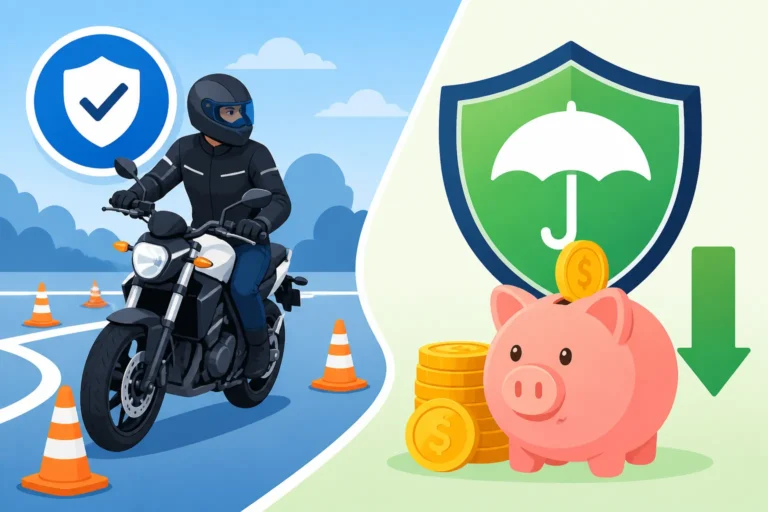
Almost every major insurer offers a discount if you complete a recognized safety course, such as those offered by the Motorcycle Safety Foundation (MSF). Not only does this refresh your skills and potentially save your life, but it also signals to the insurer that you are a "proactive" risk. This discount is usually around 5% to 10% and often lasts for three years. It is one of the few ways to get "cheap" insurance by actually doing something productive.
Bundle Your Policies
If you have a car, a house, or renters insurance, try to move your motorcycle policy to the same carrier. The "multi-policy" discount is often the largest discount available. Insurers want as much of your business as possible, and they will "price-match" or offer significant percentage drops to keep you from moving your auto policy elsewhere. For more details on this, check out Bundling Motorcycle and Auto Insurance: Worth It? to see the math behind the savings.
Evaluate Your Annual Mileage
Are you a weekend warrior or a daily commuter? Many riders over-estimate how much they actually ride. If you only put 2,000 miles a year on your bike, tell your insurer. Some companies offer "low-mileage" discounts because, quite simply, if the bike is in the garage, it isn't getting crashed. If you accurately report your mileage, you might see a decent dip in your rate.
Summary of How to Fight Back
It is easy to feel powerless when you see an expensive insurance quote, but remember that the "sticker price" is often just a starting point. By understanding the levers of risk—age, bike type, geography, and policy structure—you can start to manipulate those levers in your favor.
Whether it is improving your credit score, switching to a cruiser, or using The Zebra to shop around for a better deal, there is almost always a way to shave dollars off that premium. If you are struggling with a high quote today, take a breath, look at the data, and start shopping. The right price is out there; you just have to find the company that sees you as a safe bet. For more tips, read our guide on How to Get Cheap Motorcycle Insurance to find more hidden discounts.
Disclaimer
The information provided in this article is for informational purposes only and does not constitute professional financial, legal, or insurance advice. Insurance rates and regulations vary significantly by state and individual circumstances. Always consult with a licensed insurance agent or professional before making decisions about your coverage. Coverage options and discounts are subject to provider availability and underwriting approval.